Design and Build Quality
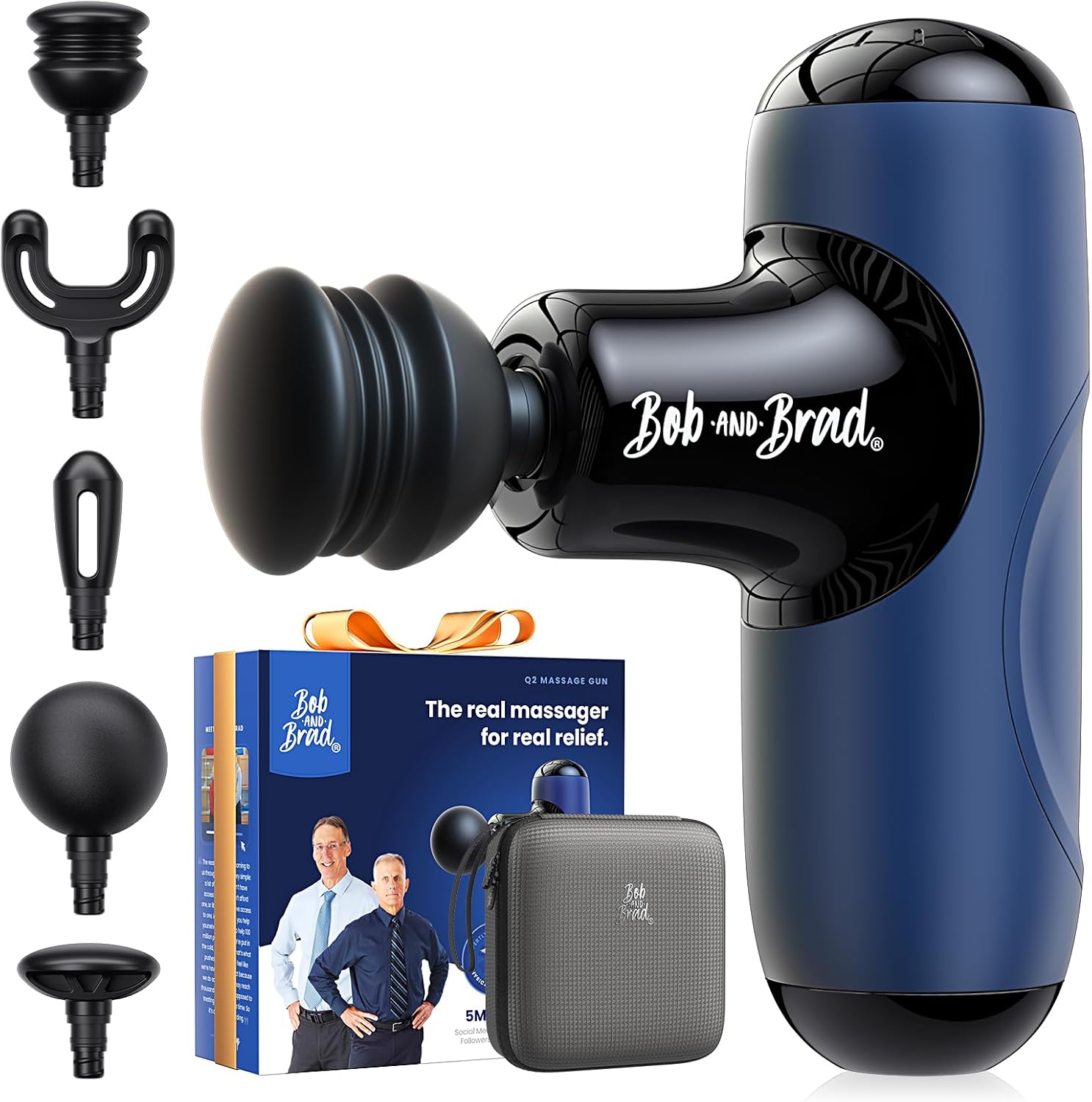
Measuring 5.7 by 3.4 by 1.8 inches and weighing 0.95 pounds (0.43 kg), the BOB AND BRAD Q2 Mini emphasizes structural efficiency. The chassis utilizes impact-resistant ABS plastic wrapped in a tactile rubberized grip designed to suppress housing resonance and limit vibration feedback into the user's hand. Internal hardware relies on a brushless motor paired with automotive-grade lithium cells, maintaining stable balance despite the small form factor. Five interchangeable attachments are supplied to address distinct muscle groups, swapping cleanly into the drive cylinder without loose tolerances. Charging relies on a modern USB Type-C port that accepts both USB-A to C and C to C connections, eliminating proprietary bricks during travel. The assembly is strictly dry-rated with no water resistance certification, so care is needed in wet locker-room settings. Overall construction feels robust, with no lateral play along the piston seam during high-frequency cycles.
Real-World Performance and Depth
Operational capability is defined by five discrete frequency settings spanning 1800 to 3000 RPM. Percussive depth is mechanically governed by a 7mm amplitude, which sits on the boundary between true percussive therapy and high-frequency vibration. In recovery equipment, stall force is what dictates deep tissue release; BOB AND BRAD does not publish a measured stall rating for the Q2 Mini, meaning buyers requiring heavy resistance should verify motor pushback limits before purchasing. When firm downward pressure is applied against thick myofascial tissue, motor drag is noticeable compared to full-sized workshop-grade units. However, for calf management, forearm fatigue, and upper trapezius stiffness, the stroke rate supplies rapid muscular warming and relief. Crucially, acoustic performance is an asset: operating at approximately 40 decibels, it runs quietly enough for living rooms and late-night use without intruding on others, fulfilling a primary threshold for sustained ownership habits.
Value for Money
Priced at $62.99, the Q2 Mini represents a sound financial proposition within the micro-percussion sector. Across more than 15,000 recorded consumer evaluations yielding a 4.6-star average, market reception indicates reliable motor longevity and battery retention. It holds FSA and HSA eligibility, allowing buyers to leverage pre-tax medical savings to offset initial investment. While full-scale professional percussion guns regularly command double or triple this cost, they primarily offer deeper reach and higher stall force. For users whose recovery routines center on desk stiffness, warmups, and light aerobic fatigue, the Q2 matches essential utility with minimal fiscal commitment. The inclusion of five specialized heads and complete USB-C power flexibility ensures the buyer avoids immediate aftermarket outlays, solidifying its place as a practical, low-risk tool for everyday physical maintenance.
Who Should Skip It
Athletes seeking aggressive, high-resistance myofascial work on large, dense muscle groups like the glutes, hamstrings, and quads will find the Q2 Mini insufficient. Because deep tissue penetration requires uncompromising stall force alongside longer stroke lengths, this unit's 7mm amplitude operates more as an invigorating vibratory massager than a blunt percussive driver. Users who lean heavily on the massage head will encounter motor slowdowns typical of miniature battery-driven mechanisms. Furthermore, those needing treatment in wet environments or post-pool decks must note the complete lack of moisture ingress protection. If your recovery routine mandates deep structural manipulation or long sustained pressure without stall interruptions, invest instead in a high-torque, full-frame massage gun boasting an amplitude of 12mm to 16mm and documented stall ratings exceeding 40 pounds.