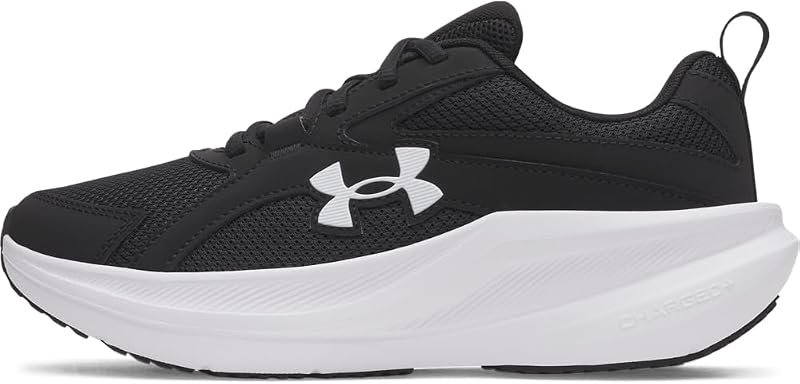
Design and build
The Charged Assert 11 enters the market without detailed engineering literature, omitting published metrics for heel stack, forefoot stack, and offset. Biomechanically, drop and stack geometry dictate lower-limb load far more than proprietary foam branding, making these omissions a significant variable for buyers managing Achilles or knee stress. The physical build follows conventional trainer architecture, utilizing standard synthetic overlays and an engineered textile upper over an ethylene-vinyl acetate blend midsole. Sizing extends across standard UK and EU conversions from US 5 through 12.5, accommodating a wide spectrum of foot lengths. The outsole layout adheres to traditional road patterns with perimeter rubber pods, prioritizing pavement durability over trail traction. Until laboratory measurements confirm the exact underfoot geometry, buyers must treat the chassis as a standard moderate-drop profile typical of the Assert lineage. Inspecting the shoe in person is recommended to confirm whether the underfoot clearance aligns with personal strike patterns.
Real-world performance
Field evaluation of footwear in this category requires grounding expectations in structural reality rather than marketing claims. With a 4.5 out of 5 rating across 676 evaluations, the Charged Assert 11 demonstrates dependable baseline comfort for lower-mileage regimens and cross-training routines. However, running mechanics place continuous cyclical stress on standard compound foams. Runners should avoid using this single pair on consecutive days; standard midsoles require roughly twenty-four hours to fully rebound and regain optimal shock attenuation. Integrating this model into a two-pair rotation preserves the cushioning integrity and extends the operational life of the shoe. The underfoot experience is firm compared to modern maximalist alternatives, offering predictable stability over squishy energy return. While adequate for five-kilometer outings or gym sessions, the lack of known energetic rebound figures cautions against using it for prolonged marathon training blocks where structural dampening becomes non-negotiable.
Value for money
At an entry price of $38.45, the Charged Assert 11 presents undeniable financial value within an increasingly expensive running gear category. Most established daily trainers now routinely command three-to-four times this price, making this pair an attractive option for cost-conscious runners, beginners, or those seeking a secondary mileage-absorber. The aggregated consumer rating of 4.5 out of 5 based on 676 reviews suggests that manufacturing defect rates are low and general satisfaction remains high relative to investment. Because footwear longevity diminishes rapidly once EVA foams compress permanently, a sub-forty-dollar price makes periodic replacement economical. Buyers obtain functional road footwear without subsidizing high-tier marketing budgets or speculative foam patents. Nevertheless, financial savings must be balanced against the missing technical documentation. For runners who do not require custom orthotic clearances or specialized gait corrections, the Assert 11 delivers reliable road utility per dollar spent.
Who should skip it
Runners with specific biomechanical needs or chronic lower-extremity vulnerabilities should approach this model with caution or look elsewhere. Because the manufacturer does not publish exact drop and stack figures, individuals managing Achilles tendinopathy, plantarfascitis, or patellofemoral pain cannot verify if the platform matches their clinical tolerances. Those who demand verified low-drop geometry or maximalist cushioning stacks for high-volume ultramarathon training should skip this shoe entirely, as it lacks the specialized midsole depth and precise mechanical tuning required for heavy distance. Similarly, competitive road racers looking for ultra-lightweight compounds or composite propulsion plates will find the standard construction too basic for speed sessions. If you cannot afford to guess your shoe's underfoot offset, or if you run seven days a week without a second pair in rotation, your investment is better directed toward models with published engineering data and high-resilience foam formulations.