Design and Physical Specifications
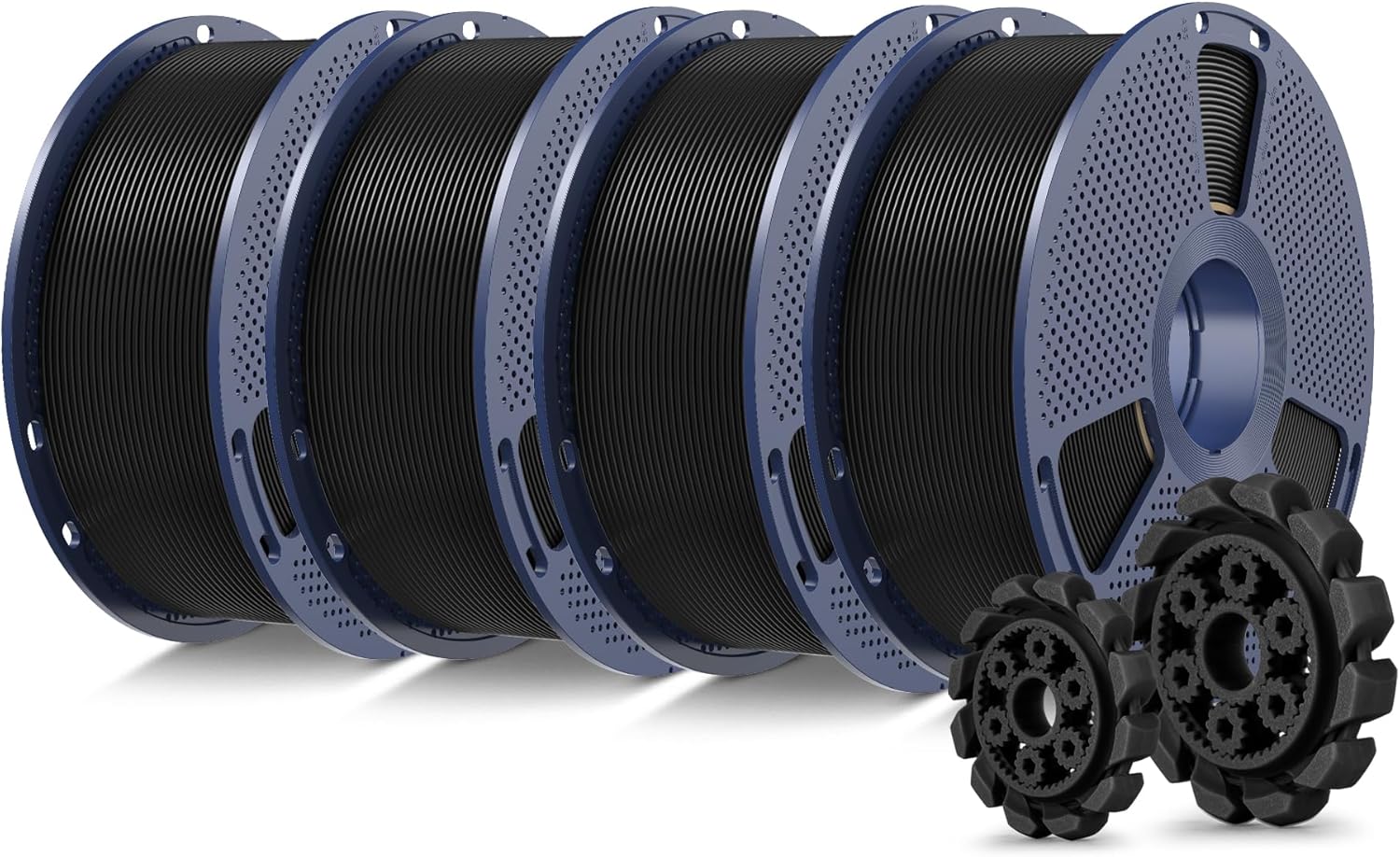
SUNLU supplies this bundle as four individually vacuum-sealed one-kilogram spools, protecting the material against atmospheric moisture uptake during transit. The spools adhere to a standard form factor with a 195mm outer diameter, 57mm width, and a 63mm hub hole, ensuring physical compatibility with the majority of external spool holders and automated material systems. The manufacturer markets these spools as reusable to reduce operational plastic waste. Across each spool, the 1.75mm diameter filament claims a dimensional accuracy tolerance of +/- 0.02mm, which is the baseline necessary to avoid volumetric under-extrusion or nozzle blockages on standard 0.4mm brass or hardened steel nozzles. Filament winding appears deliberately layered rather than randomly cross-spooled, minimizing the likelihood of spool binding or overlapping loops mid-print. For makers managing continuous production, the standardized physical dimensions and predictable tension reduce mechanical feeding snags, though users with proprietary enclosed dry boxes should confirm clearance against the 57mm spool width prior to loading.
Print Performance and Thermal Profile
The material formulation targets elevated melt rates to support print speeds between 100mm/s and 300mm/s. Recommended hotend temperatures range from 205°C to 220°C, paired with a heated bed between 50°C and 60°C. While standard PLA often suffers from under-extrusion or rough surface finishes when accelerated on modern coreXY architectures, the PLA+ 2.0 composition flows smoothly at these thermal parameters. The manufacturer notes upgraded crack and impact resistance relative to baseline PLA, though technical data sheets specifying exact Izod impact or tensile strength values are absent from the product listing; prospective buyers needing certified structural metrics should verify laboratory stress data directly. First-layer adhesion functions reliably across smooth or textured PEI sheets without requiring specialized adhesives, provided the bed is properly leveled. Layer binding remains uniform at moderate speeds, but pushing the threshold to 300mm/s may demand running the hotend closer to the 220°C limit to maintain adequate volumetric throughput and layer-to-layer adhesion.
Bulk Economics and Cost Efficiency
Retailing at $45.89 for four kilograms, this bundle calculates to roughly $11.47 per spool. In the maker tools segment, this places SUNLU PLA+ 2.0 among the most affordable branded options for high-speed-capable modified PLA. A user rating of 4.6 across 1,597 reviews supports its standing as a workhorse consumable rather than an experimental budget filament. The inclusion of a one-year warranty provides standard manufacturer recourse against manufacturing anomalies or defective batch winding, which is rare among low-cost raw materials. For design studios, print farms, and functional prototypers producing rapid geometric iterations, the low unit cost significantly decreases the risk associated with failed runs or material consumption. Provided the operational requirements do not call for specialized thermal resistance, purchasing in this four-pack format delivers consistent, repeatable material properties without imposing the premium pricing normally associated with proprietary high-speed filament lines.
Limitations and Who Should Skip It
Makers requiring parts for high-temperature or outdoor environments should avoid PLA+ 2.0 entirely. Although marketed with enhanced durability over standard PLA, the base polymer remains polylactic acid, meaning its glass transition temperature typically hovers around 60°C. Parts installed inside automotive cabins or outdoor enclosures will deform under direct summer heat and sustained UV exposure. Users seeking industrial mechanical resistance or weatherproofing should instead invest in technical polymers such as ASA or ABS, bearing in mind our buying rule that enclosed printers are mandatory to handle ASA and ABS warping stresses. Furthermore, hobbyists operating single-spool systems who prefer diverse color palettes will find a four-kilogram lot of monochrome black impractical. If your printing schedule does not consume four kilograms within a few months, ambient moisture will eventually degrade unsealed spools unless active desiccant storage or dedicated filament dryers are integrated into your workshop workflow.