Design and Build
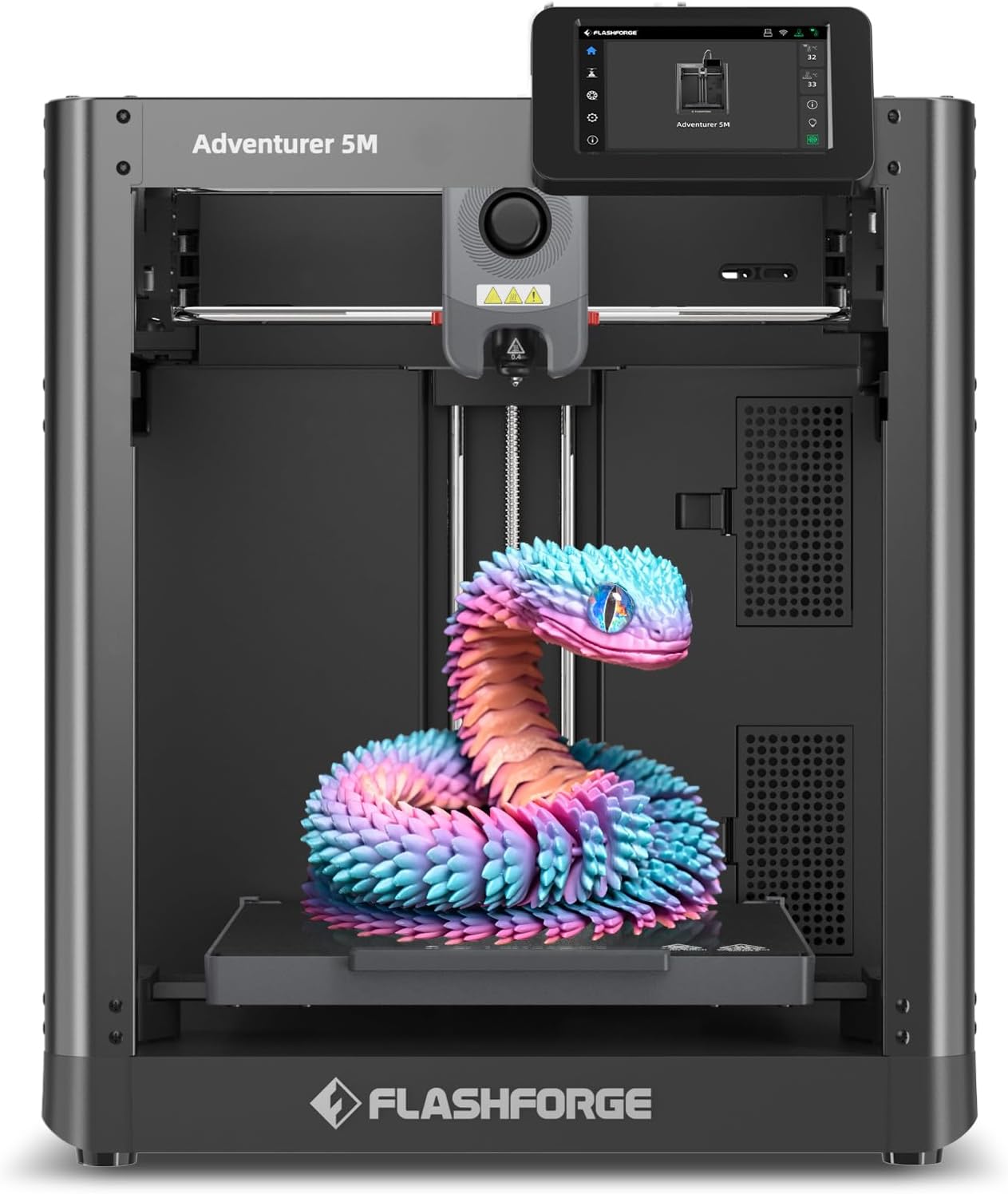
The Flashforge Adventurer 5M utilizes an all-metal CoreXY frame measuring 15.83 by 14.29 by 17.64 inches and weighing 22 pounds. Unlike cantilevered or bedslinger designs, the stationary Z-axis bed motion and rigid gantry reduce mechanical flex during directional changes. Flashforge equips the machine with a direct-drive extruder capable of reaching 280°C, paired with a dual-sided textured PEI sheet over a 220x220x220mm build volume. The printhead incorporates a quick-release nozzle assembly designed for tool-free replacement in seconds, alongside dual part-cooling fans. However, the machine operates as a strictly open-frame system. There are no side panels, top cover, or front door included in the baseline configuration. Wiring and belts are routed cleanly through the metal skeleton, but the exposed architecture leaves both the toolhead and the print bed susceptible to ambient room temperature fluctuations and ambient air currents.
Real-World Performance
Flashforge rates the Adventurer 5M for travel speeds up to 600mm/s and accelerations reaching 20,000mm/s², supported by integrated vibration compensation to mitigate resonance artifacts. The hotend reaches 200°C in roughly 35 seconds, backed by a specified maximum volumetric flow rate of 32mm³/s. In standard operation, fully automatic bed leveling executes prior to printing, measuring the bed topology to compensate for surface runout. This automation successfully eliminates the primary source of first-layer failure without requiring manual wheel adjustments or paper shims. Remote print progress and parameter adjustments are handled through the Flash Studio mobile application. While the rated 3.9 out of 5 stars from over 2,500 user reviews suggests occasional firmware hiccups or setup inconsistencies, the baseline mechanical throughput enables rapid turnaround on standard PLA and PETG parts when operating within normal speed parameters.
Value for Money
Priced at $249.00, the Adventurer 5M aggressively targets the budget market by delivering CoreXY kinematics at price tiers historically reserved for slower Cartesian bedslingers. The inclusion of genuine automated bed leveling, a flexible PEI spring-steel build surface, and an integrated high-flow hotend adds measurable hardware value right out of the box. Users do not need to budget for aftermarket bed probes or upgraded extruders to achieve reliable PLA throughput. However, prospective buyers should weigh the aggregate 3.9-star rating across 2,531 reviews against competing platforms. The lower average score indicates that while the hardware specifications are competitive on paper, software stability and assembly tolerances may exhibit wider variance than class leaders. For users seeking rapid prototyping on standard filaments without investing hundreds more, the unit delivers competent mechanical baseline performance for its entry-level cost.
Who Should Skip It
Operators intending to print engineering filaments such as ABS and ASA should skip the Adventurer 5M. Per fundamental fabrication rules, reliable ABS and ASA printing demands a sealed, heated chamber to prevent delamination and severe corner warping; this open-frame chassis cannot retain ambient heat. Additionally, production environments requiring build envelopes larger than 220x220x220mm will find the build volume restrictive. Users who prefer fully open-source firmware ecosystems should verify controller board openness before purchasing, as Flashforge utilizes a proprietary interface linked to its Flash Studio software. Finally, individuals seeking an out-of-the-box appliance with near-flawless customer review consensus may want to consider higher-scoring alternatives, as the 3.9-star average reflects potential out-of-box troubleshooting requirements that beginners may find frustrating.