Design and Material Specifications
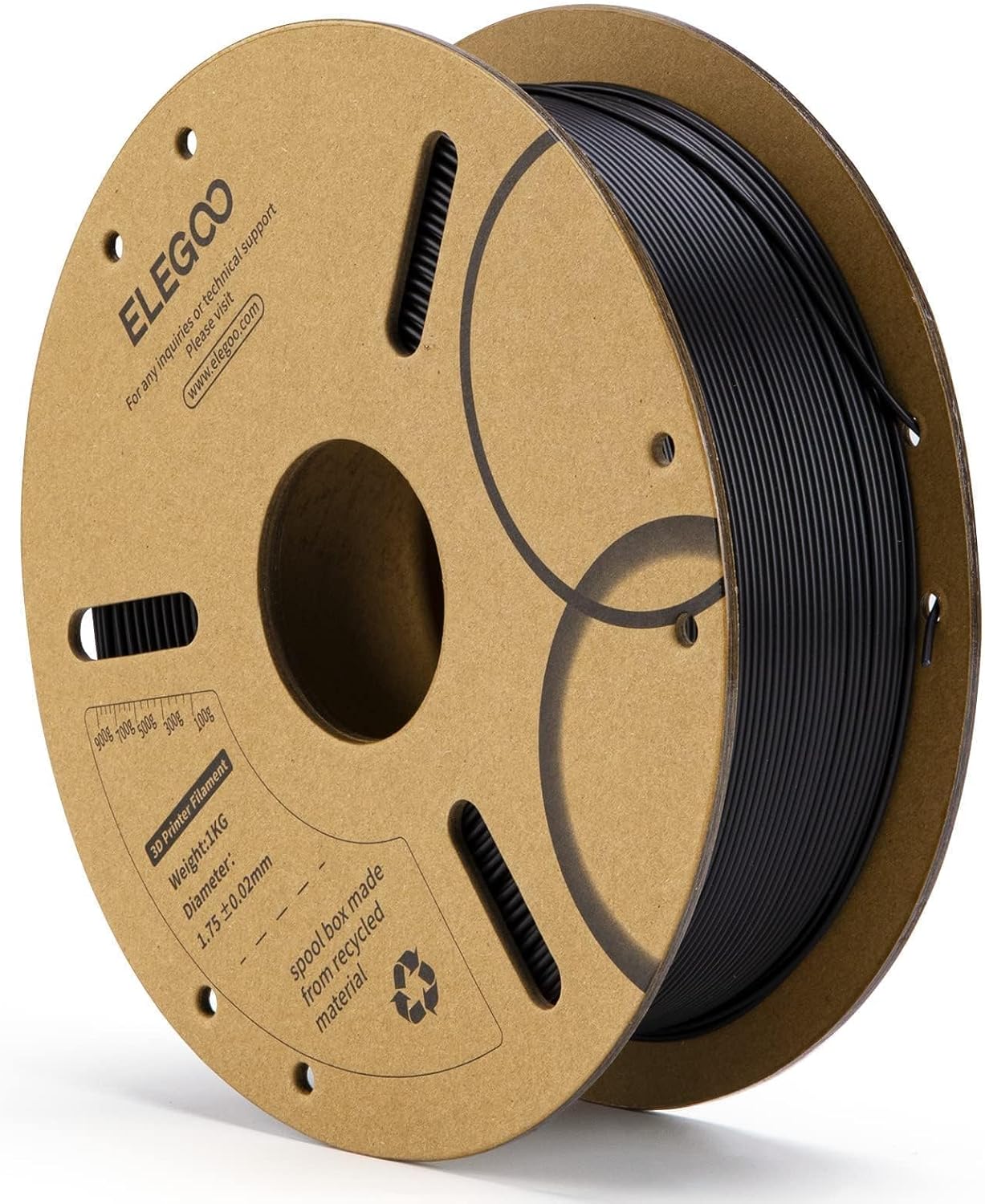
ELEGOO supplies this 1.75mm polylactic acid filament on a 1-kilogram cardboard spool designed to reduce single-use plastic waste. The physical winding demonstrates deliberate mechanical alignment, intended to mitigate common cross-overs and tangles that interrupt long-duration prints. The core features a widened internal hub to promote smoother unspooling on standard gantry-mounted holders. In terms of raw production metrics, ELEGOO specifies a dimensional accuracy limit of +/- 0.02 mm across the filament length. This tight variance helps maintain uniform volumetric flow rates through standard extruders, minimizing sudden extrusion artifacts or feed binding. Each unit ships vacuum-sealed with a desiccant pack to minimize ambient moisture pickup prior to deployment. While cardboard spools introduce sustainability benefits, buyers utilizing closed multi-material systems should inspect spool rims for slight crimping, which can introduce rotational resistance in friction-driven feeder trays if damaged in transit.
Extrusion and Printing Performance
Because this material is standard PLA, it presents a forgiving operational profile that contrasts sharply with demanding engineering thermoplastics. It requires no enclosed printer volume, adhering reliably to heated print beds between 50 and 60 degrees Celsius without excessive curling or warping. Thermal contraction remains minimal, simplifying dimensional repeatability on open-frame Cartesian and bedslinger machines. The formulation produces negligible odor during processing, making it well-suited for home workshops and classrooms lacking active exhaust setups. Extrusion fluidity remains stable at normal PLA temperatures, enabling clean layer cohesion and minimal stringing when retraction settings are properly tuned. The manufacturer emphasizes bubble-free and clog-free properties, which align with real-world outcomes provided the spool has not been left exposed to excessive relative humidity post-unsealing. Automated bed leveling systems further reduce the threshold for first-layer success, allowing this entry-level filament to yield uniform top surfaces and consistent vertical sidewalls.
Market Position and Value
Priced at $12.59 for a 1-kilogram spool, ELEGOO positions this black PLA competitively within the entry-tier consumable market. A rating of 4.6 out of 5 across more than 1,600 verified customer assessments underscores dependable manufacturing consistency at high sales volumes. The spool includes a 30-day warranty covering quality-related defects, providing a baseline recourse policy should buyers encounter localized winding snags or excessive out-of-round diameter irregularities. When compared against standard commodity PLA options that typically retail closer to twenty dollars per kilogram, this offering significantly lowers the cost per finished model. It serves primarily as an economical workhorse for non-functional mockups, decorative pieces, and mechanical calibration prints where the physical limitations of unmodified PLA are acceptable. As long as users account for cardboard spool compatibility with their specific dry boxes or material switchers, the pricing yields notable cost-to-performance efficiency.
Limitations and Who Should Skip
Users with requirements for high-temperature service environments or direct outdoor ultraviolet exposure should avoid standard PLA entirely. Unmodified polylactic acid exhibits a low glass transition temperature, typically softening under prolonged exposure above 50 to 55 degrees Celsius. For load-bearing mechanical applications, functional automotive components, or outdoor fixtures, users must look to materials like ABS or ASA. However, buyers should remember that printing ABS and ASA strictly requires an enclosed build chamber to avoid severe thermal shrinkage, along with appropriate air filtration. Laser or resin equipment operators must budget for active ventilation infrastructure, whereas this PLA prints safely without dedicated extractors. Additionally, owners of automated feed stations that grip the outer cardboard spool flange directly may find plastic-spooled or reinforced alternatives more resilient against internal chamber abrasion and dust generation over long-term multi-spool rotations.