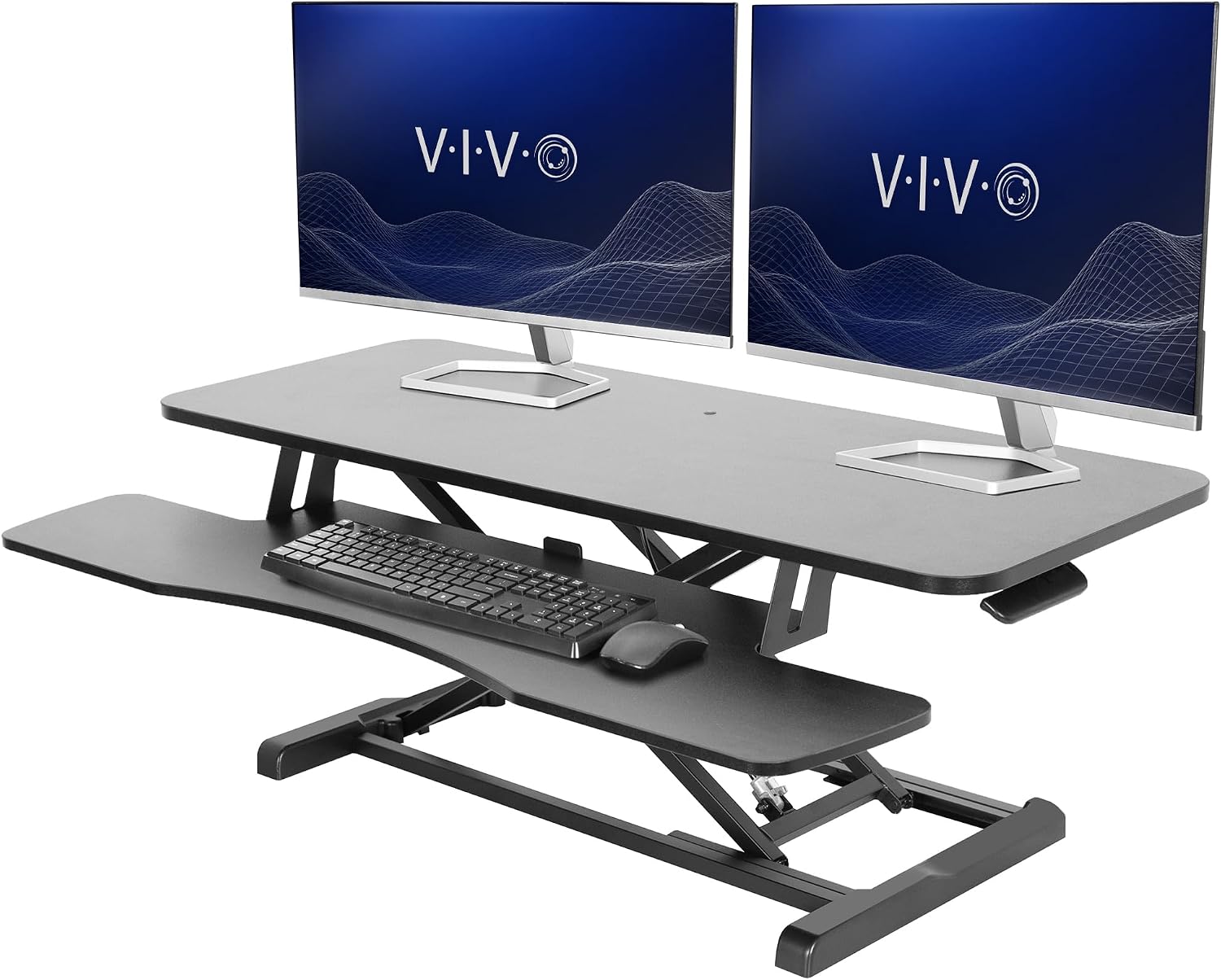
Design and build quality
The foundation of the VIVO DESK-V042KB rests on an alloy steel frame paired with laminated 0.5-inch composite boards. The 42-inch width provides substantial lateral real estate, measuring 15.7 inches deep along the main platform and 11.8 inches deep at the keyboard tier. The scissor-style lift mechanism is engineered to elevate straight upwards rather than cantilevering out towards the user, preserving the center of gravity over the base footprint. The finish is utilitarian, matte black laminate designed to resist basic scratching, though the half-inch board thickness represents standard budget-tier density. Structural integrity is dictated by the alloy steel underpinning, which prevents torsional flex along the center line. However, the keyboard deck is suspended via fixed brackets rated for only 4.4 pounds, meaning it cannot support significant downward forearm pressure without flexing.
Real-world performance and stability
Frame stability at full extension serves as the benchmark test for desktop converters. Extending from a baseline height of 4.5 inches up to 20 inches, the VIVO maintains acceptable rigidity throughout the lower and middle portions of its travel. At the maximum 20-inch elevation, minor lateral wobble emerges during vigorous typing, largely stemming from the mechanical tolerance in the scissor joints rather than base frame bending. Lift performance relies on a pneumatic assist lever. Because this is a manual system without an electric motor, the ease of lift depends strictly on payload balance. If your monitors approach the 33-pound threshold, raising the unit demands noticeable physical input. Conversely, under-loading the surface can make downward adjustment stiff. Tracking true to its vertical axis prevents the tipping risk common to outward-arcing designs.
Value for money
Priced at $179.99, the DESK-V042KB targets a functional middle ground between flimsy tabletop risers and complete motorized desks. With more than 15,000 market reviews averaging 4.6 stars, the platform has demonstrated reliable long-term mechanical survival in home and commercial offices. Unlike motorized converters, there are no internal electronics or drive motors to burn out, removing a primary failure point common to low-cost ergonomic gear. However, the manufacturer does not specify the exact warranty term for the gas spring mechanism in the published data; prospective purchasers should verify this coverage directly with the seller prior to ordering. When compared to purchasing an entire height-adjustable desk, the converter offers a practical, low-cost path to standing ergonomics if your existing desk frame is sturdy enough to carry the unit's deadweight.
Who should skip this model
Users with heavy equipment setups should look elsewhere. While 42 inches is wide enough for two displays, mounting two professional screens alongside a heavy dual-monitor clamping arm frequently exceeds the 33-pound limit, stressing the lift cylinder. Additionally, workers who lean heavily on their palms while typing will find the 4.4-pound keyboard capacity inadequate, as excessive force can warp the bracket mounts over time. Individuals shorter than average should also exercise caution: the unit adds 4.5 inches of height to your seated keyboard position when fully lowered, which can compromise neutral elbow angles if your primary desk does not adjust downward. Finally, those who require motorized, push-button elevation presets should invest in a full sit-stand frame rather than a manual spring-assisted platform.