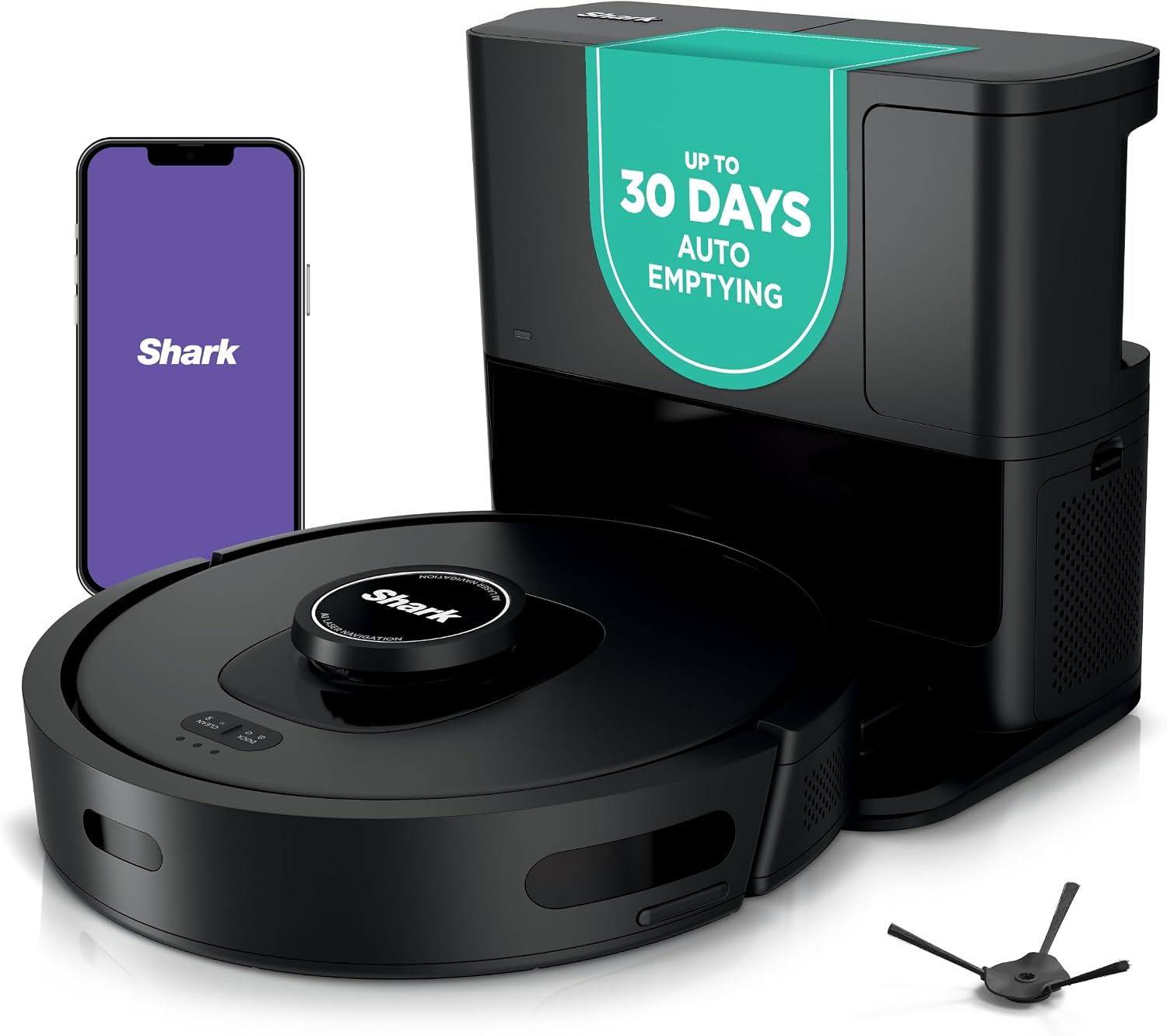
Design and Hardware Architecture
The Shark AV2501S AI Ultra relies on a low-profile dark grey circular chassis equipped with two drive wheels and a top-mounted 360-degree LiDAR turret. Shark pairs the robot with an upright self-emptying base that diverges from industry conventions by omitting disposable bags. Dust transfer occurs mechanically into a reusable clear bin fitted with a true HEPA filter designed to trap particles down to 0.3 microns. On the robot itself, structural compromises appear in the internal dust capacity, which measures an exceptionally small 0.09 liters. This internal volume necessitates total reliance on the docking evacuation sequence to prevent clogs during heavy cleaning cycles. Dual side spinning brushes assist with perimeter edge sweeping, channeling debris toward the central intake channel. The unit also includes internal foam filtration. Overall build materials lean heavily toward lightweight consumer plastics, typical for this retail bracket, focusing functional engineering entirely on the primary brushroll and docking interface rather than luxury aesthetics or modular dampening components.
Navigation and Cleaning Mechanics
Floor tracking and pickup capability center on two mechanical advantages: active LiDAR mapping and dedicated brushroll geometry. Camera-reliant platforms frequently disorient across high-contrast rugs or poorly lit corridors; Shark's top-mounted laser array maps room perimeters irrespective of ambient light conditions, ensuring consistent nighttime operation. For debris collection, brush mechanics take precedence over raw suction metrics. The anti-tangle, self-cleaning brushroll actively separates long human hair and pet fur before strands wrap tightly around the core cylinder. In practice, the system engages a Matrix Clean mode, which executes a deliberate intersecting grid pass over designated zones to loosen embedded carpet dirt that single-pass vacuuming ignores. With an operational endurance rated up to 120 minutes from its lithium-ion cell, coverage suffices for moderate footprints. When battery depletion occurs prior to completing a scheduled map routine, the Recharge and Resume system returns the chassis to base for replenishment before returning to complete the pending sector coordinates without human intervention.
Cost Analysis and Value Proposition
Priced at $239.99, the AV2501S occupies a highly aggressive tier for robot systems incorporating both active laser mapping and self-emptying stations. Its overall 4.0 out of 5-star aggregate across 23,870 owner ratings indicates reliable utility balanced against minor operational quirks. The primary financial benefit lies in the bagless base. Traditional auto-empty docks require proprietary replacement dust bags every six to eight weeks, introducing an indefinite recurring cost. Shark bypasses this ongoing expense through a cyclonic, washable bin chamber. However, this convenience trades against operational acoustic comfort. The evacuation cycle generates noticeable motor noise during debris transfer, a reality common across self-empty systems. Buyers must also balance the initial low acquisition cost against the labor requirement of rinsing the dock's foam and HEPA filters periodically to preserve airflow integrity. For budget-conscious homeowners prioritizing autonomy without subscription-like accessory outlays, the price-to-utility ratio remains exceptionally competitive.
Limitations and Who Should Look Elsewhere
Certain household configurations should pass on the AV2501S. Severe allergy sufferers will find that emptying the bagless base bin inevitably releases a small plume of airborne particulates back into the immediate breathing zone, counteracting the benefits of the HEPA filtration sealed inside. For these individuals, a sealed bagged dock remains a cleaner disposal solution despite recurring consumable costs. Homes with extreme multi-pet shedding may also overwhelm the robot during individual runs; the miniature 0.09-liter onboard dust compartment fills rapidly on dense carpets before the unit triggers an evacuation dock sequence, risking intake blockage. Additionally, prospective buyers needing variable suction control or mopping hybrid functions will be disappointed, as the single-speed mechanical layout provides vacuuming only. If your living space spans several thousand square feet with complex multi-level transitions, higher-tier vacuums offering larger onboard reservoirs and secondary mapping tiers will prove far less labor-intensive over sustained daily use.