Design and build
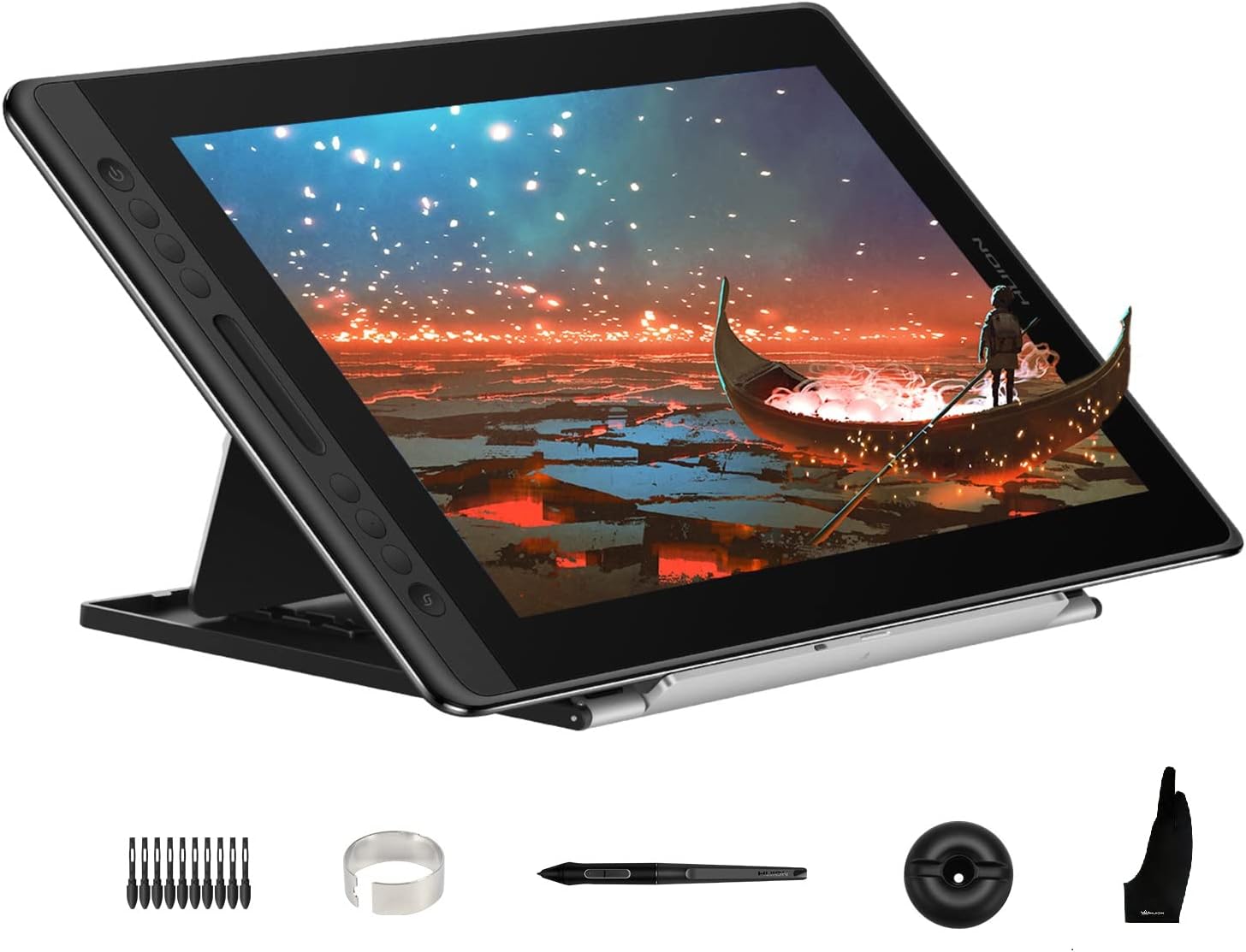
The Kamvas Pro 16 centers around a 15.6-inch full-laminated panel integrated beneath chemically etched anti-glare glass. Lamination eliminates the air gap between the digitizer surface and LCD, directly addressing pen-to-cursor gap. The glass exterior avoids the peel risk associated with matte plastic films while imparting a mild tooth that moderates stylus slip. Physically, the chassis incorporates six programmable click keys alongside a central touch bar on the left bezel, allowing physical mapping of canvas zoom, brush scaling, or scroll actions. Huion bundles the ST200 metal-hinge foldable stand, which supports working inclines between 20 and 60 degrees to counter neck strain during prolonged drafting sessions. Connectivity relies on an integrated recessed port utilizing a proprietary 3-in-1 breakout cable that splits into HDMI, USB data, and an external AC power lead. While the construction feels sufficiently rigid and keeps table footprint manageable, the reliance on a multi-branch cable assembly dictates dedicated desk routing rather than quick pack-and-go portability.
Real-world performance
As digitizer technology has matured, raw pressure sensitivity ratings past several thousand increments yield diminishing returns; the tactile interface and parallax mitigation matter considerably more. The Kamvas Pro 16 implements 8,192 pressure steps and 60 degrees of tilt via the battery-free PW507 stylus. Tracking shows minimal offset near the active center, aided by the laminated panel assembly, though corner accuracy warrants calibration across varied grip angles. The anti-glare glass offers balanced friction against standard plastic nibs without excessive drag. Visual output is anchored by a 1000:1 contrast ratio and a specified color volume of 120 percent sRGB (92 percent AdobeRGB). This provides saturated, clean color translation suitable for web-directed illustration and graphic work, though production prepress operators should independently verify factory gamma and calibration stability with a colorimeter. The passive pen eliminates internal battery charging cycles, and latency remains consistently low when tethered to supported Windows, macOS, or Ubuntu Linux workstations.
Value for money
At $289.99, the Kamvas Pro 16 targets an entry-to-intermediate desktop tier that previously offered only opaque graphics tablets or smaller 12-inch displays. Its 4.5 out of 5 composite score across more than 4,400 user evaluations indicates stable hardware consistency in field use. Much of the value proposition lies in the comprehensive inclusion of essential peripherals: rather than selling the ST200 angle stand, drawing glove, or pen cradle as auxiliary add-ons, Huion packs them alongside ten replacement nibs inside the box. Comparable medium-format creative displays often exclude articulated stands at baseline pricing or rely on air-gapped glass that degrades line precision. While higher-end competitors offer native single-cable USB-C video or higher resolution panels, the Kamvas Pro 16 provides an economical balance of functional panel size, adequate color volume, and hardware ergonomics without requiring immediate secondary accessory purchases.
Who should skip it
Prospective buyers must note that the Kamvas Pro 16 is strictly an external input monitor; it lacks an internal processor, operating system, or battery, making it entirely unsuitable for artists seeking a self-contained portable sketchbook like an iPad or standalone mobile studio. Mobile creatives working from cramped spaces or modern laptops that only supply Thunderbolt ports may find the bulky 3-in-1 HDMI cabling system cumbersome to adapt. Furthermore, professional retouchers and prepress production specialists who require factory-certified color accuracy, true DCI-P3 compliance, or 4K resolution across a 15.6-inch diagonal should bypass this unit. Finally, digital painters who insist on an entirely toothless, glossy surface will find the anti-glare glass texture counterproductive, while ultra-heavy pen users should consider that replacement nibs will eventually experience steady wear against the micro-etched glass face over extended operational cycles.