Design and build specifications
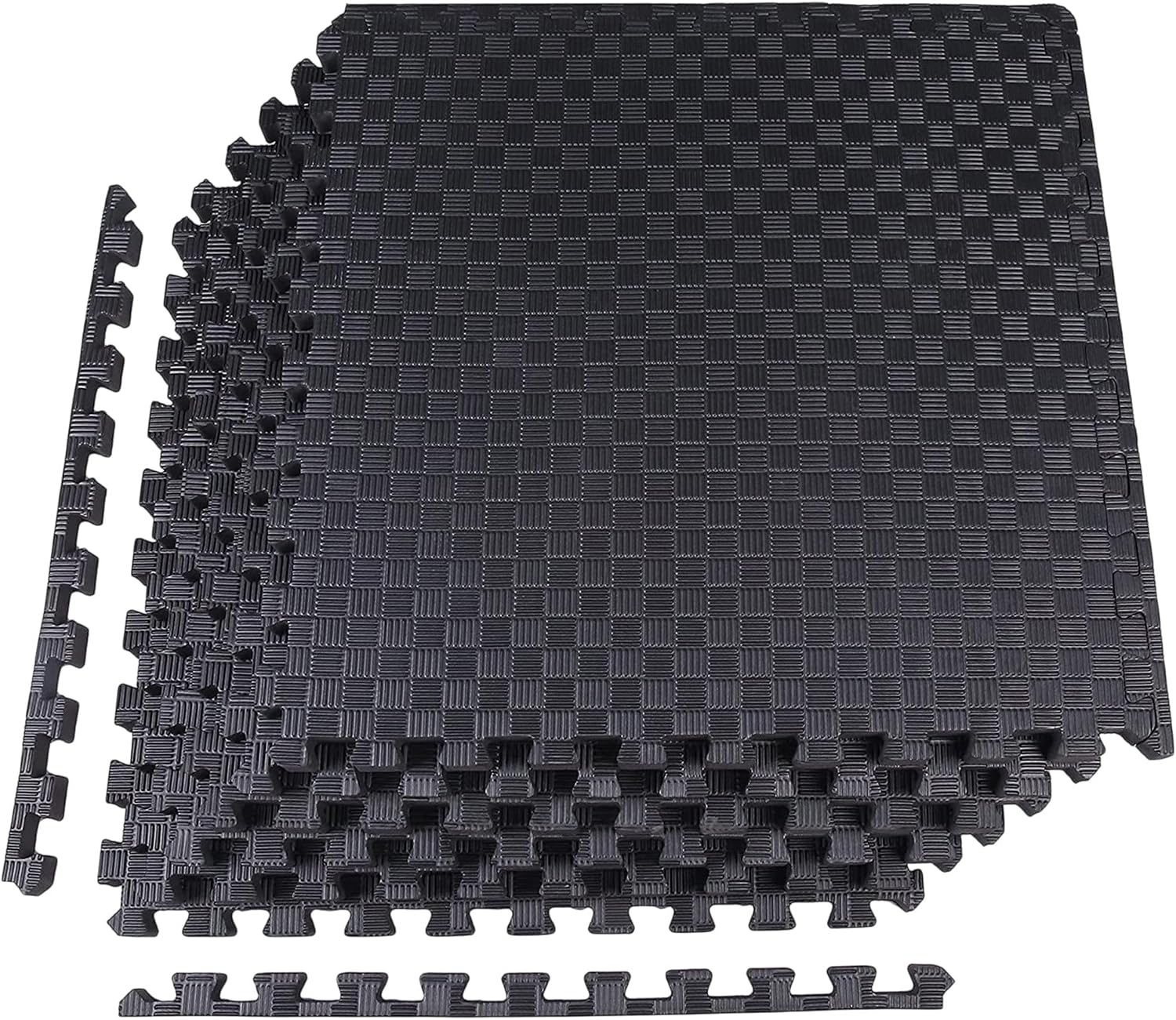
The BalanceFrom puzzle mat pack (model 2018 / BFPM-03BL) supplies 24 square feet of total coverage across interlocking square tiles. Constructed entirely from high-density ethylene-vinyl acetate (EVA) foam, the assembly measures a full one inch in thickness while keeping total package weight to a light six pounds. The interlocking perimeter tabs are cut to mesh with adjacent tiles, creating a continuous protective layer over hard concrete or hardwood surfaces. The solid black finish presents a neutral aesthetic suitable for general utility areas. Unlike vulcanized rubber flooring, EVA foam relies on closed-cell air pockets to achieve its bulk and damping properties. This construction makes handling and initial room layout simple for a single person. However, buyers should note that the light weight of the tiles means the assembled surface relies partly on room boundaries or friction against the subfloor to prevent migration during dynamic, multi-directional movements.
Real-world gym performance
In functional training scenarios, the primary asset of this flooring is baseline impact attenuation. At one inch thick, the foam absorbs bodyweight impacts during calisthenics, core exercises, and floor-based martial arts drills far better than standard thin yoga mats. Kneeling, prone pressing, and stretching routines benefit from the deep compliance of the EVA material. However, this same compliance creates drawbacks for loaded lifting. Under significant weight, such as heavy squats or deadlifts, the material compresses noticeably, introducing foot instability and robbing upward mechanical drive. Dropping cast-iron plates or dumbbells onto EVA foam can cause localized punctures or permanent indentations, as the closed-cell foam lacks the self-healing density of heavy stall mats. For floor preservation against minor scuffs and dropped light accessories, the mat functions adequately, but it should not be treated as a structural platform for heavy barbells.
Value and market positioning
Priced at $38.99 for 24 square feet, the mat breaks down to roughly $1.62 per square foot, making it one of the most accessible thick-flooring options currently on the market. A 4.6 out of 5 rating across more than 60,000 recorded consumer reviews indicates dependable baseline quality control for the entry-level segment. Adding to its appeal, BalanceFrom includes a two-year manufacturer warranty, which provides reasonable recourse against premature separation or manufacturing flaws. Compared to traditional three-quarter-inch commercial horse stall mats, which often cost twice as much per square foot and require significant effort to transport, this package offers straightforward utility on a budget. It represents a cost-conscious choice for basement spaces or spare rooms designated for mobility work, gymnastics, or stationary cycling, provided users calibrate their expectations regarding long-term resilience under mechanical stress.
Who should skip this flooring
Lifters building a dedicated barbell training space should bypass EVA foam entirely. Our home gym standard mandates 11-gauge steel and 3x3 uprights as the durability line for power racks; placing a heavy rack of that caliber directly on top of one-inch foam will cause deep, uneven sagging and frame instability. Furthermore, anyone performing heavy Olympic weightlifting or powerlifting will find the compressible foam counterproductive to maintaining stable ankle alignment and grounded balance. Owners of heavy treadmills or weight benches should also look elsewhere, as continuous high point loads will crush the foam down to the subfloor over time. Those who require a flooring surface capable of handling repeated impacts from iron plates, kettlebells, or heavy steel apparatus should invest in dense vulcanized rubber mats instead of interlocking EVA tiles.