Design and build
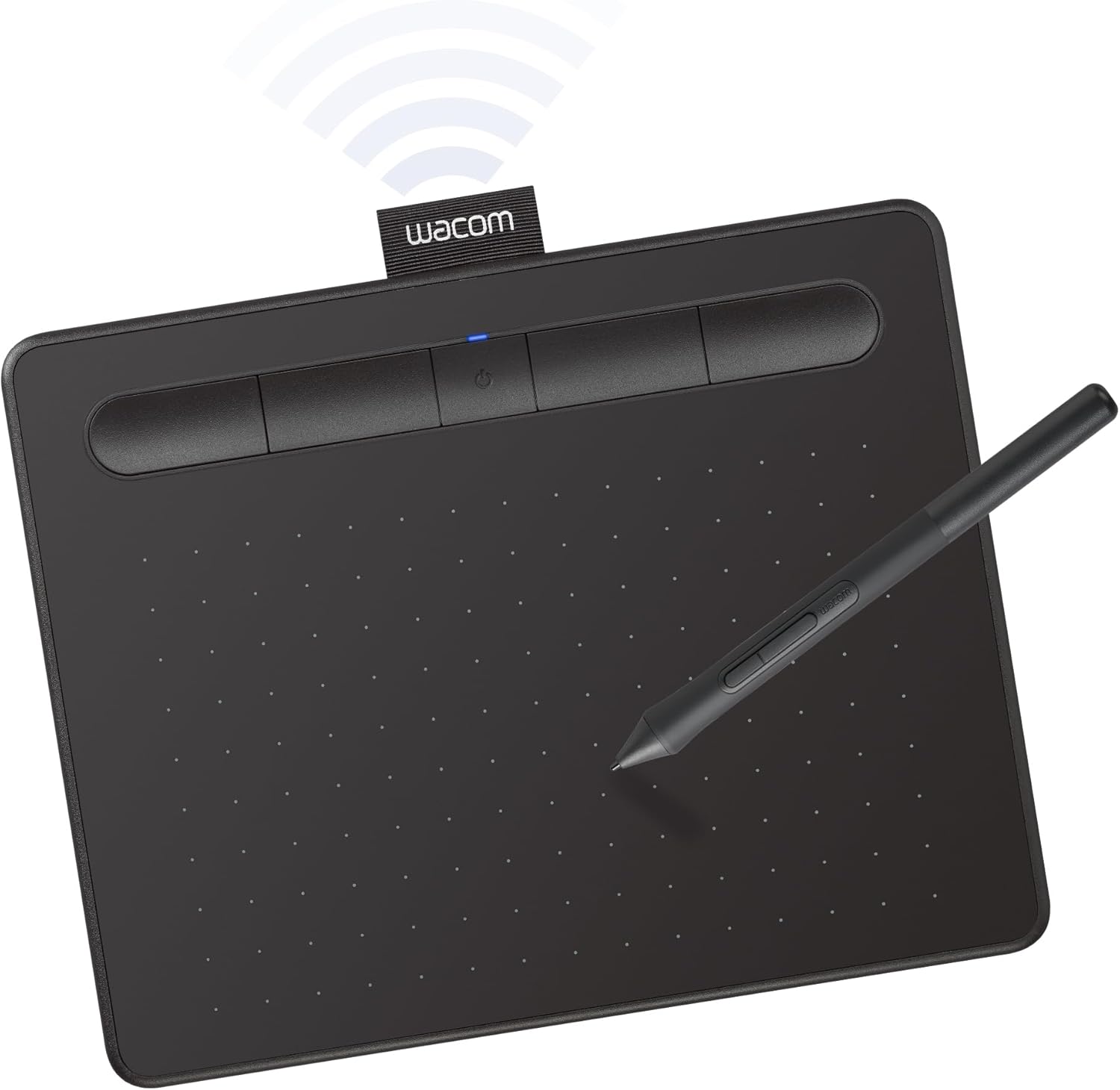
The Wacom Intuos Small, designated model CTL4100WLK0, is a lightweight desktop digitizer built primarily from rigid matte plastic. The upper edge incorporates a slight trough that houses four assignable ExpressKeys along with the central power and Bluetooth pairing indicators. This recessed button layout doubles as a temporary resting groove for the included battery-free stylus. Cable connectivity relies on an included USB-A cable, while internal Bluetooth hardware allows cord-free operation with compatible hosts. The active area is delimited by subtle printed boundary dots directly on the drawing sheet. Because this is an opaque graphics tablet rather than a pen display, the active surface sits completely flat with minimal ledge elevation at the borders. While the plastic chassis feels featherweight, there is little torsional flex during regular desk use. The pen itself remains completely passive, utilizing Wacom's established electro-magnetic resonance (EMR) technology, meaning no internal batteries or recharging routines are needed to maintain continuous tracking.
Real-world performance
In accordance with core digital media principles, digitizer pressure ratings plateau in practical utility; the 4,096 levels offered here easily register smooth gradients without noticeable stepping. More critical to the drawing experience is surface feel and coordination. Because the Intuos Small is a screenless tablet, optical parallax between pen tip and display pixels is fundamentally non-existent. Instead, visual coordination occurs entirely on the user's monitor while hand movement stays on the desk. The textured tablet sheet yields a tactile drag that prevents the nib from slipping freely, approximating the resistance of standard dry media on smooth drafting paper. Bluetooth pairing maintains stable tracking for general sketching, though connecting through the wired USB-A interface remains preferable to eliminate any marginal transmission lag during rapid cross-hatching. Multi-platform driver support covers Windows, macOS, Chrome OS, and selected Android devices, handling stroke velocity and pressure transition reliably across varied production software.
Value for money
At an established price point of $69.95 backed by a 4.4 out of 5 customer average across 5,630 ratings, the Intuos Small occupies an accessible tier in creative hardware. The financial proposition is strengthened by Wacom's inclusion of access to third-party creative software and instructional packages upon hardware registration. While competing generic digitizers sometimes push higher on-paper pressure metrics, real-world usability hinges more on steady input mapping, predictable calibration, and nib longevity. The Intuos maintains these fundamentals without requiring recurring battery changes. It carries a standard one-year manufacturer warranty, which aligns with entry-level consumer electronics standards. For students, educators marking documents, and digital illustrators starting out, the initial investment is modest considering the durability of passive EMR technology. The primary limitation to keep in mind remains active surface area rather than internal electronics or component reliability.
Who should skip it
Illustrators and concept artists who draw from the shoulder will find the Small footprint restrictive. The compact active working dimension forces input predominantly into wrist and finger pivots, which can accelerate hand fatigue during prolonged production cycles. Such users should skip this compact variant in favor of a Medium size or larger drawing slate. Professionals who require physical touch strips, rotary modifier wheels, or hardware tilt sensitivity must also bypass the CTL4100WLK0, as its feature set is strictly limited to basic pressure detection and four simple shortcut toggles. Finally, creators transitioning from traditional media who cannot adapt to hand-eye separation—looking up at a monitor while drawing down on a slate—should bypass opaque tablets entirely. For that demographic, an interactive pen display eliminates hand-eye dislocation, albeit at a significantly higher initial investment and desk space requirement.