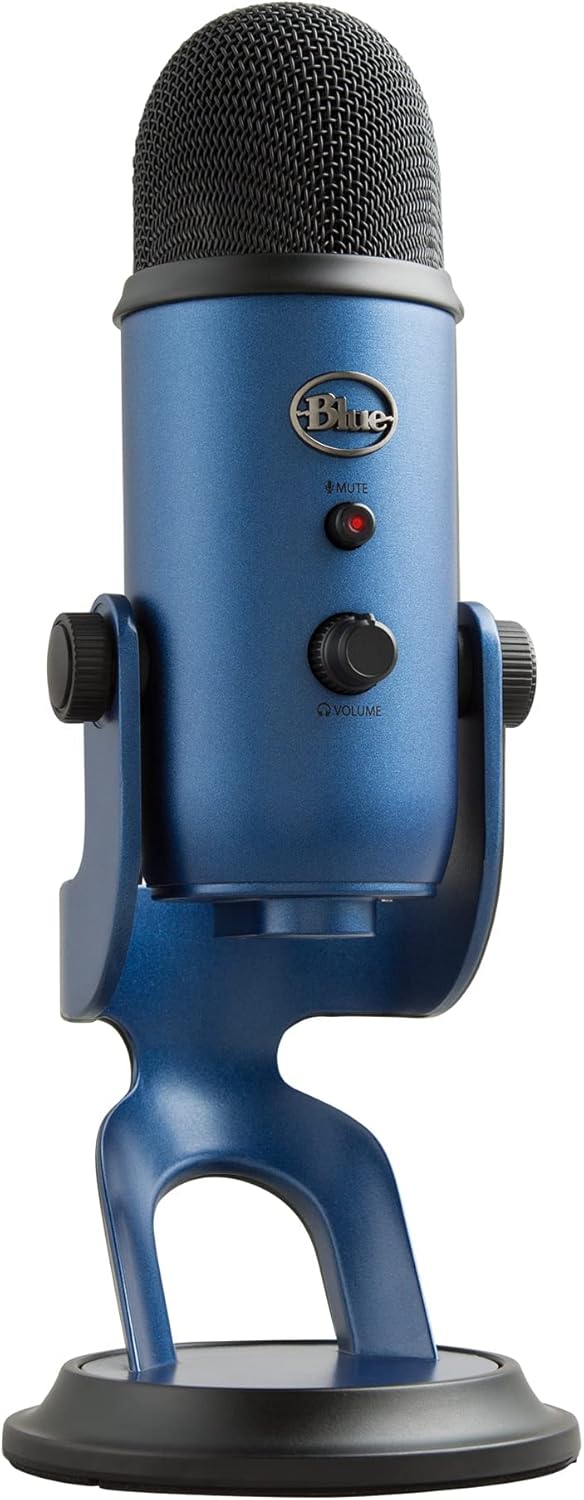
Design and build quality
The Logitech Blue Yeti maintains a substantial physical footprint, anchored by a heavy cast-metal base and pivoting side mounts that secure the microphone capsule at desired angles. Weighing down a desk comfortably, the microphone connects via a standard USB Type-A interface, requiring no external preamplifiers or phantom power supplies. Physical hardware controls are distributed across the front and rear cylinders: the front provides a headphone volume potentiometer and a soft-touch mute button with an LED status indicator, while the rear houses the analog gain pot and a four-way rotary switch for polar pattern selection. The 3.5mm headphone jack is mounted flush on the bottom plate next to the USB port, which can crowd thicker monitor cables. While the exterior casing resists physical wear, the rotary switches exhibit light plastic resistance rather than the damped action found on dedicated studio hardware. Overall, the mechanical construction prioritizes desk stability over portable isolation, functioning adequately without a supplementary boom arm.
Real-world tracking performance
Acoustic tracking with the Yeti requires strict attention to ambient surroundings, as its tri-capsule condenser array and 45 dB sensitivity capture significant off-axis room reverberation. In music production workflows, treating the tracking environment remains paramount; in an untreated room, the microphone records noticeable flutter echoes and floor noise, compounded by a moderate 70 dB signal-to-noise ratio. The microphone supports cardioid, omnidirectional, bidirectional, and stereo configurations, giving it practical utility for acoustic guitar tracking, stereo percussion capture, or dual-vocal demos. Because it functions as a class-compliant USB device without dedicated, low-latency proprietary ASIO drivers, software-monitored round-trip latency inside a digital audio workstation can impede timing. Performers must rely on the integrated 3.5mm direct monitoring output to hear their inputs in real time without buffer lag. Frequency response covers the audible 20 Hz to 20 kHz spectrum, yielding an articulate, mid-forward response that requires modest equalization to tame low-end proximity buildup.
Value for money assessment
Priced at $104.49, the Blue Yeti sits in a contested bracket between entry-level USB condensers and introductory XLR interface bundles. Backed by over 57,000 public ratings averaging 4.6 stars, the unit's core value lies in its standalone convenience. Users receive multiple polar patterns, an integrated headphone amplifier, onboard gain staging, and Blue VO!CE digital signal processing without purchasing a separate audio interface. For demo production, songwriting captures, and multi-speaker podcasting, this consolidation minimizes upfront hardware costs. However, from a pure audio fidelity standpoint, the internal analog-to-digital converters and 70 dB signal-to-noise ratio face competition from modern, dedicated audio interfaces equipped with superior preamps and high-performance drivers. For creators who demand immediate plug-and-play capability without managing multi-unit hardware chains, the pricing remains justifiable, though expanding beyond this single-channel setup later will require replacing the entire unit rather than upgrading modular components.
Who should skip this microphone
Producers seeking an integrated front end for professional multitrack music production should skip the Blue Yeti in favor of a dedicated XLR setup. Because the microphone bypasses professional ASIO driver architecture, achieving sub-five-millisecond round-trip buffer latency inside demanding DAW environments is largely unattainable. Vocalists recording in untreated, highly reflective bedrooms will struggle with ambient spill and high-frequency bounce, as the sensitive condenser capsules lack the tight acoustic rejection of a traditional dynamic broadcast microphone. Furthermore, artists who plan to expand their signal chain with outboard hardware compressors, high-grade external preamplifiers, or multi-mic drum arrays cannot scale this system, as the USB output is strictly hardwired to the internal converter. Finally, tracking engineers must adhere strictly to closed-back headphones to avoid bleed into the sensitive tri-capsule array, making the Yeti ill-suited for casual tracking environments where monitoring discipline cannot be maintained.