Design and Hardware Architecture
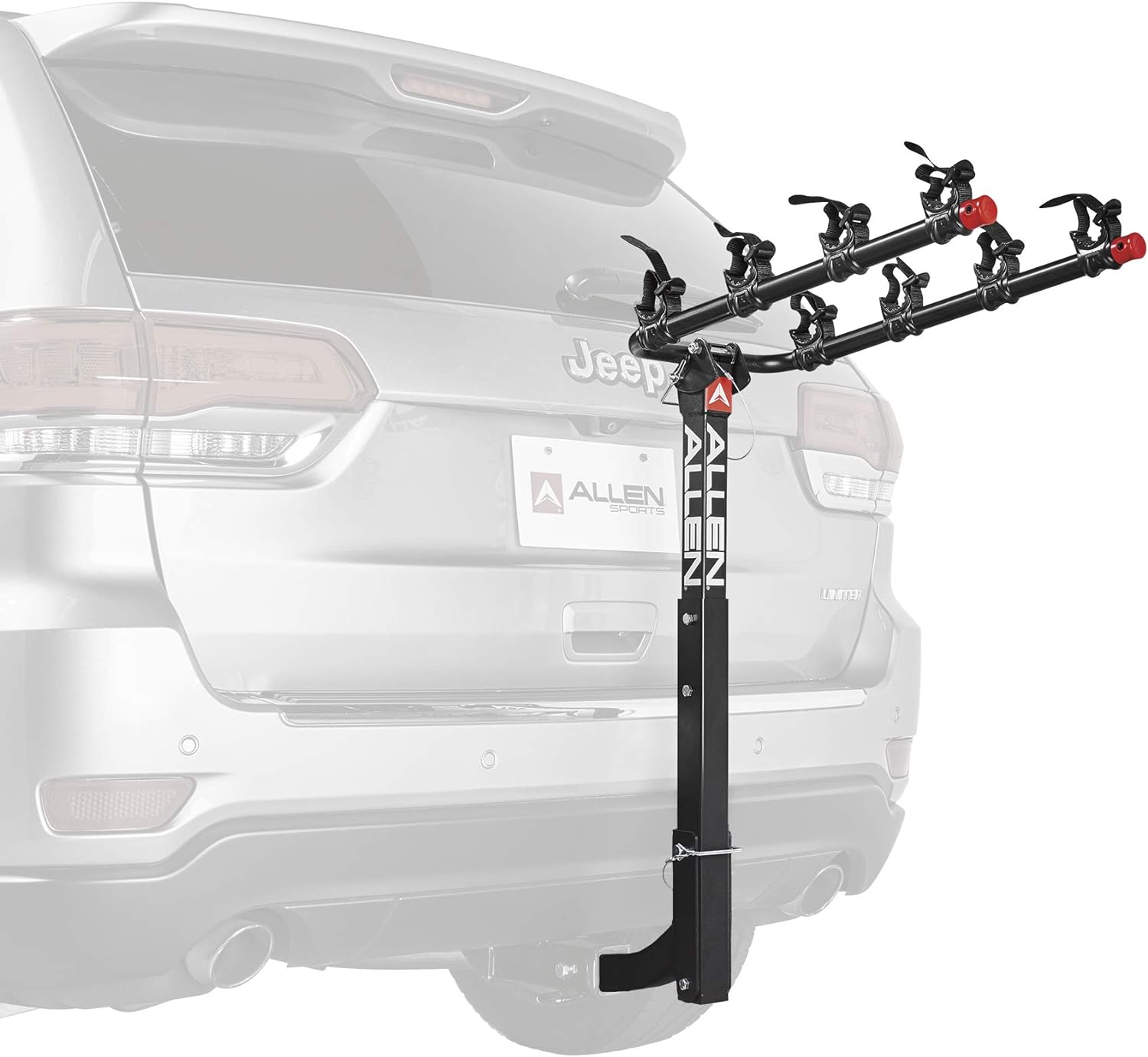
Constructed around a steel mast and twin 22-inch support arms, the Allen Sports Deluxe 542RR-R uses a standard black powder-coat finish to mitigate corrosion. Designed strictly for dedicated 2-inch receiver hitches, the base relies on a threaded no-wobble bolt rather than a quick-cam tensioner, requiring a wrench for secure vehicle installation. Allen integrates retention lanyards on the pull pins to prevent hardware loss during field operation. The dual carry arms deploy via a single-pin hinge system, allowing them to drop flat against the central mast when the rack is stored empty. Individual tie-down cradles sit along the horizontal arms to isolate bicycle top tubes, backed by flexible retention straps. Total assembly is minimal out of the box, with clear mounting hardware included. The physical layout emphasizes mechanical simplicity over complex ratcheting trays, reflecting utilitarian steel fabrication aimed at basic functional reliability.
Real-World Utility and Vehicle Clearance
On the road, stability hinges on proper torque applied to the included no-wobble hitch bolt, which anchors the carrier directly against the receiver walls to suppress lateral sway. The rack claims a 140-pound aggregate capacity across four mounting spots, averaging 35 pounds per bicycle. Because this is a top-tube hanging rack, loading four adult mountain bikes often results in close handlebar and pedal interference, necessitating strategic staggering. Rear cargo access is maintained through a manual tilt-away pin mechanism located near the base. Tilting the vertical mast downward clears the swing path of most automotive hatchbacks and tailgates, though this operation must be executed with the carrier unloaded. The individual plastic cradles support round tubes adequately, but non-traditional frame geometries, deep-drop downhill tubes, or step-through designs will require supplemental top-tube crossbar adapters to achieve level transport.
Pricing and Value Assessment
At an MSRP of $178.07, this rack operates in the budget segment of multi-bike transport hardware. With an aggregated 4.5 out of 5 stars across 9,163 user ratings, the model has accumulated extensive consumer validation focused primarily on economic accessibility. Platform-style hitch racks capable of transporting four bicycles routinely cost three to four times as much, making this hanging design an economical path to group transport for conventional lightweight bikes. The value proposition is reinforced by the inclusion of anti-sway features, folding capability, and tilt functionality at a sub-$200 threshold. However, cost reduction is evident in the reliance on basic fasteners, lack of integrated security locking cables, and manual strap adjustments. For recreational cyclists moving standard acoustic commuter or road frames on weekend outings, the carrier returns solid utility without demanding a high financial investment.
Key Limitations and Who Should Skip It
Cyclists transporting electric bicycles should bypass this rack entirely. With e-bikes regularly surpassing 50 pounds due to integrated motors and heavy frame structures, mounting two or more quickly exceeds the strict 140-pound structural limit. Moreover, lifting a heavy motorized bike onto high horizontal hanging arms presents ergonomic strain, and the cradle geometry rarely accommodates bulky downtubes containing UL-certified battery packs. Owners of vehicles fitted with 1.25-inch Class I or II hitches must also look elsewhere, as the 542RR-R is engineered solely for 2-inch receiver apertures; using hitch adapters can compromise towing ratings and void manufacturer coverage. Riders with carbon frames or non-standard frame geometry without horizontal top tubes should also pass, as hanging racks apply clamping forces and rub marks to frame finishes. Those users should prioritize platform-style wheel-basket carriers instead.