Design and build
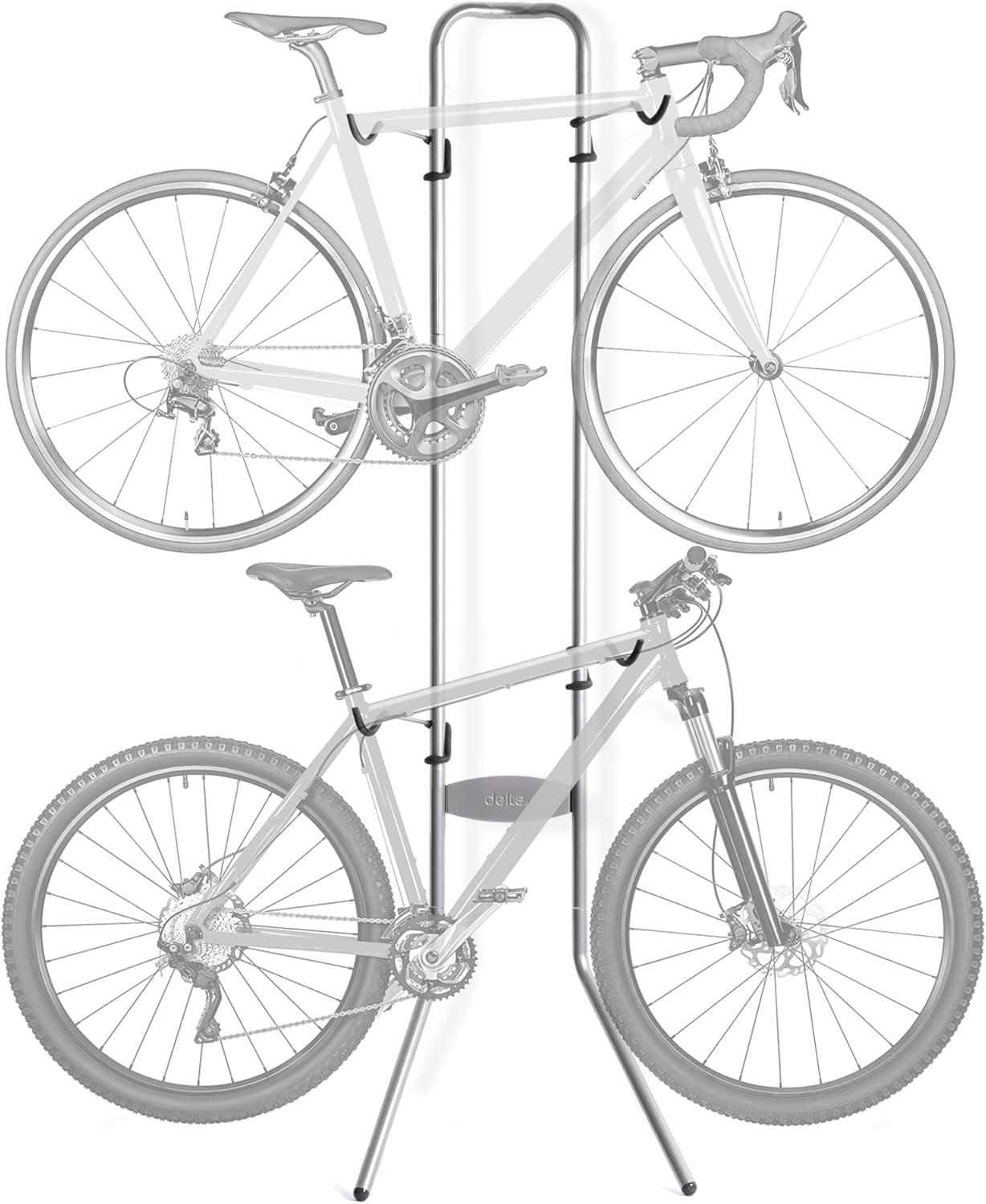
The Michelangelo utilizes a tubular alloy steel architecture protected by a silver powder-coated finish. Rather than relying on wall anchors or floor-mounted bolts, the frame employs a passive gravity-lean geometry. It measures 84 inches tall, resting against the wall while projecting outward by roughly 16 to 26 inches at the base. Coated rubber feet secure the bottom contact points to prevent sliding, while soft upper pads rest against drywall surfaces without marring paint. Note that while the manufacturer specification data lists an item weight of 113 grams, this is an erroneous catalog figure; the actual steel unit carries substantial heft to stabilize two suspended frames. Dual independently adjustable steel arms slide along the vertical tubing to support varied top-tube angles. All bicycle contact points are shielded with soft sleeves designed to prevent cosmetic paint chipping on road, hybrid, and mountain bike frames.
Real-world performance
In daily operation, the rack functions by using the downward load of the bicycles to press its upper stabilizing pads firmly into the wall. Loading the top cradle first requires lifting a complete frame to shoulder height, which demands modest physical effort depending on the machine. The independently adjustable support arms compensate effectively for sloping top tubes on mountain bikes, permitting horizontal orientation of irregular geometries. However, dynamic stability relies entirely on level flooring. On slick hardwood, smooth concrete, or thick carpeting, verifying baseline traction before loading bikes is critical. Racking and unhooking bikes requires straight vertical lifting; pulling forward abruptly can destabilize the vertical lean angle. Under its rated 80-pound cumulative payload, the structure remains stable, provided the individual bicycle weight remains distributed at or below 40 pounds per tier. It does not shudder under careful handling, maintaining clean clearance above surrounding floor space.
Value for money
At an established price point of $94.41, the Michelangelo occupies an accessible middle ground within the storage category. Freestanding tension poles and wall-drilled track systems frequently command higher prices, particularly when factoring in necessary stud-finding equipment and masonry anchors. Cheaper floor stands only support single bikes across horizontal floor space, providing minimal square-footage recovery in dense urban apartments. With more than 10,000 public ratings averaging 4.4 out of 5, the unit demonstrates durable market viability over decades of distribution. The primary trade-off at this price tier is mechanical simplicity: the rack lacks integrated locking mechanisms, wheel-stabilizing straps, or modular utility trays. For renters constrained by lease agreements prohibiting wall alterations, this gravity stand delivers functional vertical storage at a reasonable price per stored bicycle, requiring merely basic screwdriver assembly to achieve operational readiness.
Who should skip it
Owners of electric bicycles must bypass this storage unit entirely. Modern e-bikes routinely weigh between 50 and 75 pounds due to onboard hub or mid-drive motors, wiring harnesses, and high-capacity battery packs. Placing an e-bike on this rack directly violates the 40-pound-per-tier mechanical rating, risking arm failure, frame deformation, or rack collapse. Furthermore, the physics of lifting a 55-pound electric commuter bike onto an upper tier at eye level presents genuine injury risk. Riders whose setups include wide touring baskets, long rear utility racks, or full-coverage fenders may also experience awkward fitment on the support arms. If your machine features the heavy components necessary for high-torque utility hauling or demands hydraulic disc brakes because of a curb weight beyond 50 pounds, you should install heavy-duty ground-level floor stands or dedicated ceiling-mounted hoist hardware instead.