Design and Build
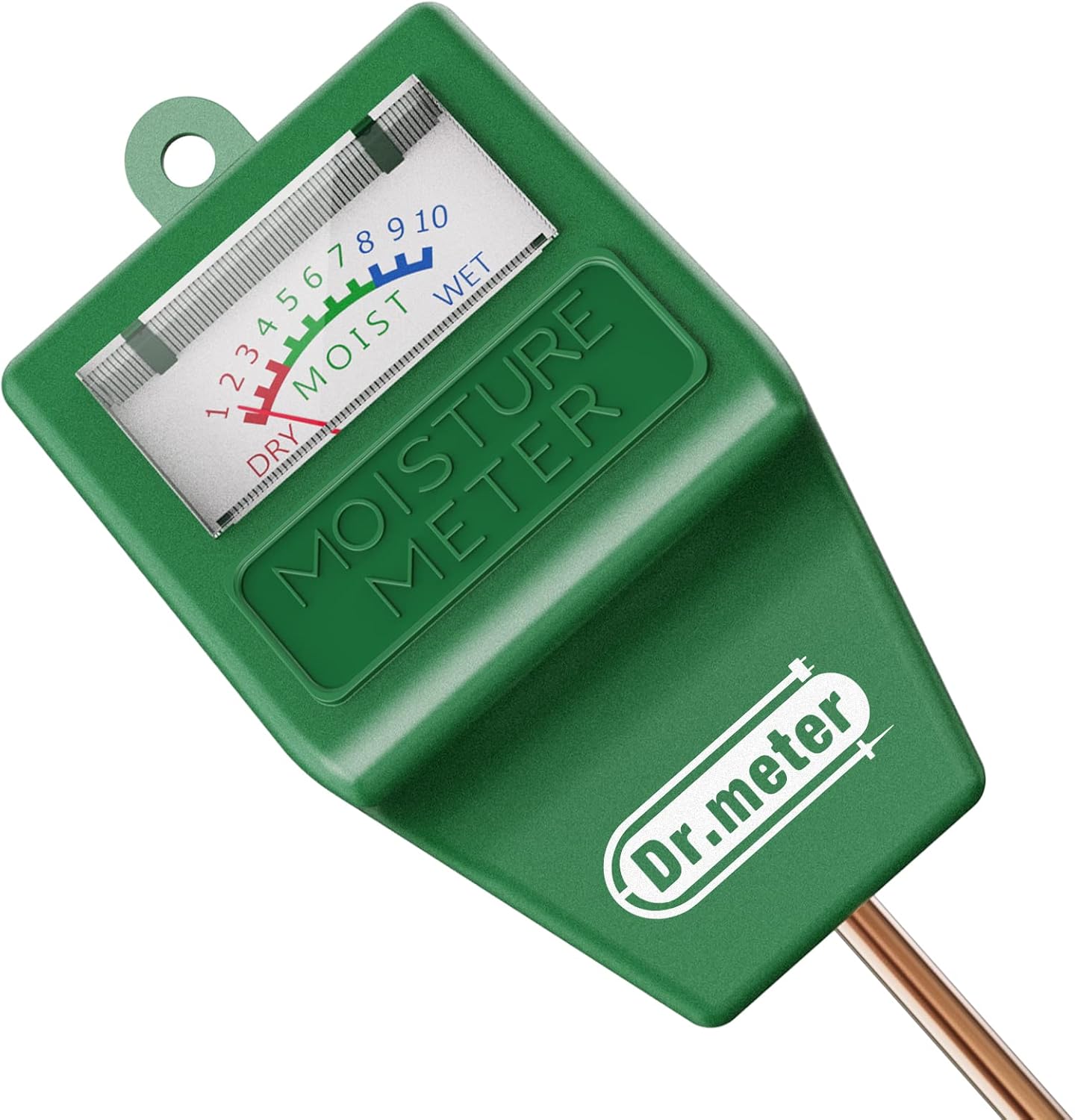
Weighing 2.72 ounces, the Dr.meter S10 features an analog meter housing measuring 2.02 inches wide by 1.6 inches high, mounted to a single metallic probe. Operating passively via galvanic reaction, the instrument requires no batteries or external power source. The display utilizes a ten-point scale segmented into three distinct color zones: red for dry, green for moist, and blue for wet. Its single-probe configuration is explicitly engineered to minimize mechanical displacement of plant root systems during insertion compared to dual-probe alternatives. However, the manufacturer specifies an upper operating limit of 40 °C and cautions against inserting the probe into extremely dense or rocky soil, which could compromise the mechanical integrity of the slender stem. The unit comes without supplementary mounting hardware or protective sheath, meaning users must manually clean and dry the probe after each insertion to prevent oxidation and ensure reliable subsequent readings across container plantings.
Real-World Performance
In practical container gardening, the Dr.meter S10 delivers immediate analog feedback by translating electrical conductivity across its tip into a relative moisture score. The primary operational advantage is speed: inserting the probe immediately swings the dial toward the relevant sector without warm-up time. Because the mechanism relies on the conductivity of dissolved salts within soil water, readings can be skewed in heavily fertilized substrates or pure demineralized water. The manufacturer clearly notes that the probe must never be immersed directly into liquids for water reservoir monitoring, limiting its role strictly to terrestrial soil and potting mixes. For dense indoor foliage or deep taproots, the single probe slides in with minimal root disruption, provided the soil is loose enough to permit entry. Users must verify probe depth consistently, as moisture stratification naturally occurs within standard containers, with surface levels drying significantly faster than bottom root zones.
Value for Money
Priced at $9.99, the S10 positions itself as an entry-level diagnostic device that carries virtually zero operational overhead. The lack of battery requirements ensures that ownership costs remain flat over its operational lifespan, distinguishing it from digital capacitive meters that demand regular button-cell replacements. A 4.4 out of 5 rating across 11,756 customer reviews reflects broad consumer satisfaction with its basic functionality, particularly for hobbyists seeking an alternative to manual finger checks. While more sophisticated tensiometers or continuous-logging sensors cost several times more and offer precise volumetric water content data, the Dr.meter provides sufficient qualitative data for baseline irrigation scheduling. Given its sub-ten-dollar bracket, the build quality aligns with typical low-cost mechanical hygrometers, provided buyers treat the probe as a delicate instrument rather than a robust trowel. For routine houseplant management, it represents a cost-effective, straightforward diagnostic asset.
Who Should Skip It
Dedicated hydroponic growers and aeroponic cultivators should skip the Dr.meter S10 entirely. By specification, the sensor is restricted to soil media and cannot function in water reservoirs, nutrient tanks, or inert liquid substrates where direct electrical immersion would short or fail to read accurately. Furthermore, gardeners managing heavy clay beds, gravel-heavy outdoor soil, or coarse semi-hydroponic aggregate like LECA or pumice risk bending or snapping the single slender probe upon insertion. Growers who demand calibrated volumetric water content percentages or wireless continuous logging to integrate into automated irrigation controllers will find the passive analog needle insufficient for their workflows. Finally, operations in environments exceeding the 40 °C upper thermal limit must look to industrial-grade probes. If your gardening routine requires monitoring water reservoirs, automated telemetry, or rocky substrates, this entry-level soil-only instrument will not meet operational requirements.