How Long Does Propane Camping Stove Fuel Last? Fuel Planning
Learn how to estimate your propane usage for camping, understand fuel burn rates, and ensure you have enough gas for every meal on your next trip.
By the Niche Picks editorsUpdated November 9, 20269 min readDrawn from our 34 research-based camping gear reviews
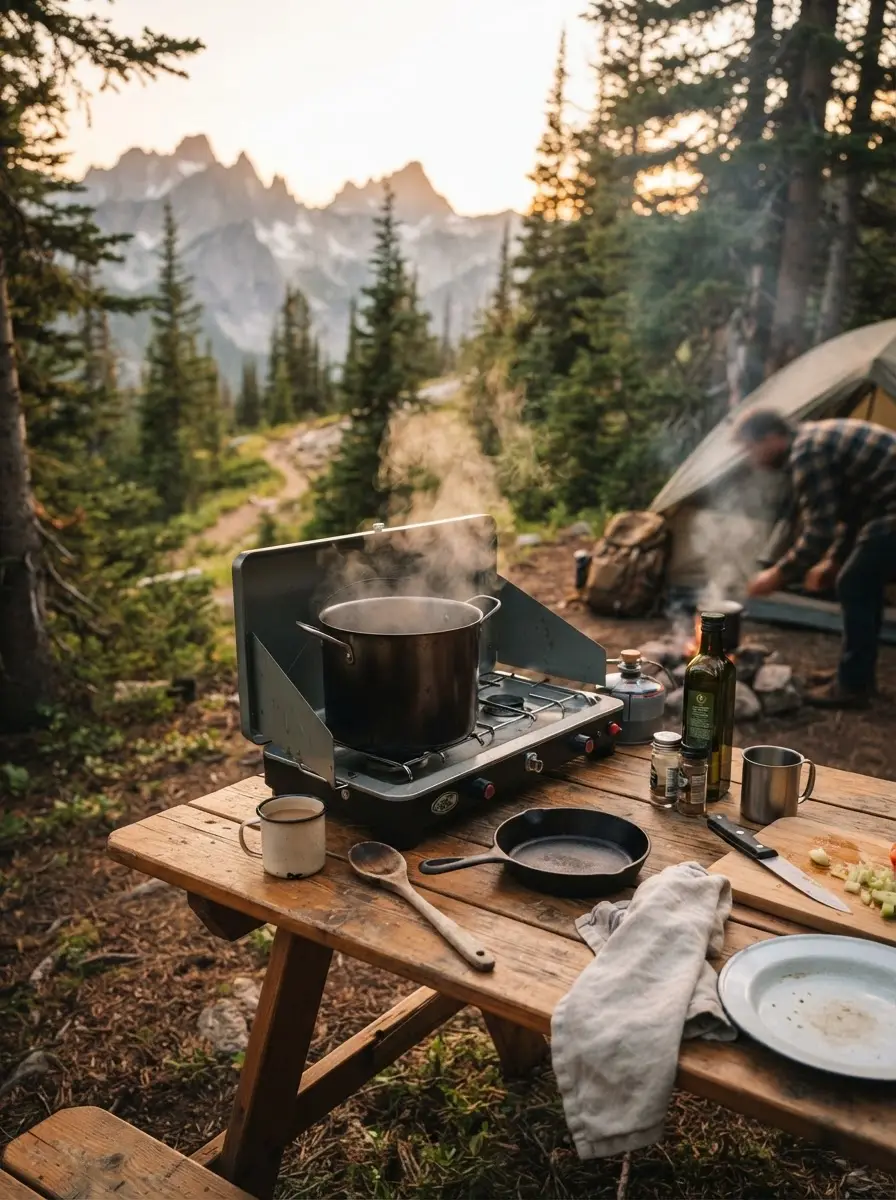
AI-generated editorial illustration; not a product or test photograph.
Short answer
A standard 16.4-ounce propane canister typically lasts between 1 to 2.5 hours of continuous high-heat usage. The exact runtime depends on your stove's total BTU output, wind exposure, and ambient temperature, with higher-output stoves depleting the gas supply significantly faster than efficient, regulated models.
3
Product listings discussed; not hands-on tests
3/3
Discussed listings with a recorded price
$29.99–$119.99
Recorded listing price range; not a complete setup cost
Key takeaways
Most 16.4-ounce propane canisters provide between 1 and 2.5 hours of burn time on high.
Higher BTU stoves consume fuel faster, meaning you need more canisters for extended trips.
Ambient conditions like wind and cold require higher heat settings, which drain fuel rapidly.
Using a pot lid and windscreen can increase your fuel efficiency by up to 30%.
Proper storage of half-used canisters allows for safe reuse on future trips.
Products discussed in this article
Editorial scores and recorded prices are reference points, not measurements of suitability for every use. Read each review's specifications and limitations.
The primary factor determining how long your propane lasts is the BTU (British Thermal Unit) rating of your stove. A single-burner unit, such as the Coleman Bottletop Propane Stove, is rated for approximately 10,000 BTUs and typically offers a runtime of up to 2.5 hours per 16.4-ounce cylinder when running at maximum capacity. In comparison, a multi-burner setup like the Coleman Triton 2-Burner Propane Stove features a total output of 22,000 BTUs. Because this stove consumes fuel through two burners simultaneously, it will exhaust a single 16.4-ounce canister in roughly one hour.
Understanding these figures helps you estimate your fuel needs before heading out. If you are planning to boil water for coffee and cook complex meals for a family of four, the total time each burner is active will dictate your supply. Budget-conscious users often rely on Gas One GS-3400P because it offers the versatility of dual-fuel (propane or butane) compatibility, which is a major advantage when fuel availability is uncertain. Always divide your planned cooking hours by the stove’s efficiency rate to determine how many canisters are required for your itinerary. A simple calculation helps you avoid the mistakes to avoid regarding supply planning, as running out of gas mid-trip is a common issue for beginners. Our buying tips advise testing your stove’s boil time at home before any major outing to understand how it performs under your specific setup. If you're building a new kitchen, browsing the best camping cookware can further highlight why selecting the right pot size can significantly impact heat transfer and total gas consumption during extended trips in the wilderness.
Your stove's environment plays a massive role in how quickly a propane canister empties. When cooking in wind, your burner must work much harder to keep the pot at a boiling temperature. This requires the knob to be turned higher than it would be on a calm day, which directly accelerates fuel usage. The Coleman Triton 2-Burner Propane Stove features integrated wind guards, which provide a physical barrier to help maintain heat efficiency. Without these, the flame energy is lost to the air, causing your gas to burn off unnecessarily fast. Furthermore, cold temperatures lower the internal pressure of the propane tank. While propane performs better in the cold than butane, extreme drops can still make the stove struggle to produce heat.
Use a windscreen to block air currents from reaching your flame.
Always use a lid on your cookware to trap heat and speed up boiling times.
Keep your gas canisters in a cool area until use, but avoid extreme sub-zero exposure.
If you find your stove is struggling, consider your overall campsite setup. Using what is a good tent for camping guidelines ensures you place your kitchen area in a location that is protected from the prevailing winds. If you are ever worried about your thermal performance, remember that ground conduction is a separate but equally important issue—ensure your sleeping bag and pad are prepared for the temperature, as you don't want your stove to be your only source of warmth. In cold weather, it is often more efficient to plan for meals that require shorter cooking times, which is a great strategy to save fuel when canisters are in short supply during winter ventures.
Always use a windscreen to prevent heat dissipation. Blocking the wind ensures that more thermal energy is transferred to your cookware, which can save up to 30% of your fuel.
The Role of Pressure Regulators in Fuel Efficiency
Pressure regulators are critical components that govern how efficiently your propane stove uses its fuel supply. As a canister empties, the internal pressure naturally drops. In an unregulated stove, this leads to a weaker flame, forcing the user to open the valve wider, which results in inconsistent heat and fuel waste. Stoves like the Coleman Bottletop Propane Stove feature pressure regulation systems, often referred to by brands as PerfectFlow, which keep the fuel delivery constant regardless of the remaining gas volume or environmental temperature. This level of consistency means you are always using the exact amount of gas needed for your current heat setting, which significantly improves the fuel life per canister.
Regulators prevent the flame from sputtering when the tank pressure is low.
Even heat leads to faster, more efficient boiling compared to variable-output models.
Regulated systems make it much easier to simmer, reducing the likelihood of burning food.
If you are a frequent camper, choosing a stove with built-in pressure management is a smart way to maximize your equipment's longevity. It is also important to maintain your gear properly; check your stove's regulator connection periodically to ensure there are no leaks or debris in the valve. If you’re assembling a comprehensive kit for the first time, use our budget planner to prioritize funds for high-efficiency stoves, as they save money in the long run by reducing the number of canisters you need to purchase each year. Remember, always refer to the manufacturer’s documentation for your Gas One GS-3400P or Coleman units, as specific care is required to ensure the regulator remains clear and functional throughout your camping season, ultimately protecting your investment and ensuring reliable performance.
Propane is a highly convenient fuel for camping, but it requires strict adherence to safety guidelines. Never use your propane stove inside a tent, a vehicle, or any other enclosed structure. The combustion process consumes oxygen and releases carbon monoxide, which is odorless, colorless, and deadly in confined spaces. Our guide on can you use a camping stove indoors explains the dangers in depth and why outdoor-only operation is the only safe method for all camping stoves. Additionally, ensure that when you connect a canister to a stove like the Coleman Triton, you tighten it properly to prevent any hissing or leakage. If you ever smell gas when the valve is closed, disconnect the canister immediately and inspect the O-ring seals for damage.
Store canisters upright in a cool, ventilated area away from ignition sources.
Do not leave canisters in direct sunlight or hot cars where heat can cause internal pressure to rise.
When disconnecting a partially used canister, ensure the stove valve is fully turned off to avoid gas leaks.
Understanding the limitations of your equipment is vital. When using a Coleman Bottletop Propane Stove, the canister acts as the base of the stove. This makes it inherently more prone to tipping than a wide, low-profile burner. Always clear your cooking area of uneven debris to create a stable, flat surface before you light the stove. For those who frequently cook for groups, having a dedicated tent for camping or a separate shelter space for your kitchen gear is a great way to isolate your stove safely. Respecting the physical properties of propane ensures that your camping adventures remain fun and free of preventable accidents, allowing you to focus on the enjoyment of the outdoors rather than equipment hazards.
Never operate a propane stove inside a tent. Carbon monoxide buildup can be fatal. Always cook outdoors on a stable, flat, and non-combustible surface.
Comparing Fuel Efficiency Across Stove Types
Not all camping stoves are created equal when it comes to fuel economy. Single-burner stoves are generally more efficient for solo travelers or small groups because they have fewer variables and often a simpler fuel delivery path. A setup like the Gas One GS-3400P is designed for convenience, offering the ability to switch between fuel types depending on what is available at local stores, which can be a massive benefit if your trip takes you through remote areas with limited supplies. However, for group basecamp cooking, the Coleman Triton is the clear winner for reliability and capacity, even if it requires two canisters for an equivalent number of total cooking hours compared to a single-burner system.
Single-burner models: Best for backpackers or minimalist campers looking to save weight and fuel.
Two-burner models: Necessary for group meals, but consume twice the fuel per hour of active cooking.
Regulated models: Offer the best efficiency over the entire life of a single canister by maintaining steady pressure.
When you are comparing models at the camping gear section of our site, look at the BTU ratings and presence of built-in regulators. A higher BTU rating doesn't necessarily mean a "better" stove, just a more powerful one. If you only boil water, a 7,000 to 10,000 BTU stove is usually more than sufficient and will save you money on fuel. However, if you enjoy pan-frying or simmering complex dishes, the extra BTU overhead is appreciated. Always look at the camping gear FAQ to see common user experiences regarding fuel usage for different models. By choosing the right tool for your specific culinary needs, you can drastically increase the number of meals you get out of every 16.4-ounce cylinder, ensuring you have enough fuel for those unexpected extra nights or spontaneous morning coffee sessions.
Achieving maximum efficiency in your camp kitchen is an art that combines the right gear with the right techniques. Start by choosing the right cookware; a pot that fits your burner's flame diameter ensures heat is transferred directly to the contents rather than wasted on the sides of the pan. Using a light-gauge metal pot can speed up boiling, but it may also burn your food more easily. For reliable performance, many seasoned campers prefer durable camping cookware that distributes heat evenly. Pairing your burner with a wind-blocking system—whether built-in or a folding aftermarket shield—is the single most effective way to protect your fuel supply during adverse weather.
Select pots with tight-fitting lids to significantly reduce the time needed to bring water to a boil.
Avoid using oversized pots that require a wider, more intense flame to heat correctly.
Keep your burners clean; a clogged burner head forces the stove to burn more fuel to reach the same temperature.
Finally, make sure you understand the best camping tent and gear maintenance protocols to keep your kitchen area protected. Cooking should always occur on a stable, fire-resistant surface. If you are ever in doubt, consult the camping gear documentation to verify if your specific model requires any special maintenance. Over time, build-up in the gas lines or regulator can reduce efficiency, so a quick check at the start of each season can ensure you get the best possible performance. With a clear plan, high-quality gear, and a focus on wind protection, you will find that your fuel goes much further than you might have expected, even on long camping trips far from a refueling station.
1Plan your menu to identify total boiling and cooking time.
2Reference the stove's rated burn time per 16.4-ounce canister.
3Add 20% to your total fuel estimate to account for wind and cold.
4Pack the required number of canisters plus one spare.
5Ensure the valve is securely threaded to the stove regulator.
6Open the gas valve and ignite immediately to avoid gas accumulation.
7Adjust flame height to the lowest setting required for the task.
8Turn off the gas valve completely before disconnecting the canister.
Quick checklist
Assess the number of meals and boiling tasks for your trip.
Verify the BTU rating and expected runtime of your stove.
Calculate the number of canisters needed based on your stove's burn rate.
Pack one extra canister for safety in case of cold weather or wind.
Ensure your cook surface is flat, level, and far from flammable brush.
Test your piezo-electric igniter and pack a backup lighter.
Check all O-ring seals for gas leaks before every usage.
Frequently asked questions
Can I reuse a propane canister after it has been opened?
Yes, standard threaded propane canisters are designed to be disconnected safely when not in use. Simply ensure the stove valve is fully closed before unscrewing the canister to prevent any leakage.
How do I know if my propane canister is almost empty?
You will observe a significant reduction in flame intensity and heat output. Because propane is a liquefied gas, you can also gauge the remaining amount by the weight of the canister; an empty one will be noticeably lighter.
Why does my stove consume more fuel on some days?
Higher fuel consumption is usually due to ambient conditions. Cold temperatures and strong winds require you to run the stove at higher settings to achieve the same boiling results as a calm, temperate day.
Are there ways to extend the lifespan of my fuel?
Yes, use a pot lid to retain heat, cook in a wind-protected area, and avoid high-heat settings when a lower simmer is sufficient for the task. These simple habits significantly reduce gas usage.
Is it safe to store half-used propane canisters?
Yes, provided the valves are fully closed. Store them upright in a cool, well-ventilated location away from heat sources or direct sunlight. Avoid leaving them in high-temperature environments like inside a car trunk.
Amazon links are affiliate links; we may earn a commission at no cost to you.
Shortlists in this category
Ranked lists from our camping gear reviews, limited to listings whose titles confirm the product type, with budget cuts where enough recorded prices sit on both sides of the line.
This page summarizes our research reviews of Amazon listings, listed specifications and captured buyer ratings. It is not a hands-on test. Scores are editorial assessments, not measured performance; prices are recorded snapshots and may change. A category can include both main products and accessories, so its overall price range is not the cost of a complete setup.
Most recent product record update: November 8, 2026. Individual records may be older; this is not a verification date for every claim. Prices on this page were read from the listings Nov 9, 2026.
Choose the product type first. These groups require a match in the listing title; an import search term alone is not enough. Scores rank our recorded research assessments within each group, not independently measured performance.
Values are shown as recorded, without unit conversions or inferred compatibility. Not recorded means unknown, not absent. Prices are snapshots, not current offers. Editorial scores are research judgments, not lab results. Amazon links are affiliate links.
Before treating a comparison as complete
Which details are still unknown?
A specification appearing in a listing is not independent verification. These counts show which shortlisted records contain the same field; a blank record does not mean the product lacks the feature.
Included Components
Recorded for 2 of 2 shortlisted models
Present in every shortlisted record. Check units, exact variants and the current manufacturer documentation before relying on it.
Item Dimensions L x W x H
Recorded for 2 of 2 shortlisted models
Present in every shortlisted record. Check units, exact variants and the current manufacturer documentation before relying on it.
Item Weight
Recorded for 2 of 2 shortlisted models
Present in every shortlisted record. Check units, exact variants and the current manufacturer documentation before relying on it.
Power Source
Recorded for 2 of 2 shortlisted models
Present in every shortlisted record. Check units, exact variants and the current manufacturer documentation before relying on it.
Fuel Type
Recorded for 2 of 2 shortlisted models
Present in every shortlisted record. Check units, exact variants and the current manufacturer documentation before relying on it.
Item Type Name
Recorded for 2 of 2 shortlisted models
Present in every shortlisted record. Check units, exact variants and the current manufacturer documentation before relying on it.
Match standardized sleeping-pad R-value and sleeping-bag comfort rating to conditions; neither rating substitutes for the other.
Hydrostatic-head ratings describe fabric water resistance; seams, pitching, ventilation and wind conditions also affect shelter performance.
Packed weight, not trail weight, is what you carry.
If a specification, certification or compatibility detail is absent, mark it as unknown and ask the seller or manufacturer. Do not substitute a star rating, an editorial score or a different model's specification.