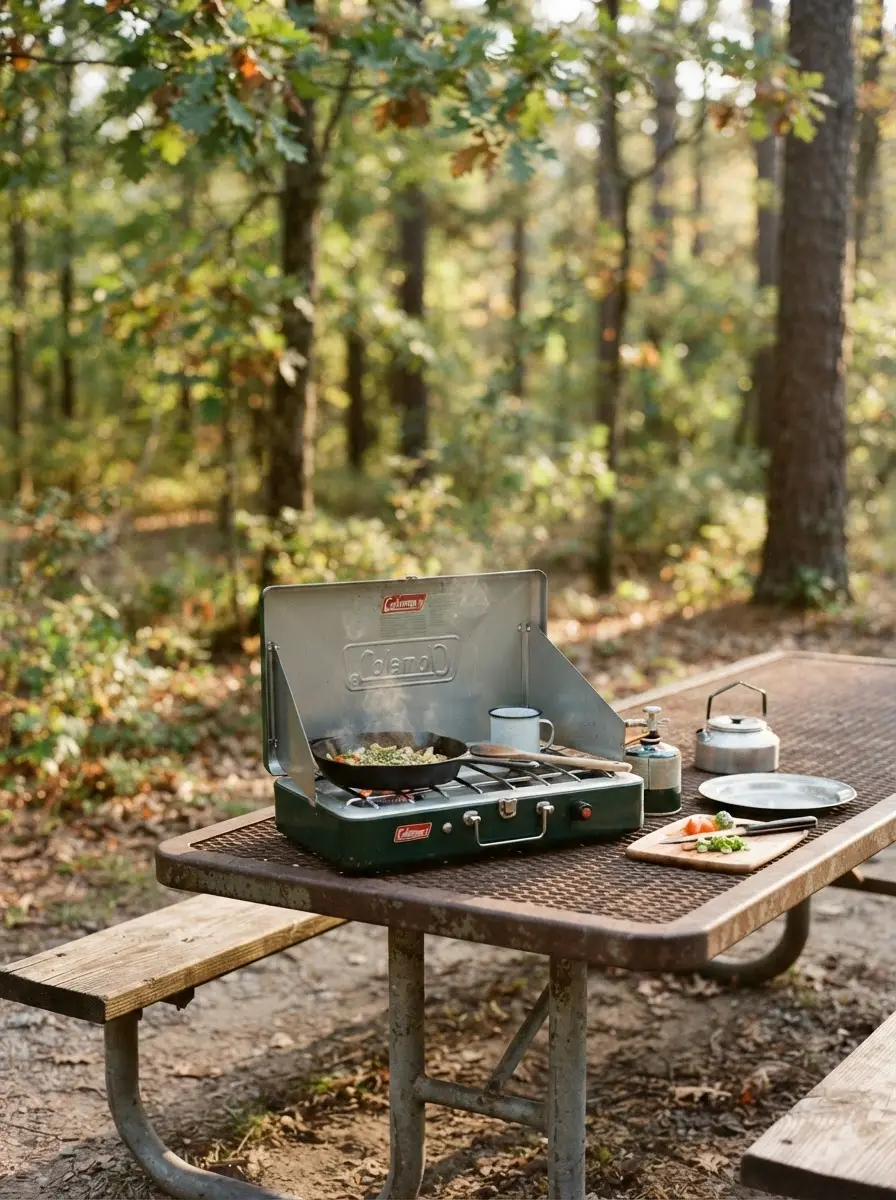
Discover the critical dangers of using camping stoves indoors and why you should stick to outdoor-rated cooking methods for your own safety.
By the Niche Picks editorsUpdated November 9, 202610 min readDrawn from our 34 research-based camping gear reviews
AI-generated editorial illustration; not a product or test photograph.
Short answer
You should never use a camping stove indoors. These devices are designed exclusively for outdoor use because they produce carbon monoxide, a colorless, odorless gas that can be fatal in enclosed spaces. Always prioritize ventilation and follow manufacturer safety instructions to prevent carbon monoxide poisoning and accidental structure fires in your living environment.
3
Product listings discussed; not hands-on tests
3/3
Discussed listings with a recorded price
$29.99–$119.99
Recorded listing price range; not a complete setup cost
Key takeaways
Camping stoves are engineered solely for outdoor air circulation and must never operate in homes, tents, or vehicles.
Incomplete combustion in portable stoves generates dangerous levels of toxic carbon monoxide.
Using a camp stove indoors significantly increases the risk of fire and potential carbon monoxide poisoning.
Manufacturers explicitly state outdoor-only usage for models like the Gas One GS-3400P and the Coleman series.
Proper ventilation is impossible to maintain indoors when using high-BTU portable cooking equipment.
Products discussed in this article
Editorial scores and recorded prices are reference points, not measurements of suitability for every use. Read each review's specifications and limitations.
The primary reason you must avoid using a camping stove indoors is the dangerous accumulation of carbon monoxide (CO). While you might be tempted to use your Gas One GS-3400P during a power outage or a winter storm, portable gas stoves are not equipped with the advanced safety venting or integrated CO-monitoring technology required for residential indoor environments. When fuel like butane or propane burns in an open, outdoor setting, it typically produces water vapor and carbon dioxide. However, in an enclosed room, the limited oxygen supply leads to incomplete combustion, which produces significant concentrations of carbon monoxide as a toxic byproduct.
Carbon monoxide is insidious because it is completely colorless, odorless, and tasteless, making it impossible for humans to detect without professional-grade specialized sensors. Even a small, compact unit like the Coleman Bottletop Propane Stove can generate lethal concentrations of this gas within minutes of operation in a closed room. Beyond the invisible threat of CO poisoning, these stoves pose a massive fire hazard. Portable stoves often have exposed flames or hot burner grates that are not shielded from common household items like curtains, furniture, or wooden cabinets. Most camping gear reviewed in our comprehensive guides emphasizes portable, lightweight designs, which often lack the structural stability found in permanent, heavy-duty kitchen ranges, making them prone to tipping if accidentally bumped by children, pets, or during routine kitchen movement.
For those interested in how to better prepare for emergencies, it is essential to consult a professional about safe, indoor-rated heating or cooking solutions rather than improvising. If you are browsing our camping gear buyer's guide, remember that every product, such as the Coleman Triton 2-Burner, is built specifically to operate under outdoor atmospheric conditions. Attempting to modify or operate these devices in a garage, basement, or living room is a critical safety failure. Always check the mistakes to avoid before considering any makeshift indoor solutions.
Understanding the Dangers of Carbon Monoxide
Carbon monoxide poisoning acts rapidly, often causing victims to lose consciousness before they realize they are in genuine danger. Symptoms often mimic common ailments like the flu or food poisoning, including dizziness, sharp headaches, nausea, and shortness of breath. Because the body reacts to CO by effectively replacing oxygen in the red blood cells, exposure at high concentrations is frequently fatal. When you look at our camping gear FAQ, the inherent dangers of improper stove placement are consistently highlighted as a primary safety concern.
Many campers assume that if they simply leave a door or a window slightly ajar, it will be safe to run their Coleman Triton. Unfortunately, this is a dangerous misconception that has led to preventable accidents. A small crack in a window does not provide enough active airflow to flush out the high volumes of hazardous combustion gases produced by a 7,650 BTU burner or higher. The Gas One GS-3400P, which is popular for its budget-conscious design, is specifically labeled for emergency preparedness in the context of outdoor usage, but users must never misinterpret this to mean it can be placed on an indoor kitchen counter. The structural design of these stoves relies entirely on wide-open air to dissipate heat and combustion gases efficiently and safely.
Furthermore, consider the physical stability of your camp kitchen. Permanent indoor stoves are anchored and utilize heavy-duty metal housings that are bolted into cabinetry. Portable camping stoves are intentionally designed to be lightweight, which makes them inherently unstable on indoor surfaces. If you place a pot of boiling water on a bottletop stove that is sitting on a standard indoor table, any slight accidental nudge could cause the stove to fall, spilling boiling liquid and potentially starting a fire. Always refer to our buying tips to understand the intended use-cases for your specific equipment before you head into the field.
Carbon Monoxide Risk
Camping stoves are strictly for outdoor use. Operating them in enclosed areas leads to lethal carbon monoxide accumulation.
Evaluating Alternatives to Indoor Stove Use
If you are rightfully concerned about cooking during a power outage or a household emergency, you must focus exclusively on safe, non-combustion alternatives. Relying on portable stoves meant for the wilderness is a high-stakes risk that is never worth the potential outcome. Instead, invest in dedicated indoor emergency solutions that are designed to function without the byproduct concerns associated with liquid or gaseous fuels. Many modern households now maintain solar-powered or high-capacity battery-operated equipment that can support basic culinary needs without the combustion of volatile propane or butane canisters.
For food preparation, consider non-flame options such as electric thermal cookers or simple pantry stocking strategies that prioritize shelf-stable, pre-cooked foods that do not require high-heat preparation. If you must use a heat source, ensure it is specifically rated by national safety boards for indoor, residential use. Never bring a Gas One dual-fuel stove inside your home. While it provides excellent versatility for car camping, it must stay in the garage, a well-ventilated tent vestibule, or a dedicated outdoor cooking area. The Coleman Triton is perfect for basecamp cooking for groups, but only when used with the integrated wind guards outdoors where air exchange is natural, constant, and unrestricted.
Always ensure that your home is equipped with working smoke detectors and, more importantly, a dedicated, wall-mounted carbon monoxide detector on every floor level. If you are ever in doubt, err on the side of extreme caution. Even the most high-rated products in our archives are not substitutes for proper residential safety standards. If you are struggling with selecting gear for a trip, consult our budget planner to find equipment that fulfills your needs without forcing you to choose between convenience and safety. By respecting the operating parameters of your equipment, you ensure that your camping experience remains enjoyable and, above all, safe for your family.
The Engineering of Camping Stoves
Camping stoves, such as those featured in our articles/best-camping-cookware, are designed with a specific focus on portability and weight reduction rather than residential safety compliance. The Coleman Triton, for instance, utilizes a briefcase-style design for ease of transport. This configuration prioritizes a foldable form factor that is ideal for moving from the car to the picnic table, but this same design results in a smaller footprint that lacks the thermal insulation of a home stove. Furthermore, the burners are tuned for optimal performance in outdoor temperatures. When you move these devices indoors, the change in ambient air pressure, oxygen density, and airflow can lead to flame instability and incomplete fuel burn.
Comparing the Gas One GS-3400P to your average home appliance reveals a massive difference in build requirements. The Gas One uses a removable propane adapter designed to withstand the rigors of outdoor transport, but it lacks the safety valves required by building codes for indoor gas appliances. The Coleman Bottletop Stove is another example of a specialized tool meant for simplicity. Its direct-to-canister mounting is brilliant for hikers, but it creates a high center of gravity that is dangerous on a kitchen table. If a tent stakes down into the ground, you can mitigate these issues, but on a smooth kitchen floor, the stability is non-existent. These engineering choices are why professional reviews always specify outdoor-only environments. As noted in our articles/how-to-insulate-a-tent-for-winter-camping, safety in camping is an integrated system; you cannot pick and choose which safety protocols to follow. The stove's design is one part of that, and ventilation is the other. Once you move the operation indoors, you negate the fundamental safety premise of the entire system.
Emergency Preparedness
For indoor emergencies, utilize electric or battery-powered solutions specifically certified for home use. Never rely on camp stoves.
Managing Your Camping Gear Safely
To ensure your camping experience remains safe, you must treat your gear with the respect these engineering standards demand. This starts with how you store and transport your fuel. Propane and butane canisters should always be stored in a cool, ventilated area—never in your home's living quarters. When it comes time to use your gear, you must follow the procedures outlined in our articles/best-camping-tents regarding where to set up your cooking station. Most accidents occur when campers try to bring their kitchen gear into the tent vestibule during a rainstorm. This is a common and dangerous mistake. Even in a vestibule, the fabric walls of a tent can act as a wind barrier that traps gases, leading to CO buildup.
When we compile articles/best-sleeping-bag or review camping gear, we always highlight that specific products have specific jobs. A tent is for shelter; a stove is for cooking; a sleeping bag is for insulation. Mixing these functions—like cooking inside a sleeping area or inside a tent—is a recipe for disaster. If you are looking for more tips on maximizing your safety and comfort, refer to our blog/camping-gear for expert advice on how to organize your camp kitchen properly. It covers everything from maintaining your burner grates to safely handling fuel canisters in different weather conditions. The key takeaway is always to separate your heat sources from your living spaces. By creating this hard barrier between your kitchen and your bedroom, you protect yourself from both the risk of fire and the silent danger of carbon monoxide accumulation. Your budget for equipment should include not just the stove, but also the proper protective gear to keep that stove safely outside your living space at all times.
Why Standardized Safety Labels Matter
Whenever you purchase gear, always look for the safety certification labels. In the United States, camping equipment is rigorously tested for its intended environment. A stove that is safe for the basecamp has passed tests for wind resistance, fuel efficiency, and ignition reliability in outdoor settings. It has not been tested for its ability to operate safely in a room with limited airflow. When manufacturers like Coleman or Gas One warn against indoor use, they are providing a legal and safety-based directive that you should never ignore. Their products are designed to be used in open-air environments where gases are naturally dissipated by the wind and the vast expanse of the outdoors.
There is a common misconception that if a device is small, it must be safe for small spaces. This is completely false. A device's size has no bearing on the volume of CO it produces. In fact, a small, direct-to-canister stove can be just as deadly as a two-burner stove if the room is enclosed. The Gas One GS-3400P is designed to be user-friendly, but its ease of use doesn't mitigate the chemical reality of combustion. When you are looking at our camping gear reviews, you will see we focus heavily on real-world performance, but that performance is always framed by the context of safety. We provide these details so that you can make informed choices about your equipment. However, the final choice to use that equipment safely lies with the user. Never prioritize a meal or a hot drink over your own safety. If the weather is too poor to cook outdoors, choose a cold meal or a non-combustible energy source. There is no meal worth the risk of CO poisoning. Staying safe is the most important part of any camping trip or emergency preparedness plan.
Step by step
1Select a flat, stable site at least 10 feet away from any tent or dwelling.
2Clear the immediate area of dry leaves, grass, or any flammable debris.
3Attach the fuel canister carefully, following instructions to ensure a tight seal.
4Ignite the stove using the built-in piezo or a long-reach lighter.
5Monitor the stove continuously while it is in operation; never leave it unattended.
6Shut off the fuel supply completely immediately after your cooking task is finished.
7Allow the burner grate to cool fully before handling or storing the unit.
Quick checklist
Verify your camping stove is used exclusively in well-ventilated outdoor areas.
Place the stove on a level, fire-resistant surface away from tent fabric.
Inspect all fuel connections for damage or leaks before every ignition.
Keep a charged fire extinguisher nearby at all times while cooking.
Store propane canisters in a cool, ventilated location away from living quarters.
Install and regularly test carbon monoxide detectors on every level of your home.
Frequently asked questions
Can I use a camping stove in my garage if the door is open?
No. Even with a garage door open, adequate ventilation is rarely guaranteed. Carbon monoxide can accumulate rapidly in semi-enclosed structures, and the high risk of fire from accidental contact with fuel containers or storage items remains extreme.
Is it safe to use a propane stove in a tent?
You should never use a camping stove inside a tent. Tents are small, poorly ventilated spaces made of highly flammable materials; using a stove inside creates an immediate risk of carbon monoxide poisoning and fire. Only use stoves in the dedicated outdoor cooking area.
What should I do if I think there is a carbon monoxide leak?
If you suspect carbon monoxide, immediately move to fresh air and call emergency services. Do not try to locate the source yourself. Symptoms like dizziness, nausea, or headaches require immediate medical attention, as carbon monoxide is colorless and odorless.
Are there any indoor-safe portable stoves?
Only stoves explicitly certified and labeled by safety organizations (such as UL or CSA) for indoor residential use are safe. Standard camping stoves sold for recreational use are specifically intended for outdoor environments and lack the safety protocols for indoor safety.
Can I use a camping stove in an RV?
Only use stoves that were factory-installed by the RV manufacturer. These are specifically vented for the space. Portable outdoor camping stoves are not designed for the interior of an RV and present the same life-threatening dangers as using them inside a residential home.
Amazon links are affiliate links; we may earn a commission at no cost to you.
Shortlists in this category
Ranked lists from our camping gear reviews, limited to listings whose titles confirm the product type, with budget cuts where enough recorded prices sit on both sides of the line.
This page summarizes our research reviews of Amazon listings, listed specifications and captured buyer ratings. It is not a hands-on test. Scores are editorial assessments, not measured performance; prices are recorded snapshots and may change. A category can include both main products and accessories, so its overall price range is not the cost of a complete setup.
Most recent product record update: November 8, 2026. Individual records may be older; this is not a verification date for every claim. Prices on this page were read from the listings Nov 9, 2026.
Choose the product type first. These groups require a match in the listing title; an import search term alone is not enough. Scores rank our recorded research assessments within each group, not independently measured performance.
Values are shown as recorded, without unit conversions or inferred compatibility. Not recorded means unknown, not absent. Prices are snapshots, not current offers. Editorial scores are research judgments, not lab results. Amazon links are affiliate links.
Before treating a comparison as complete
Which details are still unknown?
A specification appearing in a listing is not independent verification. These counts show which shortlisted records contain the same field; a blank record does not mean the product lacks the feature.
Included Components
Recorded for 2 of 2 shortlisted models
Present in every shortlisted record. Check units, exact variants and the current manufacturer documentation before relying on it.
Item Dimensions L x W x H
Recorded for 2 of 2 shortlisted models
Present in every shortlisted record. Check units, exact variants and the current manufacturer documentation before relying on it.
Item Weight
Recorded for 2 of 2 shortlisted models
Present in every shortlisted record. Check units, exact variants and the current manufacturer documentation before relying on it.
Power Source
Recorded for 2 of 2 shortlisted models
Present in every shortlisted record. Check units, exact variants and the current manufacturer documentation before relying on it.
Fuel Type
Recorded for 2 of 2 shortlisted models
Present in every shortlisted record. Check units, exact variants and the current manufacturer documentation before relying on it.
Item Type Name
Recorded for 2 of 2 shortlisted models
Present in every shortlisted record. Check units, exact variants and the current manufacturer documentation before relying on it.
Match standardized sleeping-pad R-value and sleeping-bag comfort rating to conditions; neither rating substitutes for the other.
Hydrostatic-head ratings describe fabric water resistance; seams, pitching, ventilation and wind conditions also affect shelter performance.
Packed weight, not trail weight, is what you carry.
If a specification, certification or compatibility detail is absent, mark it as unknown and ask the seller or manufacturer. Do not substitute a star rating, an editorial score or a different model's specification.