Best High Density Foam Roller for Deep Tissue Back Pain
Compare top-rated high-density foam rollers for back tension, from solid polypropylene cylinders to hollow-core grid rollers engineered for firm myofascial release.
By the Niche Picks editorsUpdated October 19, 202610 min readDrawn from our 30 research-based massage guns & recovery tools reviews
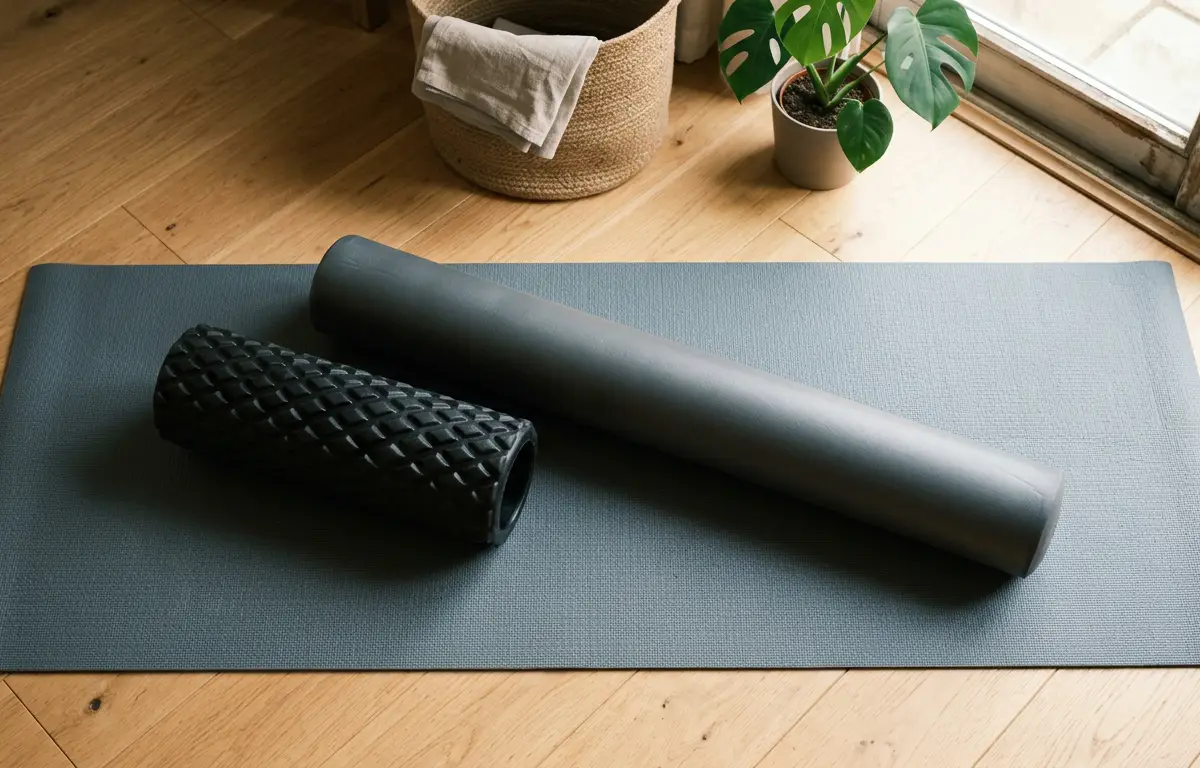
AI-generated editorial illustration; not a product or test photograph.
Short answer
The best high-density foam roller for back tension depends on your spinal support needs and firmness tolerance. The 36-inch Amazon Basics High-Density Foam Roller is the top choice for full-spine support and broad thoracic mobilization, while the extra-firm TriggerPoint Grid 1.0 delivers targeted deep-tissue compression via a rigid hollow core that prevents structural deformation over time.
4
Product listings discussed; not hands-on tests
4/4
Discussed listings with a recorded price
$15.29–$27.99
Recorded listing price range; not a complete setup cost
Key takeaways
A 36-inch continuous roller allows longitudinal spinal positioning to mobilize the entire back simultaneously.
Hollow-core designs like the TriggerPoint Grid 1.0 resist bodyweight deformation far better than standard solid foam.
Molded expanded polypropylene (EPP) delivers firm, unyielding surface density at a fraction of the cost of motorized tools.
Surface textures alter compression distribution: smooth rollers spread pressure evenly, while ribbed grids concentrate force onto focal adhesions.
Foam rollers rely completely on bodyweight positioning and deliver 0 dB acoustic output, making them completely silent for late-night routines.
Products discussed in this article
Editorial scores and recorded prices are reference points, not measurements of suitability for every use. Read each review's specifications and limitations.
The Original Body Roller - High Density Foam Roller19.99 USD
Amazon Basics High Density Foam Roller for Exercise15.29 USD
High-Density Foam Rollers Compared: Dimensions, Materials, Firmness, and Pricing
Product
Length & Diameter
Material Construction
Firmness Rating
Surface Texture
Listed Price
Amazon Basics 36-Inch
36 x 6 inches
Molded Polypropylene
Firm
Smooth
$24.14
TriggerPoint Grid 1.0
13 x 5.5 inches
EVA Foam over Hollow Plastic Core
Extra Firm
Distrodensity Multi-Pattern
$27.99
The Original Body Roller
12.5 x 5.25 inches
Expanded Polypropylene (EPP)
Medium / Firm
Dual-Grid Raised Nodules
$19.99
Amazon Basics 18-Inch
17.75 x 5.75 inches
Molded Polypropylene
Firm
Smooth
$15.29
Which high-density foam roller works best for deep tissue back relief?
When addressing muscular back tension, physical dimensions and core structural firmness determine how effectively a roller mobilizes soft tissue. For users seeking comprehensive spinal support, the Amazon Basics High-Density Foam Roller 36-Inch is our top overall selection. Measuring 36 inches long with a 6-inch diameter, its expanded polypropylene construction allows you to lie along the cylinder longitudinally, supporting your head, thoracic spine, and pelvis simultaneously for chest-opening stretches and posture resets.
If your routine prioritizes intense, focal trigger-point compression over full-length spinal alignment, the TriggerPoint Grid 1.0 Foam Roller serves as the superior deep-tissue instrument. Built around a hardened plastic core lined with extra-firm EVA foam, it generates concentrated shear force without bottoming out under heavy bodyweight. For those who want tactile variation without a hollow plastic tube, The Original Body Roller provides a molded dual-grid exterior made from expanded polypropylene foam at an accessible price point.
Finally, for individuals who need an unfussy, solid cylinder that fits easily into smaller exercise spaces, the Amazon Basics 18-Inch Foam Roller offers the same rigid polypropylene density as its 36-inch counterpart in an easy-to-store footprint. None of these passive mechanical devices introduce motor noise or battery degradation, giving them indefinite shelf life compared to motorized alternatives. Before buying, review our Massage guns & recovery tools buyer's guide to determine whether passive bodyweight compression or powered percussive therapy matches your personal training regimen.
Solid foam vs. hollow core: Which construction maintains firmness?
The primary structural difference between high-density rollers lies in core architecture: solid molded foam versus rigid hollow cores. Entry-level solid cylinders, such as the Amazon Basics 18-Inch Foam Roller and the Amazon Basics 12-Inch Foam Roller, utilize molded expanded polypropylene (EPP). EPP is a rigid closed-cell plastic that resists rapid compression far better than cheap open-cell polyethylene foam. However, solid foam cylinders can experience gradual center-sag or permanent oval deformation after years of repetitive, high-load use.
In contrast, the TriggerPoint Grid 1.0 Foam Roller replaces the solid foam interior with an extruded plastic tube wrapped in multi-density ethylene-vinyl acetate (EVA). This rigid tube creates an unyielding structural foundation that does not soften, flatten, or buckle under full adult bodyweight. The firm exterior EVA foam provides direct contact without losing its geometric integrity, which ensures that downward pressure translates cleanly into the targeted fascia rather than absorbing your energy.
Budget-conscious shoppers frequently debate whether a hollow core justifies spending nearly double the price of a standard cylinder. If you weigh more than 200 pounds or plan on daily deep-tissue thoracic mobilization, the hollow core delivers consistent pressure dynamics over the product's lifespan. Solid EPP rollers, such as The Original Body Roller, provide a reliable middle ground by leveraging chemical-free, dense expanded polypropylene that retains sufficient stiffness for intermediate bodyweight routines. You can check our Massage guns & recovery tools reviews to compare physical durability specifications across our analyzed catalog.
Why roller length matters for back tension and thoracic mobility
Selecting the right cylinder length is critical when working on back muscles. Foam rollers generally come in three standardized lengths: 36 inches, 18 inches, and 12 to 13 inches. Each footprint enables distinctly different exercises and degrees of physical stability.
A full-length model like the Amazon Basics High-Density Foam Roller 36-Inch is uniquely capable of longitudinal work. By aligning the roller parallel to your spine—from the tailbone to the base of the skull—you can relax your shoulders backward to expand the anterior chest and gently mobilize thoracic vertebrae. Shorter rollers cannot perform this movement because the torso overhangs the edges. The 36-inch format also offers ample horizontal width, preventing you from sliding off the roller when rolling back and forth across broad latissimus dorsi or trapezius muscles.
Conversely, compact rollers like the 13-inch TriggerPoint Grid 1.0 Foam Roller and the 12.5-inch The Original Body Roller prioritize portability and localized control. When positioned perpendicular to the spine, a 13-inch cylinder spans the full width of the ribcage, providing adequate surface area for mid-back extensions. The trade-off is stability: shorter rollers require precise balance to keep your torso centered, meaning you must actively engage core stabilizers to avoid tilting sideways onto the floor. If you frequently travel to the gym, a 12- to 18-inch cylinder fits into standard athletic duffels, whereas 36-inch models are best kept in dedicated home gym spaces. Learn more about matching footprint to living space via our budget recovery tool planner.
Smooth vs. textured surface patterns: What delivers better deep tissue release?
Surface topography dictates how compressive force is distributed across your back. Smooth cylinders deliver uniform pressure across the entire contact plane, whereas textured models create focal pressure points that simulate clinical manual therapy.
Smooth rollers, including the Amazon Basics 18-Inch Foam Roller, provide wide, even surface contact. This design is well suited for broad muscle groups where localized pressure spikes might trigger protective muscle guarding or discomfort over sensitive ribs. Because there are no grooves or ridges to create friction, your body slides smoothly across the cylinder during continuous thoracic passes.
Textured rollers modify force application dramatically. The Original Body Roller incorporates a molded dual-grid layout featuring raised, finger-like ridges alongside broader flat zones. Similarly, the TriggerPoint Grid 1.0 Foam Roller uses proprietary Distrodensity channels that combine high-profile blocks, elongated ridges, and flat tubular sections. These variable surface profiles replicate the tactile sensations of palm, finger, and thumb pressure:
Low flat zones distribute weight evenly for broad fascial flushing.
Tubular ridges channel fluid movement and mobilize tissue laterally.
Raised rectangular nodules penetrate deeply into localized muscle knots.
When applied along the rhomboids and erector spinae, these ridges generate localized tissue shear that helps break up stubborn adhesions. However, users with acute muscular sensitivity or lean builds may find firm raised nodules too aggressive on bony landmarks like the scapula or spinous processes. If you prefer unyielding pinpoint focus on isolated knots, consider contrasting these rollers against Massage Lacrosse Balls using our product comparison tool.
How to roll your back safely without straining your spine
Using high-density foam rollers on the back requires sound biomechanical technique to avoid joint strain. A common error among beginners is rolling directly onto the unsupported lumbar spine (lower back). Because the lower back lacks the structural cage provided by the ribs, applying full downward bodyweight can force the lumbar vertebrae into hyperextension, tightening surrounding muscles rather than relaxing them.
To safely mobilize your back using a roller like the Amazon Basics High-Density Foam Roller 36-Inch or The Original Body Roller, focus your movement on the thoracic spine (the mid and upper back between the bottom of your shoulder blades and your neck). Follow these biomechanical principles:
Position the roller horizontally across your mid-back while lying face up.
Bend your knees, place your feet flat on the floor, and cross your arms over your chest to pull the shoulder blades apart, exposing the rhomboid muscles underneath.
Lift your hips slightly off the floor using your glutes and hamstrings to engage your core and regulate downward force.
Push and pull with your feet to roll smoothly between the mid-back and the top of the shoulders, avoiding rolling onto the cervical spine (neck).
Breathe slowly and pause for 20 to 30 seconds over dense muscular tension without bouncing.
If you experience localized tightness in the lower back or gluteal region, avoid direct lumbar rolling. Instead, pivot the roller to target the gluteus medius, piriformis, and hip flexors, as restrictions in these lower-body muscular chains frequently contribute to compensatory back strain. For more foundational guidance, explore our guide on mistakes to avoid with recovery tools.
Foam rollers vs. percussion massage guns for back tension
When deciding how to manage back tension, athletes often weigh passive foam rollers against powered handheld recovery equipment. Both tools offer distinct mechanical benefits, and understanding their operational differences prevents unrealistic expectations regarding recovery outcomes.
A high-density foam roller relies strictly on your bodyweight and gravitational leverage. Rollers like the TriggerPoint Grid 1.0 Foam Roller provide a broad surface contact area that releases extensive fascial sheets across the back, lats, and posterior chain simultaneously. Because they have no motorized parts, mechanical foam rollers operate at an acoustic output of exactly 0 dB. This makes them ideal for shared apartments or late-night recovery sessions where the mechanical drone of an electric motor might disturb household members.
In contrast, percussive massage tools utilize battery-powered motors to drive attachment heads into soft tissue at specific stroke depths and frequencies. While devices like the Bob and Brad C2 Massage Gun deliver over 45 pounds of stall force to break up deep trigger points, applying a handheld gun to your own mid-back is ergonomically awkward without assistance. Massage guns also require regular recharging, carry mechanical failure points, and emit operational noise between 40 and 50 dB. If you are curious about the mechanical efficacy of percussive therapy, read our breakdown on whether massage guns actually work or browse our guide on the best massage guns to see how active devices complement passive foam rolling.
How to inspect material density, maintenance, and warranty terms
To maximize the longevity of your high-density roller, examine material specifications, cleaning requirements, and manufacturer warranty coverage before finalizing a purchase. Expanded polypropylene and closed-cell EVA foams are naturally non-porous, meaning they resist absorbing sweat, skin oils, and ambient dust during floor workouts. Cleaning both smooth models like the Amazon Basics 18-Inch Foam Roller and textured options like The Original Body Roller is straightforward: wipe the exterior using a damp cloth mild soap, then allow it to air-dry completely away from direct heat sources.
Keep in mind that warranty protection varies considerably across brands in the recovery category:
Amazon Basics provides a standard 30-day return guarantee on its polypropylene cylinders, such as the 18-inch and 36-inch models, reflecting budget-tier coverage.
The TriggerPoint Grid 1.0 includes a 1-year manufacturer warranty, backing its hollow-core construction against premature structural cracking or foam detachment.
Chemical formulations are also worth verifying: The Original Body Roller explicitly verifies that its expanded polypropylene foam is free from BPA, PVC, lead, formamide, and phthalates, ensuring an inert skin-contact surface during bare-skin rolling.
Inspect your roller periodically for signs of material fatigue. If a solid foam cylinder develops a permanent indentation along its center axis, or if an outer foam layer begins delaminating from an inner core, tissue compression will become uneven. Replacing an aged roller ensures that your body receives consistent, calibrated resistance during deep-tissue sessions. For additional technical queries, consult our recovery tools FAQ.
Inspect chemical safety ratings: verify BPA-, PVC-, and phthalate-free certifications if rolling against bare skin.
Verify cleaning guidelines: wipe non-porous EPP and EVA surfaces with a damp cloth and air-dry away from direct sunlight.
Review warranty coverage: look for 1-year manufacturer warranties over standard 30-day return windows.
Frequently asked questions
Can high-density foam rollers damage your back?
Foam rollers can cause discomfort or muscle guarding if used incorrectly. Rolling directly onto the lower lumbar spine or the cervical spine forces unsupported joints into hyperextension under bodyweight. Restrict rolling to the thoracic spine (mid and upper back), keep your core engaged, and never roll over bony spinous processes with aggressive force.
How long should a high-density foam roller last?
Solid expanded polypropylene (EPP) rollers typically retain their structural firmness for two to three years of regular home use before minor center compression occurs. Hollow-core models, such as the TriggerPoint Grid 1.0, feature rigid plastic tubes that maintain their geometric roundness indefinitely without sagging under bodyweight.
Is a smooth or textured foam roller better for back pain?
Smooth rollers distribute downward force evenly across large surface areas, making them gentle on sensitive ribs and tight muscles. Textured rollers feature ridges and nodules that concentrate pressure onto isolated trigger points. If you have heightened sensitivity, choose smooth; if you need aggressive myofascial release, choose textured.
What is the ideal roller length for back exercises?
A 36-inch roller is ideal for back therapy because it accommodates longitudinal spinal stretches that support both your head and tailbone. If your workout area is constrained or you need a travel-friendly option, a 13- to 18-inch roller is sufficient for horizontal mid-back rolling.
Are high-density foam rollers completely silent?
Yes. Because passive high-density foam rollers contain no electrical motors, internal batteries, or moving mechanical parts, they operate at exactly zero decibels. You can use them late at night on carpet or a yoga mat without generating ambient noise.
Amazon links are affiliate links; we may earn a commission at no cost to you.
Sources and limits
This page summarizes our research reviews of Amazon listings, listed specifications and captured buyer ratings. It is not a hands-on test. Scores are editorial assessments, not measured performance; prices are recorded snapshots and may change. A category can include both main products and accessories, so its overall price range is not the cost of a complete setup.
Most recent product record update: September 29, 2026. Individual records may be older; this is not a verification date for every claim.
Compare the same kind of massage guns & recovery tools
Choose the product type first. These groups require a match in the listing title; an import search term alone is not enough. Scores rank our recorded research assessments within each group, not independently measured performance.
Values are shown as recorded, without unit conversions or inferred compatibility. Not recorded means unknown, not absent. Prices are snapshots, not current offers. Editorial scores are research judgments, not lab results. Amazon links are affiliate links.
Before treating a comparison as complete
Which details are still unknown?
A specification appearing in a listing is not independent verification. These counts show which shortlisted records contain the same field; a blank record does not mean the product lacks the feature.
Item Dimensions
Recorded for 2 of 2 shortlisted models
Present in every shortlisted record. Check units, exact variants and the current manufacturer documentation before relying on it.
Item Weight
Recorded for 2 of 2 shortlisted models
Present in every shortlisted record. Check units, exact variants and the current manufacturer documentation before relying on it.
Compare documented amplitude, force settings and instructions; these specifications do not establish a medical benefit or suitability for an injury.
Noise level decides whether you actually use it at night.
Compression boots need chamber count and pressure control.
If a specification, certification or compatibility detail is absent, mark it as unknown and ask the seller or manufacturer. Do not substitute a star rating, an editorial score or a different model's specification.