The best family board games
The best family board games from our reviewed selection are Splendor for three-player strategy, Sequence for team play, Rummikub for mixed generations, Azul for tile drafting, and Pandemic for cooperation.
Research-based article drawn from our 19 board games & tabletop rpgs reviews. Updated September 2026.
Short answer
Splendor is our best family board game for three-player strategy, while Sequence suits four or six people playing in teams. Choose Rummikub for mixed-generation play, Azul for tactical drafting with two or three, or Pandemic for cooperative sessions. Match the game to your usual group size rather than the maximum on the box, and consider storage before sleeving cards.
Our picks for “best family board games”
- 1
 Asmodee Splendor Gem Trading Strategy Board Game, 2-4 Players4.9$31.99Our score 8.8/10
 - 2
 SEQUENCE- Original SEQUENCE Game with Folding Board, Cards and Chips by Jax ( Packaging may Vary ) White, 10.3" x 8.1" x 2.31"4.8$19.97Our score 7.6/10
 - 3
 Pressman Rummikub - The Original Rummy Tile Game | Exciting Family Game of Strategy and Luck | Promotes STEM Skills | For Kids, Teens, Adults | 2-4 Players, Ages 8+4.8$19.70Our score 7.5/10
 - 4
 Azul Mosaic Tile-Placement Strategy Board Game, 2-4 Players, 30-45 Min4.8$31.99Our score 8.5/10
 - 5
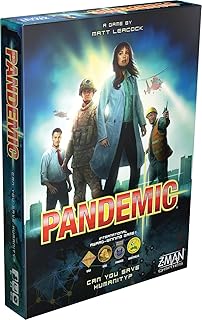 Pandemic Cooperative Strategy Board Game, 2-4 Players, 45-60 Min4.8$44.99Our score 8.1/10
Best for three-player strategy: Splendor
Splendor is our strongest pick for families wanting a fast-playing engine builder, earning 8.8/10 in our review. The listed price is $31.99, with a stated playing time of 30 minutes and a recommended age of 10 and up. Players act as Renaissance merchants, gathering gems, acquiring property, and seeking to please nobility.
Although the box supports two to four players, three is the sweet spot: board churn works particularly well at that count. Four players introduce more downtime, so the maximum capacity should not be the deciding reason to buy it for a regular four-person evening.
The heavy poker-style chips are a particular strength, and the stock plastic insert organizes those chips and unsleeved cards neatly. Sleeved cards do not fit the stock insert, making alternative storage a consideration if you protect your cards. The base game is self-contained, and expansions are entirely optional.
Read the reviews: Asmodee Splendor Gem Trading Strategy Board Game
Best for family teams: Sequence
Sequence is the pick for casual, multigenerational evenings when four or six people want to play in teams. Its straightforward rules are accessible to non-gamers, and the listed $19.97 price makes it a lower-cost choice than Splendor or Azul. Our review score is 7.6/10.
The advertised range is two to 12 players, but that broad capacity is not the same as a recommendation for every count. Our preferred setup is four or six players in teams. The two-player duel tends to run long and lacks tactical tension, so this is not our first choice for a household that usually plays as a pair.
The folding board and chip components are functional rather than a reason to spend more. Our review describes their quality as utilitarian. No expansions are required: the core rules deliver the complete experience. For a buying decision, prioritize its team format and accessibility over the largest number printed on the box.
Read the reviews: SEQUENCE
Best for mixed generations: Rummikub
Rummikub suits families seeking accessible core rules with tactical depth that emerges through play. At a listed $19.70 and a review score of 7.5/10, it is a straightforward option for mixed-generation groups. The supplied minimum age is eight, and the box includes 106 plastic tiles, four racks, and instructions.
It plays reliably across its two-to-four-player range, with three often providing the strategic sweet spot. That makes it worth considering when attendance varies within a small household. Unlike Sequence, whose strongest use here is team play at four or six, Rummikub is our mixed-generation choice for smaller groups.
Storage is the main practical compromise. The factory insert provides little organization for loose tiles, and the plastic racks can feel flimsy under heavy use. An aftermarket pouch is worth considering for easier setup. No expansions are needed, so the listed purchase price buys the complete game rather than the start of an add-on collection.
Read the reviews: Pressman Rummikub
Best for tactical tile drafting: Azul
Azul is our tile-drafting recommendation for families who want tactical decisions at two or three players. It costs a listed $31.99 and earned 8.5/10 in our review. The supplied title gives a two-to-four-player range and a playing time of 30–45 minutes, but our preferred counts are two and three, where tracking the tiles remains calculable.
The resin tiles are a standout component, and setup and breakdown are fast. Those practical strengths matter when choosing something to bring out repeatedly. The flat player boards are less successful: scored tiles can slide out of position if someone bumps the board.
Consider your family's appetite for direct competition before choosing it primarily for two. Our review found that two-player play becomes mean and unforgiving, which may not suit every household. Azul is fully standalone, with no expansions required for its full depth. Choose it for tactical drafting rather than assuming tactile components mean a gentle competitive experience.
Read the reviews: Azul Mosaic Tile
Best for working together: Pandemic
Pandemic is our cooperative pick for families who prefer shared strategy to competing against one another. The listed price is $44.99, and our review score is 8.1/10. It supports two to four players, with a stated playing time of 45–60 minutes. Three players provide the smoothest experience in our review, keeping hand management agile and dominant-player direction more manageable.
That last issue deserves attention: cooperation does not automatically mean equal participation. Pandemic is susceptible to one player directing everyone else's choices. A widely useful table practice is to let each person explain their own decision before others offer advice; check the rulebook for the game's communication rules.
The base game is mechanically complete and has clear modular difficulty settings. Expansions are optional initially, although our review notes that veteran groups will likely want added challenge later. The stock insert does not comfortably accommodate sleeved cards, so factor alternative storage into your decision if you plan to sleeve them.
Read the reviews: Pandemic Cooperative Strategy Board Game
Frequently asked
- What is the best family board game for four to six players?
- Sequence is our choice for four or six people playing in teams. Magical Athlete is another option, with its strongest player count at four to five and a low rules barrier, although its price is unavailable. CATAN's base game supports three to four; five or six requires a separate paid extension.
- Which family board games are suitable for younger children?
- Among the supplied age recommendations, Battleship with Planes is labeled for ages seven and up, while Rummikub and Stratego are labeled eight and up. Splendor and CATAN are recommended for ages 10 and up. Check the specific edition's manual and age guidance, then consider your child's comfort with its rules.
- Do these family board games need expansions?
- Splendor, Sequence, Rummikub, and Azul provide complete experiences without expansions. Pandemic is also mechanically complete, though our review suggests veteran groups may eventually want an expansion for sustained challenge. Player-count extensions are a separate consideration: CATAN requires an additional purchase to move beyond the base game's four-player maximum.
- Should I buy card sleeves or a storage organizer with a family board game?
- Do not assume either is necessary. Splendor's stock insert works neatly with unsleeved components, but it does not support sleeved cards; Pandemic has a similar storage limitation. Rummikub offers minimal loose-tile organization. Check card dimensions and your edition's storage layout before buying accessories, and consult the manual where editions differ.