Best Bread Proofing Basket: Top Bannetons for Sourdough
Discover the best bread proofing basket for artisan boules and batards, comparing natural rattan cane brotforms, fabric liners, and essential shaping accessories.
By the Niche Picks editorsUpdated October 10, 202610 min readDrawn from our 30 research-based bread baking equipment reviews
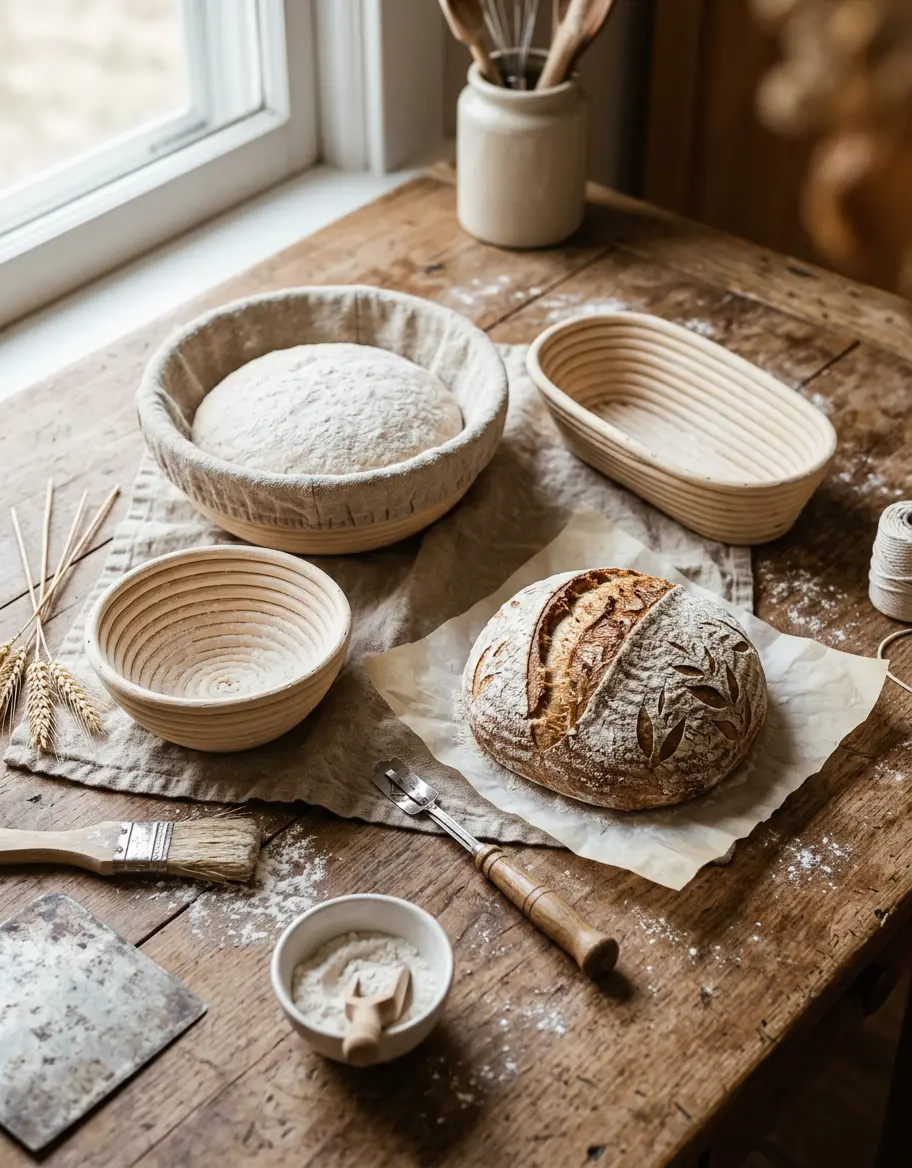
AI-generated editorial illustration; not a product or test photograph.
Short answer
The best bread proofing basket depends on your recipe volume and shaping preference. The Superbaking 9-Inch Round Set of 2 offers the best overall utility for standard two-loaf sourdough bakes, while the Saint Germain Bakery 9-Inch Banneton provides an affordable single-loaf option. For bakers seeking both round boules and oblong batards, the 9-piece Sourdough Proofing Basket Gift Set delivers unmatched shaping versatility.
3
Product listings discussed; not hands-on tests
3/3
Discussed listings with a recorded price
$12.99–$30.99
Recorded listing price range; not a complete setup cost
Key takeaways
Indonesian rattan cane wicks away surface moisture during final fermentation to create a taut skin for crisp crust blisters and clean scoring.
A standard 9-inch round banneton holds up to two pounds of dough, perfectly matching common 5-quart to 7-quart Dutch ovens.
Washable cloth liners prevent high-hydration formulations (above 75%) from catching in raw cane grooves.
Pairing proofing baskets with a reliable 0.1 g scale ensures repeatable starter ratios and consistent loaf volume.
Cane proofing baskets should never be submerged in water or washed with soap; brush them dry and allow full air circulation between uses.
Products discussed in this article
Editorial scores and recorded prices are reference points, not measurements of suitability for every use. Read each review's specifications and limitations.
Sourdough Proofing Basket Gift Set, 9" Round and 10"23.99 USD
Saint Germain Bakery Premium Round Bread Banneton12.99 USD
Bread Proofing Basket Specification Comparison
Product
Price
Baskets Included
Shapes & Sizes
Liner Type
Material
Superbaking 9" Set
$30.99
2 Baskets
Two 9" Round
Fitted Elastic Liners
Indonesian Rattan
EWFEN 9-Piece Set
$23.99
2 Baskets
9" Round & 10" Oval
Tailored Linen Liners
Indonesian Rattan
Saint Germain 9" Banneton
$12.99
1 Basket
One 9" Round
Cotton-Linen Cover
Vietnamese Rattan
Why Does a Dedicated Proofing Basket Matter for Sourdough?
A bread proofing basket—traditionally referred to as a banneton or brotform—serves a distinct mechanical purpose during the secondary fermentation phase of artisan bread baking. While bulk fermentation develops gluten and internal aeration, the final bench rest requires structural support. Without a dedicated vessel, high-hydration sourdough doughs tend to pool outward, flattening across the work surface and losing tension before they hit the heat.
Coil-wound natural rattan acts as a rigid corset for fermenting dough. The porous cane breathes continuously, subtly wicking surface moisture away from the dough skin while holding the loaf in a vertical posture. This slight dehydration of the outer layer creates a delicate, non-sticky membrane. When the baker flips the dough out of the basket onto a baking peel or parchment sling, this taut skin supports intricate decorative blade cuts that bloom cleanly rather than snagging. Additionally, the bare cane ribs impart the iconic concentric spiral flour rings associated with rustic European hearth loaves.
While glass bowls lined with tea towels can function as rudimentary substitutes, they lack the calibrated breathability and moisture transfer of raw cane. Trapped condensation in non-porous bowls can cause dough surfaces to turn gummy, leading to tearing upon release. Investing in purpose-built equipment from our Bread baking equipment buyer's guide establishes the foundation for consistent oven spring, especially when baking inside enclosed vessels like the covered pots discussed in our guide to the best Dutch ovens and tools for bread. Exploring our broader bread baking equipment reviews will help you pair the right shaping forms with your oven setup.
Best Overall: Superbaking 9" Round Sourdough Banneton (Set of 2)
For bakers routinely handling standard two-loaf formulas, the Superbaking 9-Inch Round Banneton Set of 2 provides dependable craftsmanship and practical value. Retailing at $30.99, this matched pair is constructed from premium Indonesian rattan cane held securely with recessed staples. Concealed joinery is an important engineering detail in cane ware, as exposed wire staples can easily scratch hands or snag moist dough during high-speed loading.
Each 9-inch circular form accommodates standard 500-gram to 1,000-gram dough charges. The coil-wound cane breathes effectively, drawing out surface humidity to create the dry, manageable skin required for clean scoring. For recipes exceeding 75 percent hydration, the package includes two elastic-rimmed cloth liners. Unlike loose fabric squares that can wrinkle and leave irregular indentations on the loaf face, these fitted covers wrap securely over the outer rim to present a smooth, taut proofing bed.
Logistically, purchasing two identical baskets eliminates the operational bottleneck of sequential proofing. Standard artisan recipes typically yield two boules from a single mixing cycle; having matched forms allows both loaves to ferment concurrently in the refrigerator during an overnight cold retard. With an aggregate rating of 4.7 out of 5 stars across more than 7,500 reviews, this set delivers proven consistency. The forms nest neatly during storage, and the included manual and digital app integration provide accessible scheduling support for beginner and intermediate bakers alike.
Best Shape Versatility: Sourdough Proofing Basket Set with Round and Oval Bannetons
Artisan baking involves more than just round boules; oblong loaves, known as batards, offer practical advantages for uniform sandwich slicing and oval baking roasters. The Sourdough Proofing Basket Set (BPB-001) addresses this need directly by bundling a 9-inch round banneton (measuring 9 by 9 by 3 inches) and a 10-inch oval banneton (measuring 10 by 5.7 by 3.5 inches) for a listed price of $23.99.
Both baskets are constructed from coiled Indonesian rattan cane joined with sturdy metal staples. Each form is rated to support dough weights up to two pounds, granting ample volume for rustic whole-grain or white sourdough formulations. The unfinished cane ribs wick ambient moisture away from the loaf exterior, promoting the traditional spiral flour rings and exterior skin tension that hearth bakers expect. When dealing with sticky, enriched doughs or elevated water content, the two included tailored linen liners can be installed to ensure an effortless, tear-free demolding process.
Beyond the dual baskets, this 9-piece kit includes a curved bread lame fitted with five replacement razor blades, a rigid bench scraper, a flexible plastic bowl scraper, a wire Danish dough whisk, and a stiff cleaning brush. While these bundled accessories represent basic entry-level hardware, securing all essential handling tools in a single purchase minimizes upfront outlay. Backed by a 4.6-star consumer rating across more than 1,800 evaluations, this set provides an economical path to mastering both boule and batard shaping techniques simultaneously.
Best Budget Single Loaf: Saint Germain Bakery 9" Premium Round Banneton
Bakers who prefer producing one loaf at a time or who want to add an extra vessel to their existing collection without buying redundant accessories will appreciate the Saint Germain Bakery 9-Inch Banneton. Priced at an accessible $12.99, this individual brotform focuses strictly on quality materials rather than inflated tool bundles.
Manufactured from natural, unbleached Vietnamese rattan cane, the basket features a traditional spiral coil structure assembled without synthetic lacquers or chemical coatings. At nine inches across, the interior depth and diameter are optimized for standard round boules, fitting cleanly into the 5-quart and 6-quart Dutch ovens favored by domestic hearth bakers. When dusted thoroughly with rice flour, the raw cane holds dusting powder within its ridges, producing sharp contrast rings across the dark caramelized crust of the baked loaf.
For higher-hydration doughs that tend to wedge into cane seams, the basket includes an elasticated cotton-linen blend liner. This breathable fabric layer prevents sticking while maintaining the vertical contour of the fermenting loaf. Holding an average rating of 4.6 out of 5 stars across nearly 4,000 user reviews, the Saint Germain brotform demonstrates exceptional manufacturing consistency. Skipping low-grade plastic scrapers or cheap lames keeps the price low while providing a durable, dedicated fermentation vessel that can last for years with proper dry maintenance.
How to Size and Shape: Boule vs. Batard Proofing Forms
Choosing between a circular banneton and an oval brotform depends entirely on your slicing preferences, baking vessels, and formula scale. A 9-inch round basket produces a classic boule—a spherical loaf characterized by even radial expansion during the bake. Boules are exceptionally forgiving during the shaping process and nestle symmetrically into standard round Dutch ovens, such as the cookware analyzed in our guide on what size Dutch oven do you need for sourdough.
Conversely, an oval basket—typically measuring 10 inches in length—produces an elongated batard. Batards are widely favored for table loaves because they yield consistent, evenly proportioned slices from end to end, making them ideal for sandwiches and toast. However, batards require careful consideration of oven geometry: an oblong loaf can touch the curved sidewalls of a standard round Dutch oven, pinching dough expansion at the tips. If you prefer baking batards, ensure your covered baker features an oval base or generous interior floor space.
Weight capacity is another critical baseline. Standard 9-inch round and 10-inch oval baskets are rated to comfortably support 500-gram to 900-gram dough portions (roughly 1 to 2 pounds). Overfilling a proofing basket causes dough to spill past the rim during fermentation, creating an uneven lip that deforms upon release. Underfilling leaves the loaf sitting deep within the coils, increasing the drop distance when turning it out. Accurately tracking dough mass with equipment like the Etekcity 0.1g Food Kitchen Scale ensures your scaled portions fill the brotform precisely.
Liners vs. Bare Cane: Preventing Sticking on High-Hydration Loaves
A recurring debate among artisan bread bakers centers on whether to proof dough against bare cane or use an elasticated fabric liner. Both methods offer distinct physical benefits depending on dough hydration and desired crust aesthetics. Bare cane allows the raw rattan ribs to impress classic flour spirals into the loaf, while simultaneously absorbing moisture directly from the dough surface to encourage blistered crust development. However, high-hydration sourdough formulas—particularly those exceeding 75 to 80 percent water content—can flow into the microscopic crevices between coils and stick stubbornly if flouring is uneven.
To use bare cane without disaster, seasoned bakers rely on white rice flour rather than standard wheat flour. Rice flour is gluten-free and does not absorb water at the same rate as wheat flour, remaining dry and powdery even against wet dough surfaces. Dusting the raw coils liberally creates an effective physical barrier that allows chilled dough to release cleanly onto the baking peel.
When working with exceptionally sticky doughs, ancient whole-grain grains, or sweet enriched doughs, utilizing the included linen or cotton-linen liners provides a foolproof release mechanism. The fabric provides a smooth, continuous barrier that eliminates the risk of tear-outs while allowing the dough to breathe. Fabric liners also simplify routine maintenance, as they can be slipped off the basket rim and hand-washed separately, protecting the raw rattan from moisture accumulation.
Essential Maintenance: How to Clean, Dry, and Store Cane Bannetons
Proper post-bake maintenance is essential for extending the working lifespan of natural rattan proofing baskets and avoiding mold colonization. The cardinal rule of banneton care is simple: never submerge a cane basket in water, and never apply dish soap. Rattan cane is an organic, porous material; washing it like standard cookware saturates the wood fiber, causing the coils to swell, distort, and potentially trap fungal spores within the seams.
After turning your dough out for baking, immediately knock the basket upside down over a sink or trash bin to dislodge loose flour. If the cane feels slightly damp from dough transpiration, place the basket in a warm, well-ventilated spot to dry thoroughly. Many bakers utilize the gentle residual heat of a recently turned-off oven (ensuring the temperature is well below 200°F) to desiccate the cane completely before storage. To review common workflow pitfalls in home baking setups, refer to our breakdown of mistakes to avoid in bread baking.
Once the basket is fully dry, take a dedicated stiff-bristled brush—such as the brush included in the EWFEN BPB-001 proofing set—and sweep along the direction of the cane spirals to sweep away dried flour crusts. Store your cleaned bannetons in a dry, open pantry or wire shelf. Avoid sealing them inside airtight plastic containers or damp cabinets where trapped ambient humidity can invite mold growth. If mold does ever appear, brush it away aggressively and place the dry form in a 250°F oven for 30 minutes to sterilize the cane.
Verify your typical loaf shape preference (round boule vs. oblong batard) before choosing a form.
Measure your baking vessel's interior floor diameter to ensure the proofed loaf will fit without touching sidewalls.
Inspect raw cane coils for recessed staples and smooth finishes without sharp, exposed hardware.
Ensure the basket capacity matches your standard recipe scale (typically 500g to 900g of dough).
Acquire white rice flour for initial seasoning and routine non-stick basket dusting.
Check that included fabric liners feature elastic rims to prevent slippage during dough loading.
Plan a dry, well-ventilated storage space where clean bannetons can dry completely after each use.
Frequently asked questions
Can I bake my bread directly inside a rattan proofing basket?
No. Bannetons are strictly designed for proofing and shaping dough during fermentation. Natural rattan cane and fabric liners are combustible materials that will burn or catch fire if exposed to oven baking temperatures. Always invert the proofed dough onto parchment paper, a baking peel, or into a preheated baking vessel before loading it into your oven.
How do I season a new rattan banneton before its first use?
To season a raw rattan basket, lightly mist the inside coils with clean water from a spray bottle, then dust the interior thoroughly with white rice flour. Tilt and tap the basket to coat all grooves evenly, then tip out the excess. Allow the basket to dry completely before loading dough. This builds an initial non-stick patina.
What is the benefit of a round banneton versus an oval banneton?
A round banneton shapes spherical boules, which expand uniformly in round Dutch ovens and require straightforward circular shaping. An oval banneton produces oblong batards, which provide uniform cross-sectional slices that fit standard toasters and sandwich bread needs. However, batards require oval-shaped roasters or baking stones to prevent pinched loaf tips.
Do I need to wash the fabric liner after every single bake?
Not necessarily. If the liner remains dry and releases cleanly, simply shake off excess flour and air-dry it completely between uses. If high-hydration dough leaves sticky residue or wet spots on the fabric, wash the liner by hand with warm water, avoid scented detergents, and air-dry thoroughly before reinstalling it onto the basket.
Why is my sourdough sticking to the proofing basket?
Dough sticks to cane when the basket lacks sufficient dusting flour, when standard wheat flour absorbs water and forms gluten bonds with the coils, or when dough hydration exceeds 75% without adequate surface tension. Using white rice flour and chilling your shaped loaf in the refrigerator before turning it out dramatically reduces sticking.
Amazon links are affiliate links; we may earn a commission at no cost to you.
Sources and limits
This page summarizes our research reviews of Amazon listings, listed specifications and captured buyer ratings. It is not a hands-on test. Scores are editorial assessments, not measured performance; prices are recorded snapshots and may change. A category can include both main products and accessories, so its overall price range is not the cost of a complete setup.
Most recent product record update: September 15, 2026. Individual records may be older; this is not a verification date for every claim.
Choose the product type first. These groups require a match in the listing title; an import search term alone is not enough. Scores rank our recorded research assessments within each group, not independently measured performance.
Check the manufacturer's dough capacity and duty-cycle guidance; bowl-lift versus tilt-head design alone does not establish capability.
For a covered baking vessel, compare heat retention, lid fit and safe oven temperature; loaf results also depend on dough and baking technique.
A 0.1 g scale makes starter ratios repeatable.
If a specification, certification or compatibility detail is absent, mark it as unknown and ask the seller or manufacturer. Do not substitute a star rating, an editorial score or a different model's specification.


 Superbaking Sourdough Banneton Bread Proofing Basket, 9" Round, Set of 2