Design and build quality
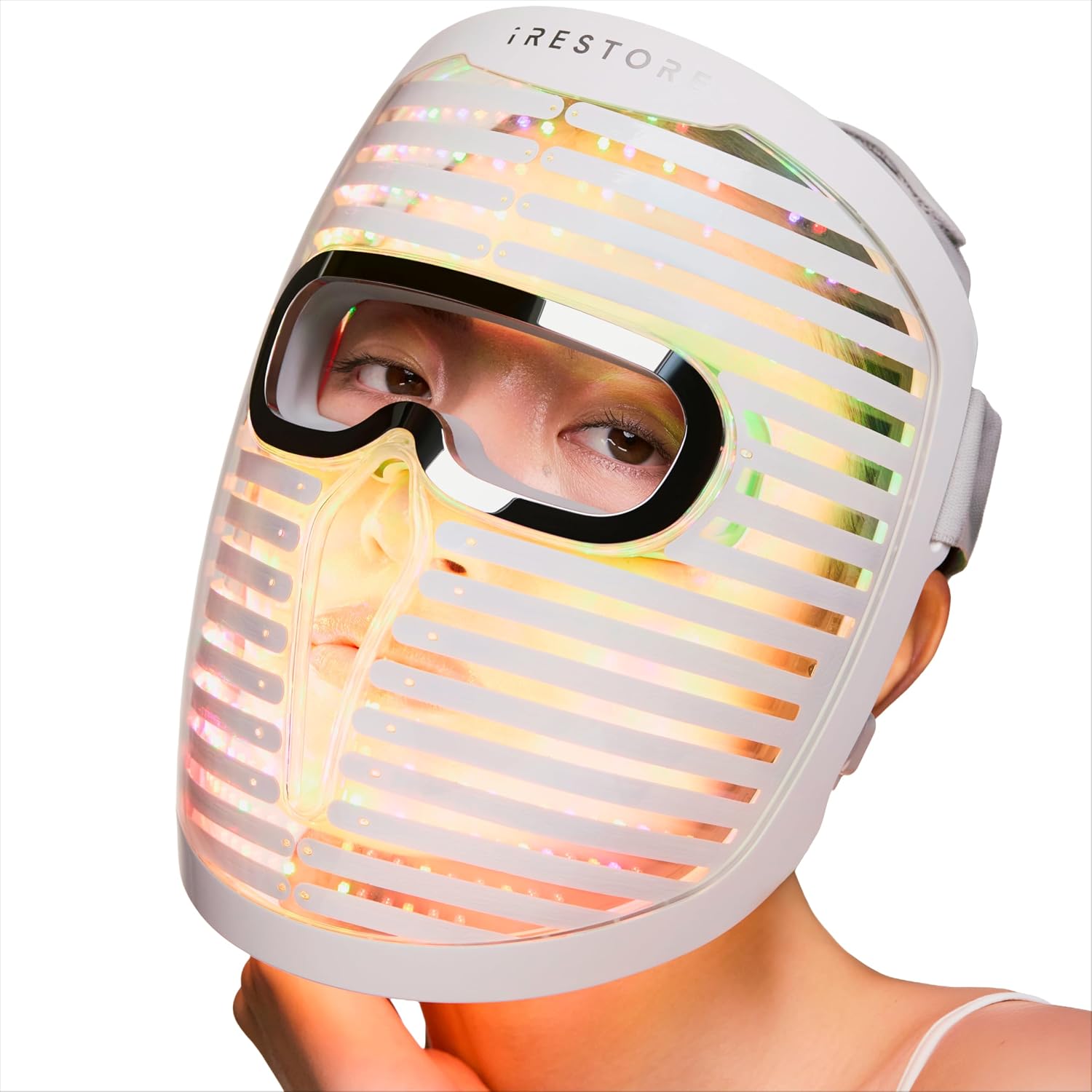
The iRestore Face Mask Pro presents a rigid-style white chassis secured by a standard head strap, weighing approximately 2.49 pounds in its packaged retail configuration. Internally, the surface houses 800 individual points of light, partitioned into 650 standard light-emitting diodes and 150 proprietary VIXO emitters designed to minimize dark areas across the facial geometry. Build construction incorporates dedicated silicone eye guards intended to shield the user from direct optical exposure during high-output sessions. The fit relies on the rear strap tensioning system to balance the perimeter weight against the forehead and mid-face. While the hardware feels structurally sound and avoids flimsy components, buyers must account for the solid form factor, which adapts less fluidly to atypical facial contours than flexible medical-grade silicone sheets. Cable management and control interfaces connect cleanly, supporting routine use without delicate mechanical points of failure.
Real-world performance and dosimetry
Therapeutic photobiomodulation relies strictly on energy density, which requires both precise wavelengths and verified irradiance measured in milliwatts per square centimeter. iRestore lists eight active wavelengths across the 415nm to 1072nm band, notably incorporating blue light at 415nm alongside amber, green, standard red, and deep near-infrared at 1072nm. Five pre-set modes adjust these light arrays automatically based on target application. However, the manufacturer omits published irradiance metrics and exact per-mode session durations in the primary specifications. While user feedback remains generally positive at a 4.5 out of 5 average rating, calculating the cumulative biological dose remains impossible without laboratory measurement of irradiance. Buyers seeking precise clinical Joules-per-square-centimeter delivery must note that diode count alone does not guarantee high optical output power, making independent bench testing necessary to substantiate long-term efficacy claims.
Value for money and running costs
At an investment of $799.00, the iRestore Face Mask Pro sits squarely within the upper tier of personal skincare light therapy. The pricing model does possess one distinct advantage regarding ongoing ownership expenses: it functions as a dry-contact system. Unlike microcurrent or radiofrequency devices, it requires no conductive primers, topical serums, or periodic replacement head cartridges to maintain basic operation. The initial purchase price covers the complete operational life cycle, assuming battery longevity and diode stability persist. Nevertheless, $799 is a substantial capital outlay for a device that withholds certified power output data. Competing clinical panels and cleared masks occasionally offer lower diode densities while delivering fully documented optical irradiance. The financial value here hinges entirely on whether the multi-wavelength versatility and diode volume justify the cost in the absence of verified laboratory output metrics.
Who should skip it
Consumers demanding strictly verifiable clinical standards should exercise caution before purchasing this model. If your buying protocol requires documented FDA 510(k) clearance or published irradiance figures to calculate exact photobiomodulation dosing, the documentation provided here will fall short of expectations. Individuals who only require evidence-backed 633nm red and 830nm near-infrared wavelengths for collagen maintenance can find simpler, single-spectrum or dual-spectrum devices for substantially less money without paying for secondary green or amber emitters. Furthermore, individuals with sensitive facial pressure points or atypical bridge shapes may find rigid masks uncomfortable relative to soft silicone alternatives. Anyone seeking quick, verifiable output data or operating on a modest personal hardware budget should consider fully documented lower-tier alternatives before allocating $799.00 to this multi-wavelength unit.