Design and build
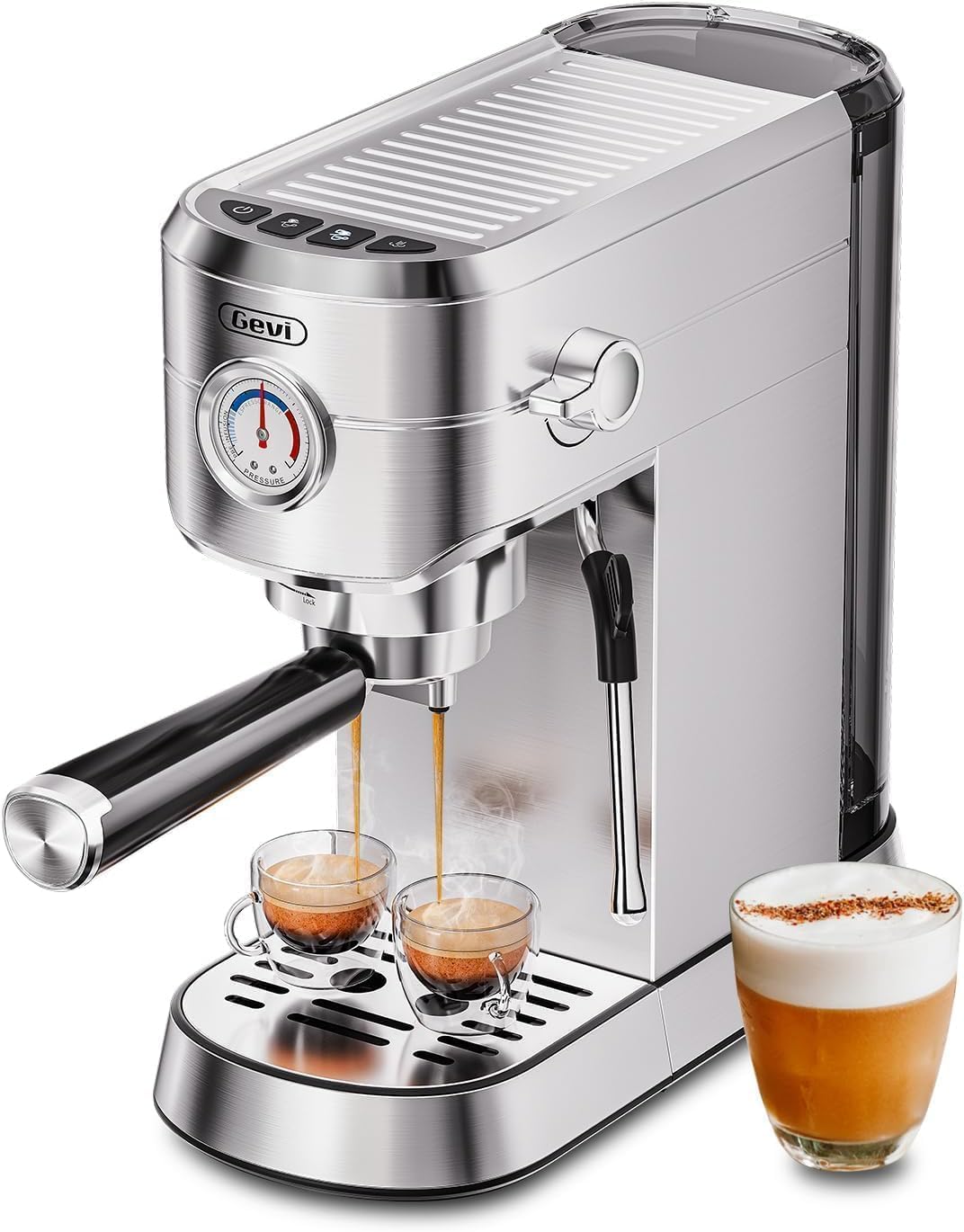
The Gevi compact espresso machine measures 5.5 inches wide, 12.3 inches deep, and 12 inches high, making it one of the slimmest semi-automatic options in the entry-level bracket. Weighing 8.6 pounds, the chassis uses stainless steel sheet metal wrapped over an internal frame. While the exterior delivers a neat presentation, the light overall weight means users must hold the unit steady when locking or unlocking the portafilter into the group head. The top surface functions as a passive cup warmer, heated indirectly by internal components. Fluid is drawn from a 1-liter removable rear reservoir that is accessible for filling and cleaning, though clearance above the machine should be checked if placing it beneath low kitchen cabinetry. User interaction relies on a simple front-mounted push-button array alongside an analog pressure gauge. The mechanical gauge provides immediate visual feedback during extraction, though the internal componentry remains characteristic of budget appliance manufacturing rather than commercial brass group standards.
Real-world performance
Marketing literature highlights a 20-bar pump, but experienced brewers understand that actual espresso extraction peaks around 9 bars. Without an adjustable over-pressure valve, the pump forces water through the coffee bed at elevated pressures, increasing the risk of channeling unless using pressurized baskets. Gevi integrates an initial pre-infusion phase to mitigate puck disruption, which dampens the grounds prior to full pressure ramp-up. Temperature regulation relies on a 1350-watt heating element managed by an NTC sensor. While the system reaches operating temperature quickly, the low thermal mass of the group head causes temperature drift across successive shots. Pulling a blank shot beforehand is essential to saturate the metal pathways. For milk texturing, the steam wand incorporates a slip-on frothing sheath intended for dense foam. Removing the nozzle allows conventional milk rolling, but steam power remains bounded by single-heater limitations, demanding a short recovery interval between brewing espresso and steaming milk.
Value for money
Listed at $126.99, the Gevi undercuts established entry-level benchmarks while offering convenience features like pre-infusion and an analog pressure readout. An aggregate rating of 4.3 out of 5 across 3,780 customer reviews suggests consistent user satisfaction within its intended consumer segment. However, evaluating true value requires considering the complete setup. Espresso fundamentals dictate spending roughly the same amount on a grinder as on the machine itself. Pairing this unit with a capable $100 to $130 conical burr grinder ensures the machine receives grounds fine enough to resist the pump pressure properly. The 12-month warranty provides baseline consumer protection, though long-term serviceability is constrained by proprietary internal parts and lightweight plastic fittings typical of this price class. For budget-conscious drinkers moving away from pod machines, the initial outlay delivers functional espresso preparation, provided expectations regarding component durability and thermal precision remain grounded.
Who should skip it
Enthusiasts seeking precise extraction control and traditional 58mm group architecture should bypass this machine. The absence of a calibrated over-pressure valve set to 9 bars prevents proper dial-in with unpressurized commercial baskets, as the 20-bar pump easily fractures sensitive coffee pucks. Drinkers who prioritize rapid multi-cup preparation will find the single heating system and 1-liter tank restrictive, given the required recovery time between brewing and steaming. Furthermore, buyers unwilling to invest in a dedicated, espresso-capable burr grinder should skip semi-automatic units entirely; pre-ground supermarket coffee cannot fully utilize the machine's pressure dynamics, even with pressurized portafilters. Those who require true dry microfoam for complex latte art will struggle with the steam wand geometry, which prioritizes aeration over micro-texture. Serious home baristas are better served by investing in heavier machines with larger boilers, standard group dimensions, and PID-controlled temperature systems.