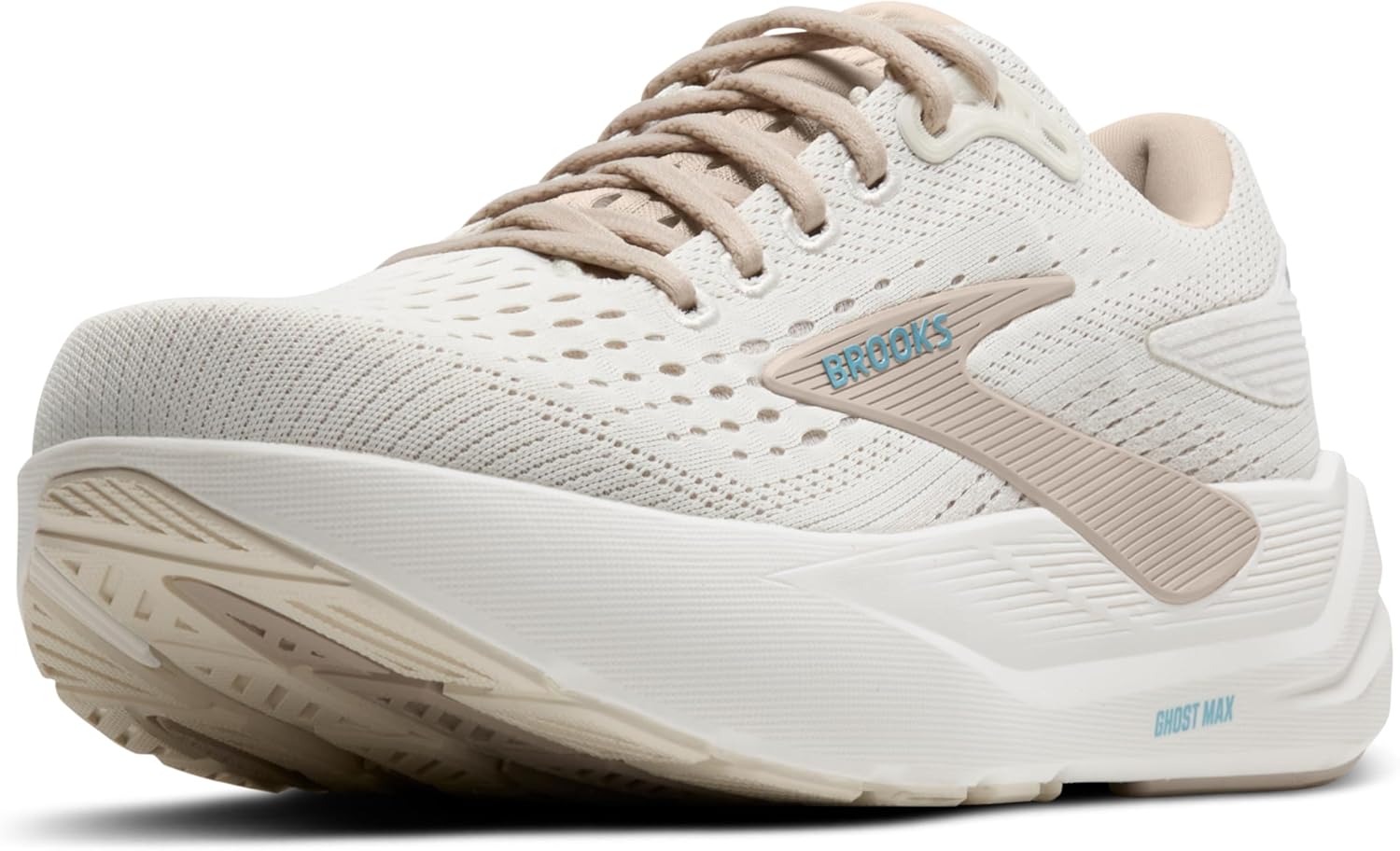
Design and build
The technical profile for this model is constrained by an absence of published manufacturer specifications. The retail entry confirms a comprehensive women's sizing array spanning US 5 through US 12.5 with half sizes throughout, which accommodates precise sizing demands. However, core engineering details remain unstated. In footwear assessment, midsole geometry directly governs lower-leg mechanics, meaning stack height and drop dictate impact absorption far more reliably than branded compound names. The 'Ghost Max' moniker historically indicates a high-stack platform with an integrated rocker design meant to offload forefoot pressure and stabilize transitions, yet the exact millimeters of foam under the heel and forefoot are not confirmed on this sheet. Without verified metrics for midsole composition, outsole rubber coverage, or upper textile density, runners must approach the shoe as an unverified platform until physical measurements confirm its actual offset and construction integrity.
Real-world performance
With an aggregate rating of 4.3 out of 5 across 3,377 entries, the model demonstrates broadly dependable real-world endurance across a significant runner population. In daily use, a maximal daily shoe typically serves as a recovery and base-mileage tool, designed to dampen road chatter through high-volume foam. Runners incorporating this shoe into a structured program must adhere to basic recovery principles: rotating two pairs of shoes is essential, as EVA and standard compound midsoles require roughly twenty-four hours to fully decompress and recover their native elasticity between sessions. While the aggregate rating suggests user satisfaction with general comfort and fit, performance outcomes will diverge based on unknown geometric factors. If the drop is low, such as four to six millimeters, mechanical load will shift toward the Achilles tendon; if higher, impact moves up to the knee.
Value for money
Listed at $94.95, the Ghost Max 3 occupies an unusually low price bracket for contemporary maximalist footwear. Modern high-stack road trainers typically command pricing between one hundred forty and one hundred eighty dollars, making this offering economically distinct. For sub-hundred-dollar expenditure, the buyer gains access to a platform verified by several thousand users, offsetting some of the risk introduced by the absent technical data sheet. If the foam longevity matches standard road iterations, the cost-per-mile metric will prove favorable for high-volume runners needing a disposable or secondary mileage accumulator. The primary compromise remains informational rather than monetary: you receive a substantial footwear package at a direct discount, but you bear the burden of measuring or testing the shoe's biomechanical parameters yourself to ensure it matches your gait requirements.
Who should skip it
Athletes seeking precise, quantifiable training tools should bypass this listing until full manufacturer documentation becomes available. If you have specific injury considerations—such as plantarfaciitis requiring a verified ten-millimeter drop, or metatarsalgia demanding a confirmed forefoot rocker profile—purchasing a shoe with undisclosed stack dimensions is inadvisable. Furthermore, runners looking for a lightweight tempo shoe or a track-ready platform will find maximal trainers too decoupled from the ground and structurally overbuilt for fast cadences. Finally, individuals who do not maintain a training rotation and run every single day in a solitary pair will likely compact the unrated midsole foam prematurely, negating the protective cushioning qualities before reaching standard lifespan thresholds.