Design and build
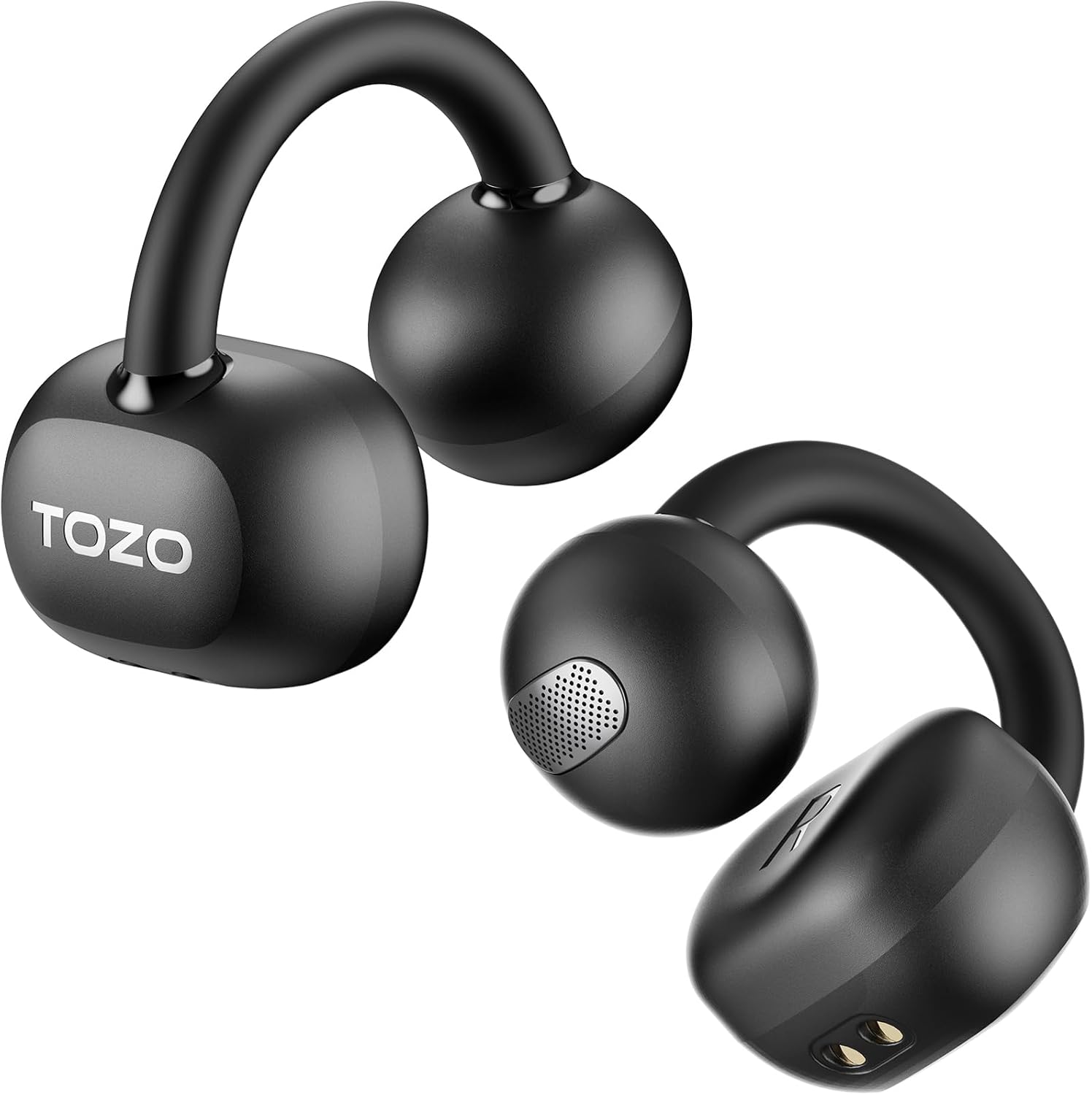
Weighing 5.1 grams per earpiece, the TOZO OpenEarRing utilizes a mechanical clip-on architecture coated in skin-friendly silicone. Unlike traditional in-ear monitors that seal the canal, this open design leaves the ear opening unobstructed, facilitating ambient awareness during outdoor movement. The tensioned clip sits adjacent to the ear cartilage, positioned specifically to prevent interference with sunglasses or prescription eyewear frames. Construction integrity is reinforced by an IPX5 water-resistance rating, meaning the internal components and nano-coatings are protected against low-pressure water streams and sweat. The included charging case features a hard-shell exterior and an integrated digital readout indicating remaining power reserves, charged via an included USB-C cable. While the silicone exterior mitigates skin irritation over prolonged sessions, potential purchasers with unusually thick or thin outer ear anatomy should verify clamping pressure, as clip ergonomics do not permit mechanical adjustment beyond the resilience of the base material.
Real-world performance
Audio performance relies on TOZO's proprietary OrigX driver arrangement paired with Bluetooth 5.4 transmission. The wireless protocol maintains connection integrity up to an advertised 15 to 20 meters, reducing packet dropouts when paired with a pocketed phone or sports tracker. Because open-ear acoustics project sound from outside the canal, low-frequency bass impact is naturally attenuated compared to sealed earbuds. TOZO counters this limitation through the companion mobile application, which offers 32 equalizer presets to emphasize vocal clarity or acoustic detail. Control inputs are managed via tactile physical buttons rather than capacitive touch sensors, an intentional design choice that prevents misfires from dripping sweat or rain during running. Battery endurance stands at a manufacturer-rated 10 hours per charge, supplemented by 30 hours from the charging case for 40 hours total. In real-world outdoor sessions, higher volume levels will likely reduce these figures, requiring empirical verification in loud traffic conditions.
Value for money
Priced at $26.98, the TOZO OpenEarRing occupies the budget tier of sports-oriented audio hardware. With an aggregate rating of 4.3 out of 5 stars across 45,769 consumer evaluations, the product demonstrates consistent mass-market reliability. For runners seeking baseline situational awareness without investing in high-priced bone-conduction equipment, this clip-on configuration delivers practical operational features. The inclusion of modern Bluetooth 5.4, a clear digital battery percentage indicator, and a standard USB-C charging interface represents substantial utility at this specific price floor. Cost-cutting measures appear primarily in the acoustic architecture; dynamic drivers firing into open air cannot replicate the fidelity of premium micro-drivers. Nonetheless, for training sessions where environmental alertness outweighs critical studio listening, the hardware provides an accessible entry point that resists perspiration and integrates seamlessly with workout schedules without demanding a significant financial outlay.
Who should skip it
Certain runners and audio enthusiasts should seek alternative designs. Those training in noisy indoor fitness facilities or traveling on mass transit should bypass this model, as the open-ear design provides zero passive isolation or active noise cancellation, allowing gym sound systems to drown out audio. Similarly, listeners who prioritize sub-bass response, punchy low-end transients, or critical audio playback will find open-air projection acoustically thin. Athletes who participate in aggressive contact sports or high-impact technical trail running should also proceed with caution; although the 5.1-gram clip holds adequately during road jogging, extreme head movements or snagging against branches can dislodge a clip-on unit more readily than a wrap-around neckband. Finally, buyers needing high-definition audio codecs such as LDAC or aptX Adaptive should look elsewhere, as the manufacturer specifies only standard Bluetooth protocols within the provided technical literature.