Design and build
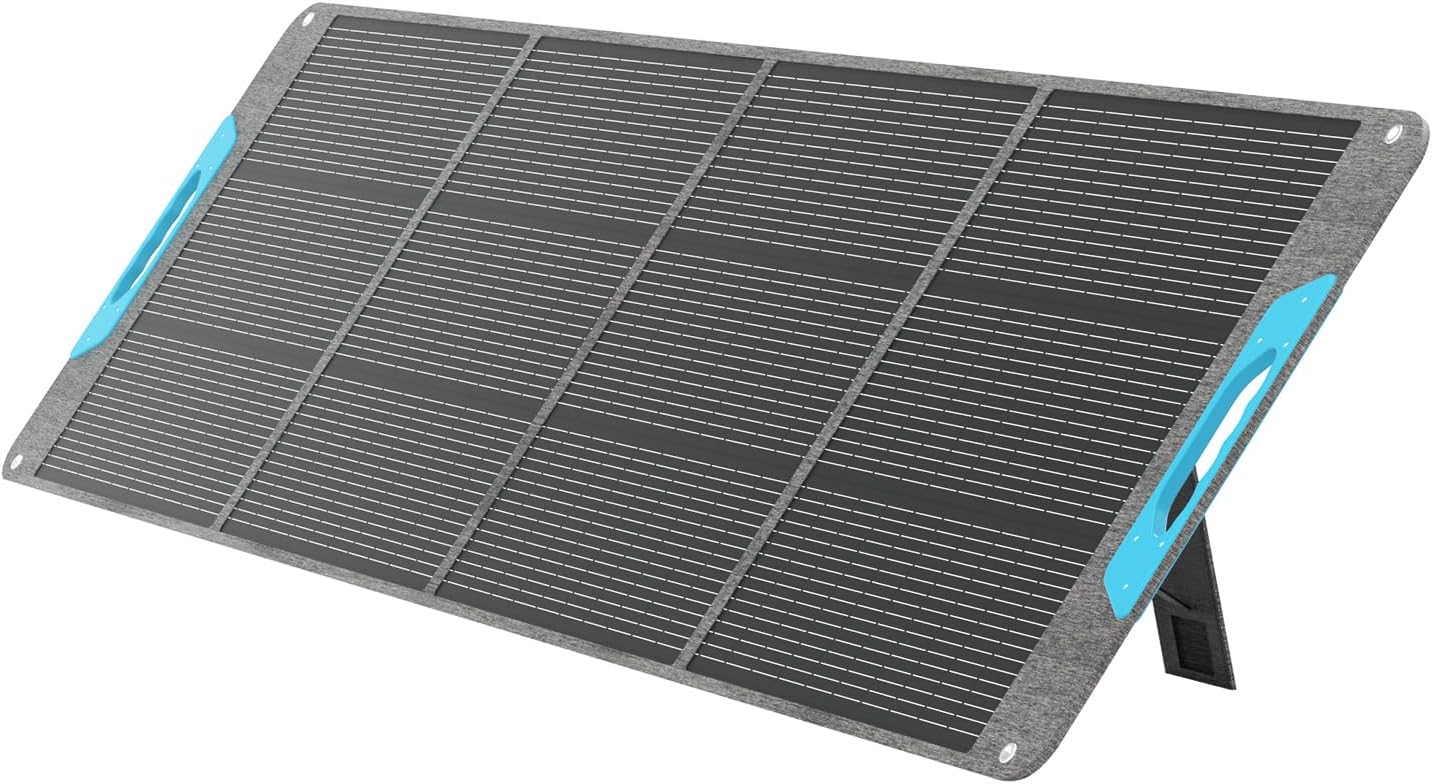
The Renogy E.Flex 200W (RPP200EF-SE) adopts a four-panel folding structure that packs down to 23.72 by 22.99 by 1.97 inches. At 13.9 pounds, it avoids the excessive mass common to earlier generation portable panels, making vehicle packing straightforward. Renogy employs a magnetic closure system rather than standard hook-and-loop fasteners or plastic buckles, which reduces mechanical wear during transit. The panel uses N-type monocrystalline silicon cells configured in a 16-busbar array, encased in a durable laminate fabric. Support is handled by four integrated kickstands that provide tilt adjustments at 40, 50, and 60 degrees. These angles help maintain direct orientation toward the sun as seasons change. For vehicle or ground anchoring, reinforced perimeter grommets accommodate tie-downs or mounting hardware. Build standards meet UL 61730 safety requirements, and the chassis carries an IP65 rating for protection against dust and splashing water. It feels sufficiently rigid when deployed, though windy conditions will require weighting down the kickstand supports.
Real-world performance
Rated at 200 watts with an operational voltage of 21.6 volts and 11.3 amps, the panel is engineered around N-type cells boasting 25 percent laboratory efficiency. In field conditions, solar panels rarely achieve their nameplate capacity due to thermal derating, cable resistance, and atmospheric filtering. Users should realistically anticipate 150 to 170 watts under clear midday skies when properly oriented. The 21.6-volt ceiling makes it compatible with standard portable power station MPPT inputs, though users must confirm their station can accept at least 11.3 amps. If connected to modern LiFePO4 power stations, it provides steady input for daily replenishment. A useful feature is the onboard junction box, which supplies a 45-watt USB-C Power Delivery port alongside two USB-A ports (18W and 15W). This enables charging mobile electronics directly from the panel without running an intermediary battery station, although concurrent use divides the total harvested wattage among active connected loads.
Value for money
Listed at $219.99, this unit prices out to roughly $1.10 per rated watt, positioning it competitively within the portable folding panel segment. Premium brand alternatives often demand $1.50 to $2.00 per watt for comparable wattage ratings, frequently without delivering superior cell efficiency or direct USB charging circuitry. The 25 percent cell efficiency rating means smaller physical surface area per watt compared to older 9-busbar monocrystalline designs, saving cargo space in overland setups. Renogy backs the unit with a standard two-year material and workmanship warranty, consistent with entry to mid-tier solar equipment. Its 4.5 out of 5 rating across 940 consumer reviews reflects reliable general adoption and consistent manufacturing tolerances. While accessory adapter cables to connect specific proprietary power station ports must generally be sourced separately, the baseline price-to-performance ratio remains strong for mobile off-grid users needing a self-contained 200-watt charging array.
Who should skip it
Buyers seeking permanent, year-round exterior setups for RV roofs or off-grid cabins should skip this model. The fabric backing and IP65 enclosure are built for temporary mobile deployments, not continuous exposure to multi-year weathering, where rigid glass-and-aluminum panels are mandatory. Similarly, users managing high-capacity home backup systems requiring 800 to 1,200 watts of solar input should avoid assembling multiple quadfold portables. Managing separate kickstands, cables, and junction points across three or four portable panels creates unnecessary clutter and friction compared to larger stationary arrays. Additionally, verify your power station's direct-current input parameters before purchase. Stations with low solar input current caps—such as those restricted to 8 amps maximum—will bottleneck this panel's 11.3-amp output, leaving available wattage unused. Finally, those strictly needing extreme submersion resistance should look toward IP67 or IP68 rated alternatives designed for marine deck environments.