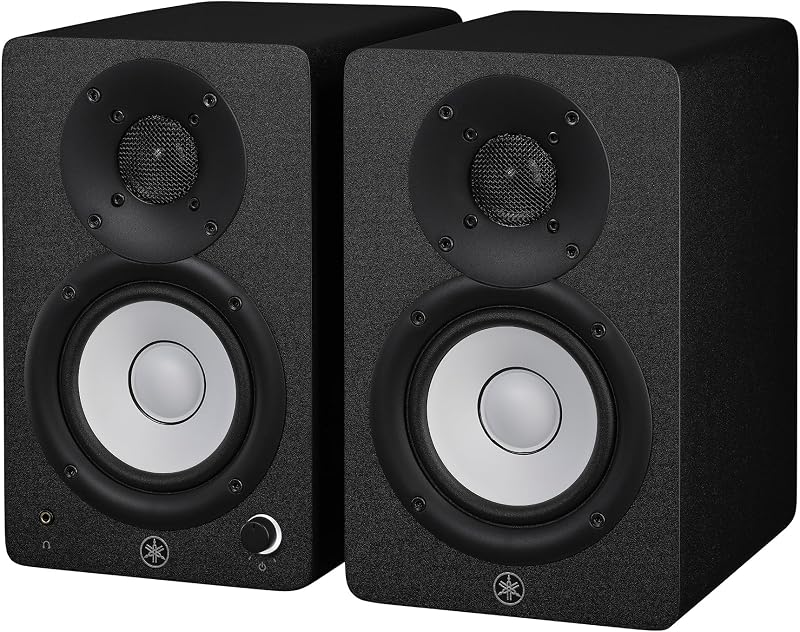
Design and build
The Yamaha HS4 adopts the aesthetic profile of the broader HS series, scaled down to accommodate space-constrained mixing stations. Each monitor pairs a 4.5-inch (11.43-centimeter) cone woofer with a 1-inch dome tweeter in a bass-reflex tabletop enclosure. The retail listing notes stainless steel construction, though buyers should verify whether this refers to internal shielding or external cabinetry, as studio monitors in this class standardly employ engineered wood composite. The active-passive configuration houses the amplification hardware and primary input array on one speaker, linking to the secondary unit via bundled speaker wire. Input provisions are practical, supplying balanced combo XLR/TRS jacks, unbalanced stereo RCA terminals, and a 3.5-millimeter stereo mini-jack. A front-panel volume dial and power switch offer immediate control, while included anti-slip isolation pads provide base decoupling from resonant workstation surfaces.
Real-world performance
Acoustically, the HS4 delivers a frequency response rated from 60 Hz to 22 kHz at a -10 dB tolerance. This envelope provides clean mid-range articulation for dialogue editing and vocal arrangement, but the steep low-end roll-off limits its utility for evaluating kick drums and sub-bass fundamentals. The internal amplifier delivers 26 watts per channel, which generates adequate sound pressure for meter-distance monitoring without introducing premature port turbulence, provided output remains moderate. Critically, studio monitors cannot bypass the laws of physics or boundary loading; our core rule dictates treating the room before upgrading monitors. To aid suboptimal spaces, Yamaha includes rear-panel Room Control and High Trim equalization switches. Room Control attenuates unnatural low-end accumulation caused by placing monitors against rear boundaries or in corners, assisting in flattening the perceived acoustic profile across untreated desktop perimeters.
Value for money
Priced at $249.99 for the stereo pair, the HS4 sits comfortably between consumer computer speakers and costlier dedicated nearfield monitors. The package includes essential cabling—specifically a 3.5-millimeter to RCA lead and passive speaker interconnect—reducing hidden startup expenses for novice producers. With an average rating of 4.7 out of 5 across more than 2,350 user reviews, user reception aligns with the unit's promise of steady, uncolored desktop reproduction. While larger eight-inch models offer broader bandwidth, they demand substantially higher capital outlays and significant room acoustic remediation. Within its immediate price tier, the HS4 offers dependable utility by retaining professional balanced connections alongside consumer inputs, making it an economically viable monitoring tool for content creators, podcast editors, and entry-level tracking tasks.
Who should skip it
Producers operating in bass-intensive genres—such as electronic dance music, hip-hop, or cinematic scoring—should skip the HS4 unless they plan to integrate a dedicated subwoofer. A low end that drops off sharply around 60 Hz will hide sub-bass harmonic artifacts, leading to translation errors on full-range playback systems. Similarly, engineers working in mid-sized or large control rooms will rapidly exhaust the headroom of the 26-watt amplifiers, leading to distortion at professional reference listening levels. Finally, creators operating in rooms with severe untreated flutter echo and corner reflections will not magically solve their mixing dilemmas by purchasing these speakers; the room's reflective properties will overpower the monitor's output regardless. Those tracking live instruments in close proximity should rely on closed-back headphones instead to prevent microphone bleed.