Design and hardware implementation
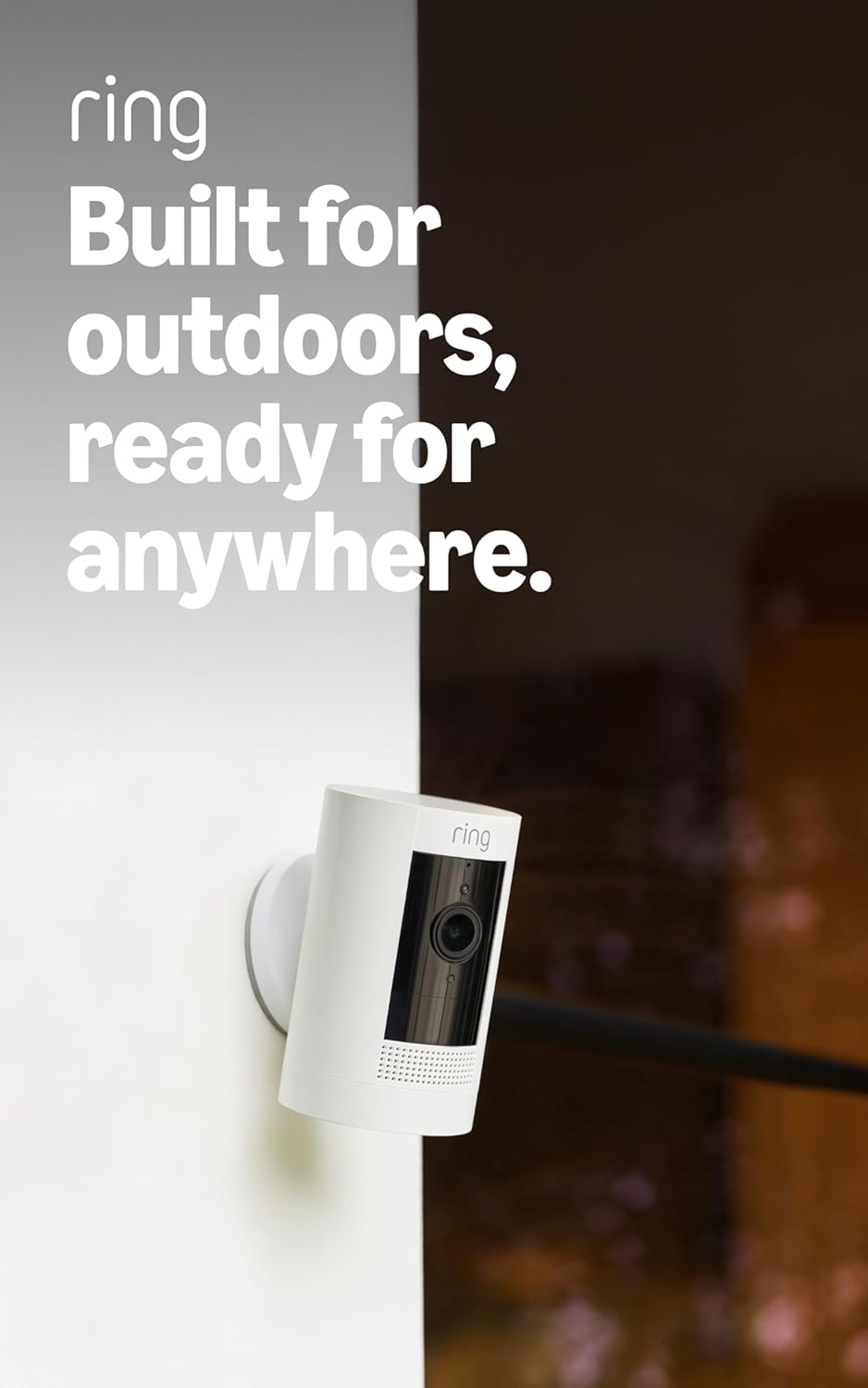
The Ring Outdoor Cam, historically designated as the Stick Up Cam, utilizes a cylindrical, weather-resistant plastic chassis intended for indoor or exterior deployment. Its primary mechanical asset is mounting adaptability. The integrated bracket allows placement on flat surfaces or attachment to vertical walls, though an inverted ceiling configuration requires a separate accessory mount sold separately. Power is supplied by a removable, rechargeable battery pack, eliminating the requirement for exterior mains wiring during installation. While weather resistance is specified, precise IP ingress ratings are omitted from the technical documentation, meaning buyers in regions with driving rain or extreme dust should verify exact environmental tolerances before mounting. The physical build is functional and unassuming, emphasizing quick access to the battery compartment over high-end materials. At this price point, the construction meets standard residential expectations for sheltered eaves or fence perimeters without introducing physical bulk or mechanical complexity.
Performance and operational realities
Monitoring is conducted through a 1080p HD optical sensor paired with color night vision and two-way audio. In practice, streaming reliability is constrained by the camera's single-band 2.4GHz Wi-Fi radio. Although 2.4GHz frequencies offer superior wall penetration compared to 5GHz bands, congested home radio environments can introduce noticeable latency during live view initialization and two-way voice communication. Motion notifications dispatch swiftly to the Ring companion application and integrate natively with select Amazon Alexa devices, enabling audio announcements on Echo Dot hardware and video feeds on Echo Show displays. However, the camera exposes no RTSP feeds or open streaming protocols for local network video recorders. Operational assessments confirm that without an optional cloud tier, live viewing and instantaneous motion pings constitute the entire feature set. The sensor delivers adequate sharpness for identifying human activity across average suburban perimeters, but optical zoom capability is absent.
Subscription dependency and ownership cost
At an initial cost of $79.99, supported by over 65,000 public ratings, the hardware entry price is relatively accessible. However, calculating the actual cost of ownership requires scrutinizing Ring's cloud subscription terms. Real-time notifications and live feeds function without an ongoing fee, but video event recording, historical review, and intelligent motion filtering demand a paid Ring Protect plan. Prospective buyers must inspect these terms prior to purchase; without an active tier, the device operates purely as a real-time observation tool with no footage retention. The absence of an onboard microSD slot or local network storage ensures full dependency on Ring's cloud infrastructure. Should service fees increase, your local internet fail, or the cloud service terminate, video archival functionality ceases immediately. Consequently, long-term operational costs will steadily outpace the hardware's upfront sticker price, transforming this device into a continuous service commitment.
Who should look elsewhere
Buyers seeking to insulate their smart home from vendor lock-in should avoid this hardware. The unit lacks Matter and Thread integration, remaining isolated within Amazon's Alexa and Ring ecosystems. If your household relies on Apple Home, Google Home, or local automation hubs like Home Assistant, integration is either absent or dependent on brittle third-party cloud bridges. Furthermore, privacy advocates and buyers prioritizing local network control should seek alternative solutions. Because the camera cannot store video locally and relies entirely on external servers, it conflicts with the core principle of local-first security; cloud-only devices lose critical functionality if the underlying service is disrupted. Consumers who demand independent, offline-capable surveillance systems utilizing network-attached storage, as well as those unwilling to pay an ongoing monthly fee to access their own recorded security footage, should bypass this camera in favor of local-storage alternatives.