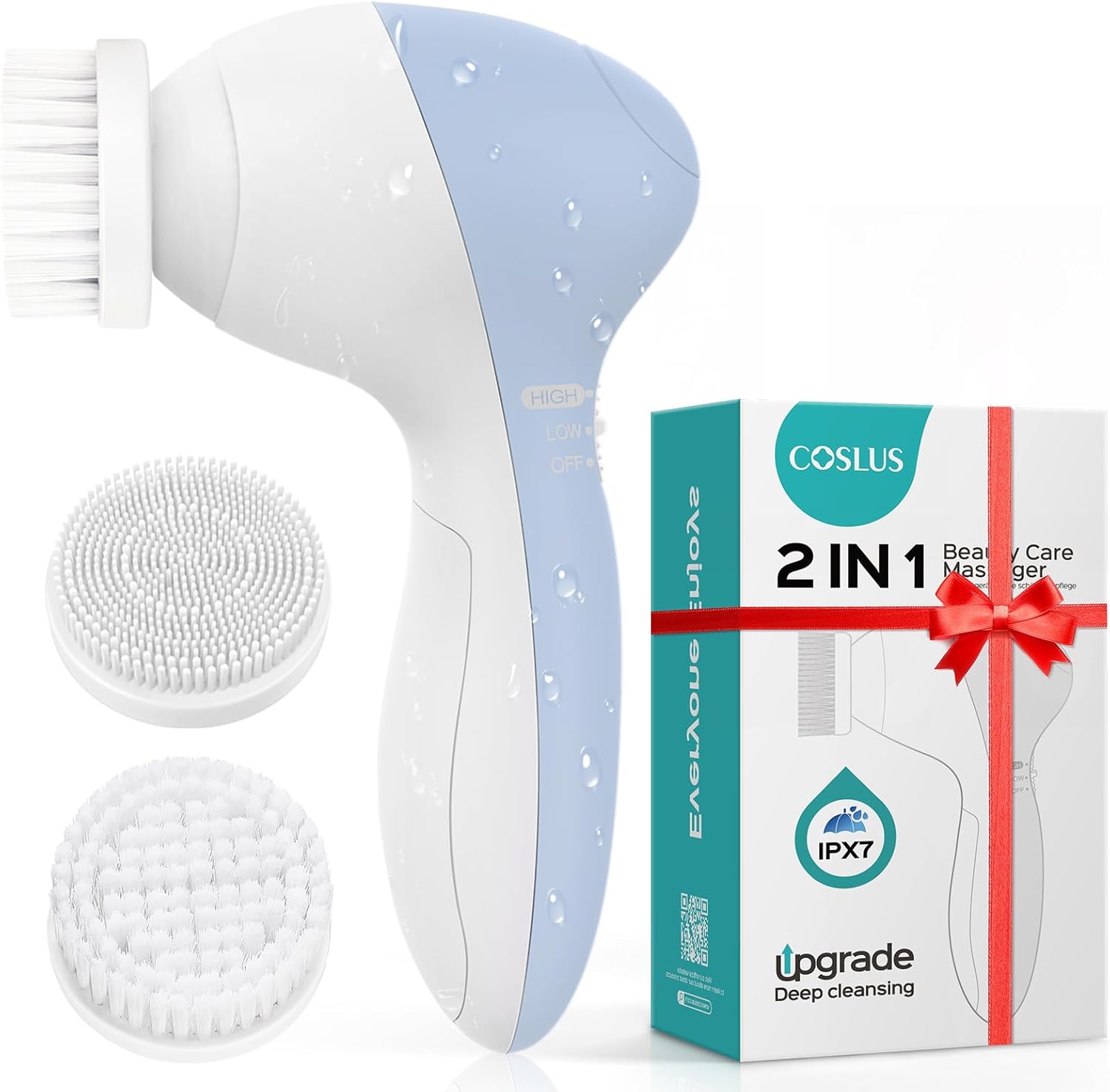
Design and build quality
Constructed from lightweight molded plastic and tipping the scales at 3.84 ounces, the COSLUS P2017 is engineered strictly as a low-cost utilitarian tool. Power is supplied via external AA batteries rather than an integrated rechargeable lithium-ion cell, which keeps the entry price down but introduces long-term friction. The battery compartment relies on a friction-fit or mechanical seal; however, the manufacturer explicitly warns against submerging the device in water. In the absence of an official IPX rating, shower use carries inherent risk of moisture ingress and motor failure. Furthermore, the manufacturer documentation exhibits notable discrepancies regarding included accessories: the text simultaneously advertises a '2-in-1' design while listing three distinct brush heads (silicone, coarse bristle, and ultra-fine). Buyers should inspect the package upon arrival to confirm exact inclusions, as standard tolerances and fitment for the interchangeable head spindle reflect basic mass-market manufacturing.
Real-world cleansing performance
The device operates via a traditional mechanical rotary action across two discrete speed settings. The lower speed provides moderate surface sweeping, while the higher setting produces enough rotational friction to slough dead surface cells. However, claims regarding collagen production or pore shrinkage lack clinical backing and should be dismissed; rotary friction merely clears sebum and debris from follicle openings. Unlike sonic devices that operate at hundreds of hertz to agitate fluids deep within pores, this unit depends entirely on physical bristle friction against the skin. The silicone head mitigates mechanical abrasiveness for daily wash routines, whereas the nylon bristle attachments present a higher risk of epidermal micro-tears if excessive downward pressure is applied. Because the motor lacks stall-protection sensors, applying firm pressure against the face visibly slows the rotation, indicating limited torque capacity under load.
Ownership costs and value assessment
At an initial retail price of $9.99, the COSLUS brush presents minimal financial barrier to entry, explaining its substantial volume of over 14,000 consumer reviews averaging 4.3 stars. Nevertheless, calculating true total cost of ownership alters the value proposition. The requirement for disposable AA batteries creates continuous operational expenditure, particularly because high-drain rotary motors deplete standard alkaline cells rapidly if used daily. Additionally, hygienic maintenance mandates replacing the bristle attachments every three months to prevent bacterial accumulation. Buyers must verify the availability and cost of specific COSLUS P2017 replacement heads before committing, as third-party rotary heads rarely share universal mounting stems. When factoring in annual battery expenditures and replacement bristles, the ongoing expense over twelve months frequently surpasses the purchase price of an entry-level rechargeable sonic alternative with standardized replacement options.
Who should skip it
Individuals with compromised skin barriers, active cystic acne, eczema, or rosacea should avoid this rotary cleanser entirely. Mechanical spinning bristles can easily aggravate active inflammatory conditions, spread surface bacteria, and strip delicate epidermal lipids. Shoppers looking for modern phototherapy features should also look elsewhere; this unit contains zero LED components, published wavelengths, or clinical clearance records. Furthermore, users seeking a seamless shower experience must skip this brush due to its lack of certified waterproof protection and vulnerable battery chamber. If your preference leans toward durable, sealed hardware with USB recharging, silicone-only contact points, or regulated oscillation frequencies that do not pull or twist the skin mantle, this budget rotary unit will likely prove frustrating. It remains strictly suited for those wanting an inexpensive, disposable-battery exfoliator for occasional use on resilient skin types.