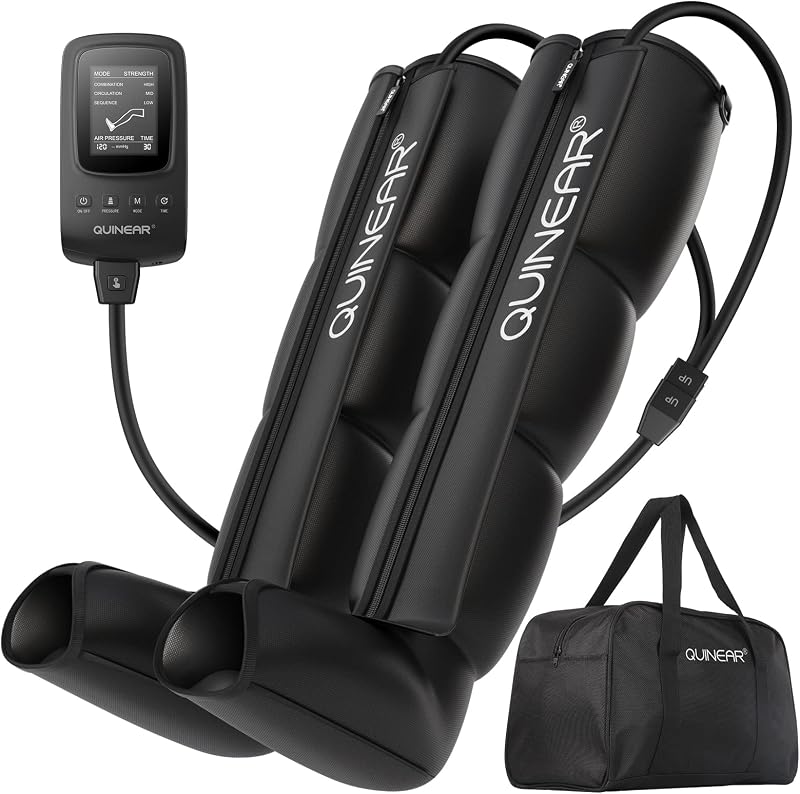
Design and Build Quality
The QUINEAR system relies on a utilitarian, functional design centered around two full-leg boots and a dedicated central air pump. Constructed in a standard black fabric shell, each boot houses four discrete air chambers segmenting the foot, lower calf, upper calf, and thigh. Heavy-duty zippers run the length of each sleeve to facilitate donning and doffing without overstretching the fabric. At 3.25 kilograms for the complete kit, the package is manageable for transit, aided by an included soft-sided carry case. The control unit features clearly marked digital controls for cycle selection, pressure increments, and timers. Unlike premium competitor models that incorporate internal hose routing, the QUINEAR utilizes external pneumatic tubing that requires secure coupling prior to use. It is corded electric, tethering the user to a standard wall outlet. Materials feel durable for home use, backed by a 24-month manufacturer warranty, though the textiles lack the reinforced wipe-clean polyurethane coatings seen on clinical equipment.
Real-World Performance and Pressure Control
In compression therapy, chamber configuration and pressure modulation dictate therapeutic effectiveness. The QUINEAR device supplies pressure settings from 50 to 120 mmHg across eight discrete levels. This operational ceiling aligns with standard athletic recovery protocols, which typically sit between 60 and 100 mmHg to encourage venous return without vascular pinching. Built-in pressure sensors sample the sleeve volume during inflation, adapting fill cycles to variable leg circumferences to maintain calibrated pressure. Users select between three sequencing modes: a progressive step-up sequence, a circulating flush, and a combined program. Treatment durations can be locked to 20, 25, or 30 minutes via the remote timer. The gradient compression acts sequentially from the pedal zone upward, mechanically assisting lymphatic drainage. However, because the system relies on four chambers rather than five or six overlapping bladders, the pressure transitions between segments feel stepped rather than continuously smooth, omitting integrated heat settings.
Value for Money
Listing at $359.99, the QUINEAR QN-071A-L targets the intermediate recovery market. It sits substantially lower in cost than flagship recovery systems from brands such as NormaTec or Therabody, which frequently command prices upwards of $800 to $1,000. Maintaining a 4.5 out of 5-star rating across more than 1,800 customer logs indicates strong consumer satisfaction regarding longevity and core utility. The inclusion of medical expense account compatibility via FSA and HSA eligibility further strengthens the financial calculation for domestic users. While it sacrifices wireless battery operation, internal chamber overlapping, and Bluetooth app telemetry, it retains essential therapeutic mechanics: automated gradient cycling, digital calibration, and reproducible pressure tiers. For private athletes seeking systemic leg flushes following road cycling or marathon training, the price-to-utility ratio remains decidedly favorable.
Who Should Skip It
Athletes requiring true mobile recovery should look elsewhere. Because the compressor requires a continuous AC power connection, this device cannot be utilized field-side, at trailheads, or during travel without access to mains power or a specialized power inverter. Additionally, individuals seeking deep-tissue mechanical relief must note that pneumatic boots solely regulate fluid dynamics; they do not replace high-stall-force percussion guns for focal muscle knots. Users who need extremely quiet nighttime operation in shared spaces should approach with caution, as QUINEAR does not publish official pump sound levels, and air compressors inherently produce cyclic motor drone. Finally, individuals with exceptionally long inseams may find the four-chamber layout provides incomplete thigh coverage compared to tall-specific, six-chamber alternatives.