Design and build
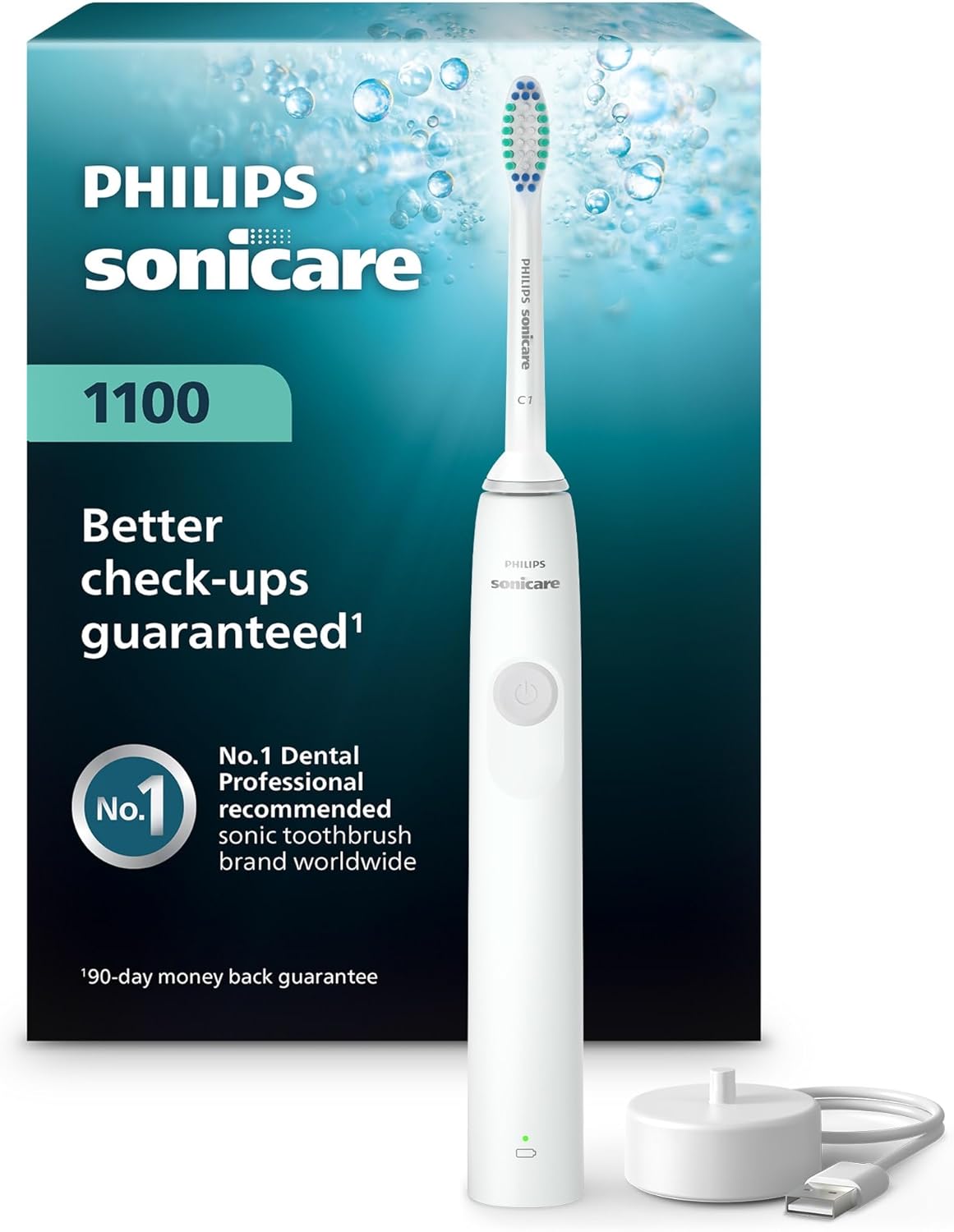
The Philips Sonicare 1100 utilizes a minimalist, functional plastic chassis finished in matte white. Weighing very little in hand, the ergonomic cylindrical handle features a single tactile power switch and standard snap-on brush head connection. Philips supplies the unit with one C1 Simply Clean brush head, featuring soft, contoured bristles engineered for basic mechanical cleaning. The base interfaces with a proprietary inductive stand terminating in a standard USB-A connector. As documented in the packaging inventory, Philips does not supply an AC wall adapter, requiring buyers to source their own USB power brick or use existing USB wall outlets. The construction reflects its entry-level price point, omitting silicone grip inlays or metallic accents in favor of smooth, wipeable plastic. The assembly tolerances remain tight, preventing moisture ingress around the drive shaft and sealing the rechargeable internal battery against routine water exposure during rinsing.
Real-world performance
In everyday operation, the 1100 relies on Philips standard sonic fluid dynamics to agitate liquid along the gumline and between teeth. Time management is handled by two internal mechanisms: the SmarTimer, which automatically powers down the motor at the two-minute mark, and the QuadPacer, which pulses every thirty seconds to prompt quadrant transitions. New users benefit from the EasyStart protocol, which ramps vibration intensity across the first fourteen brushings to acclimatize sensitive gum tissue. However, operational evaluation reveals a significant omission: the handle lacks an integrated pressure sensor. Oral care buying guidelines indicate that pressure sensors protect gum tissue far more effectively than secondary brushing modes or ramp-up profiles. Without haptic or visual warnings when pressing too hard, users must remain mindful of their own manual force to avoid bristle splay and gum irritation.
Value for money
Priced at $19.96, the Sonicare 1100 offers exceptionally low barrier to entry for motorized oral hygiene. Based on 9,749 user ratings yielding a 4.4 out of 5 average, customer reception remains steady. Nevertheless, the total cost of ownership extends well beyond the initial purchase price. In this category, replacement brush head expenditures over a three-year period routinely exceed the price of the handle itself. Standard C1 Simply Clean or compatible Sonicare heads require replacement every three months, totaling twelve heads across three years. Buyers should verify current multi-pack head pricing, as this ongoing commitment represents the true investment rather than the twenty-dollar handle. Even so, for an individual seeking reliable sonic motorization without unnecessary Bluetooth tracking or redundant cleaning modes, the initial capital outlay remains difficult to dispute.
Who should skip it
Consumers diagnosed with aggressive brushing habits, receding gums, or active periodontal disease should skip the 1100 Series handle. The complete absence of an automated pressure sensor places the responsibility of force regulation entirely on the user, increasing the risk of mechanical abrasion. Additionally, frequent travelers may find the unit inconvenient. While the internal battery provides up to fourteen days of operation between charges, the packaging lacks a travel case, and the proprietary inductive charging puck requires carrying a specific cable setup. Users who demand customized brushing routines, such as dedicated whitening or tongue-cleaning intensities, should also look elsewhere, as the 1100 provides only a single baseline speed. Those wanting plug-and-play wall charging out of the box will likewise need to look at higher tiers or supply their own power block.