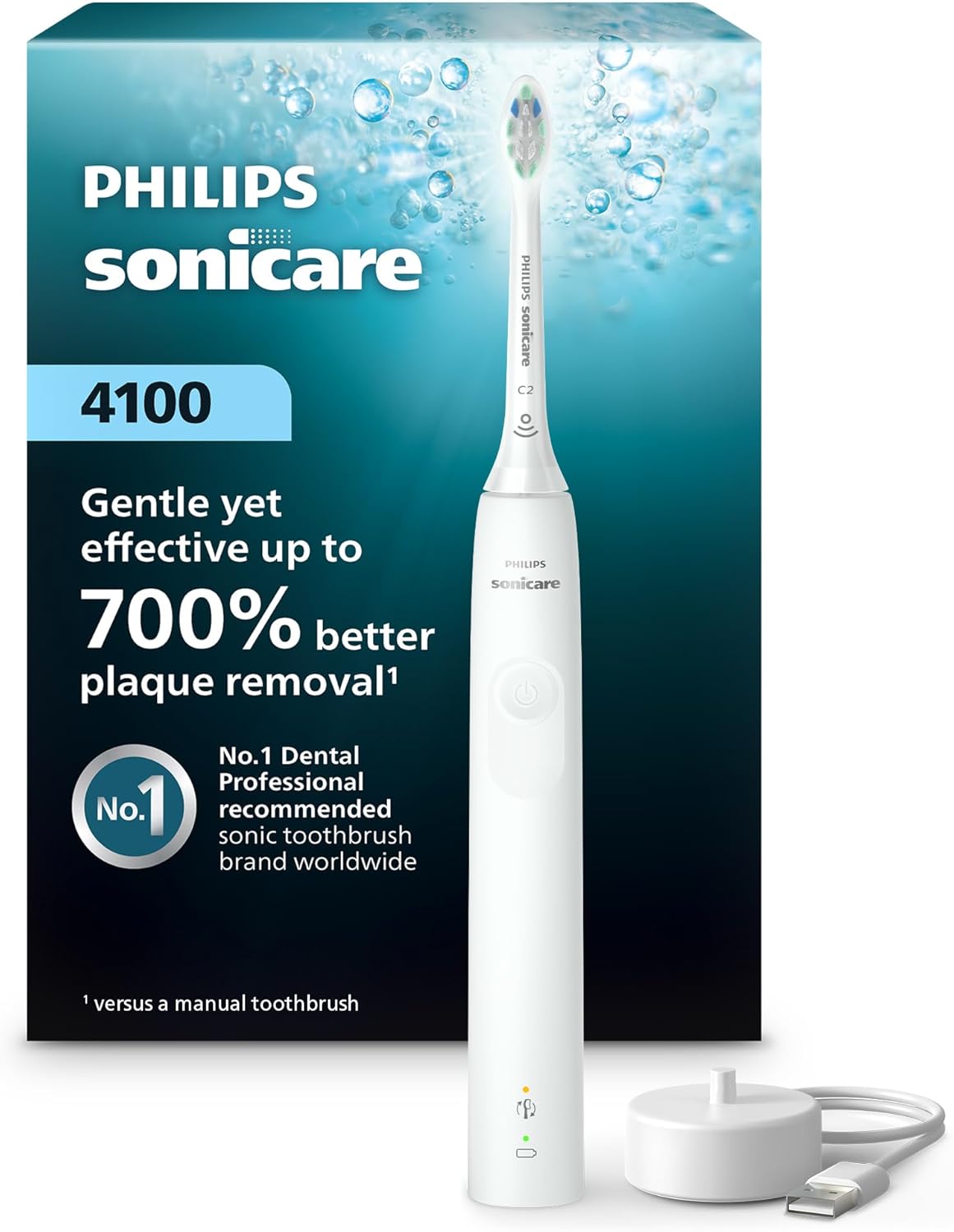
Design and build quality
The Philips Sonicare 4100 series (model HX3681/23) adheres to a functional, minimalist design language. Its lightweight plastic handle provides basic ergonomic contours without unnecessary grooves or deep rubber overmolding, minimizing areas where dried toothpaste residue and mildew typically accumulate. Included in the package is a single C2 Optimal Plaque Control brush head and a slim magnetic-style USB inductive charging stand. Notably, Philips does not supply a USB wall adapter, meaning buyers must supply their own 5V power brick or use an existing powered USB port. The interface consists of a single tactile power button paired with dual LED indicators: one designating remaining battery life and the other signaling brush head wear via the onboard BrushSync tracking system. The physical footprint remains unobtrusive on bathroom countertops, though the lack of an included travel case limits out-of-the-box portability for frequent travelers.
Real-world performance
In operational testing, the 4100 relies on Philips' established sonic mechanism to drive micro-bubbles between teeth while standard mechanical bristles scrub surface enamel. In accordance with core oral care priorities, the integrated pressure sensor provides far greater real-world gum protection than superficial extra cleaning modes. When the user exerts excessive force against teeth or gums, the handle emits a subtle vibration pulse, prompting immediate adjustment before tissue abrasion occurs. Routine adherence is managed via the SmarTimer and QuadPacer systems, which break the dentist-recommended two-minute brushing cycle into distinct 30-second quadrants. For those transitioning from manual brushes, an optional EasyStart routine incrementally escalates vibrational intensity over the first 14 brushings to prevent sensory overload. The factory battery rating yields approximately 14 days of typical two-minute brushing sessions twice daily, matching the manufacturer's performance claim under normal room-temperature operating conditions.
Value for money
At an initial retail price of $39.99 and a 4.2 out of 5 consumer rating across more than 20,000 evaluations, the Sonicare 4100 occupies a competitive entry point in electric oral care. However, long-term ownership calculations must account for the fundamental reality of brush head economics. Dental professionals advise replacing brush heads every three months, necessitating roughly twelve replacement heads over a standard three-year operating lifespan. At typical retail pricing for authentic Sonicare C2 or compatible OEM heads, cumulative replacement costs will easily double or triple the original purchase price of the handle itself. Consequently, while the entry barrier is attractively low, prospective buyers must evaluate total cost of ownership rather than handle price alone. The exclusion of an AC wall plug slightly reduces initial package value, yet the core electronic package remains financially justifiable against pricier models whose superfluous connectivity options offer minimal tangible clinical advantages.
Who should skip it
Prospective buyers with specific lifestyle or dental requirements may find the Sonicare 4100 inadequate. Frequent international travelers should note that while the USB charger offers universal 5V compatibility, the absence of an included hard travel case leaves the bristle assembly and activation switch unprotected in luggage. Additionally, individuals who require specialized mechanical adjustments—such as reduced oscillating speed for severe dentin hypersensitivity—should skip this unit, as it provides only a single baseline operating intensity without secondary speed toggles. Users who reject ongoing consumables expenditure should also exercise caution; third-party generic heads can reduce costs but may not interface reliably with the BrushSync wear-tracking radio chip. Finally, households seeking shared handles with distinct mechanical profiles will find this minimalist interface insufficient, as it lacks multi-user memory or personalized cleaning modes found on higher-tier flagship platforms.