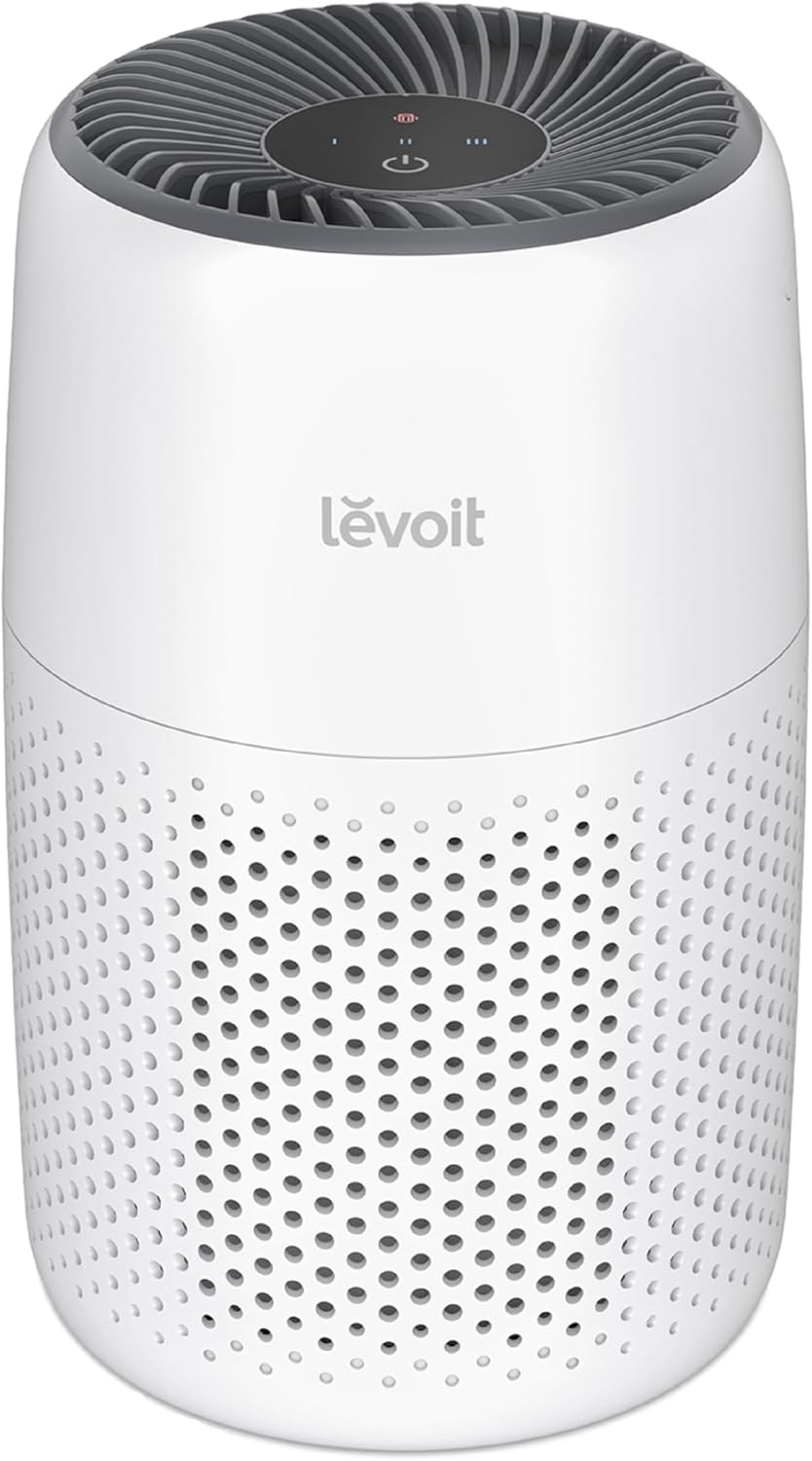
Design and build
The Levoit LAP-C161-WUS adopts a miniature cylindrical footprint designed specifically for tabletops, desks, and nightstands. The plastic housing prioritizes portability and minimal visual distraction, matching dorm rooms and compact offices. Controls are mounted directly on top, utilizing straightforward capacitive touch buttons that toggle fan speeds and display illumination. An integrated aroma pad allows users to add essential oils, though this feature operates independently of the primary filtration assembly. Air intake draws through a lower 360-degree perimeter grille, channeling air upward through an internal cylindrical filter before discharging it vertically through the top exhaust. Internally, the mechanism is powered by an AC motor rated at a frugal seven watts, keeping electrical and thermal footprint minimal. While structural tolerances are standard for entry-tier consumer plastics, the lack of mechanical complexity reduces points of failure. The power cable is standard mains AC, eliminating external brick transformers and preserving floor clearance around the socket.
Real-world performance
Air filtration relies on a 3-in-1 composite filter claimed to capture particles down to 0.1 micrometers, targeting pet dander, pollen, household dust, and volatile organic compounds. However, the manufacturer data categorizes this simply as a 3-in-1 filter rather than an explicitly certified True HEPA assembly, a critical distinction for severe allergy sufferers. Operating noise levels begin at 25 decibels on the lowest setting, rendering it virtually silent in standard bedroom ambient conditions. At higher speeds, acoustic levels rise predictably, though the small fan diameter produces more of a focused broadband whoosh than a low-frequency hum. While rated to treat areas up to 255 square feet, the manufacturer does not explicitly publish raw Clean Air Delivery Rate (CADR) figures for smoke, dust, and pollen in cubic feet per minute. Buyers expecting rapid air exchange in a large room will find turnaround times slow compared to standard mid-sized consoles.
Value for money
Evaluating overall value requires assessing total ownership costs rather than the purchase price alone. At a modest seven watts of continuous power draw, electrical consumption represents a negligible long-term operating expense. However, replacement filter cartridges for small personal units require frequent turnover, typically every three to six months depending on environmental particulate load. Over a standard three-year ownership window, the recurring cost of replacement 3-in-1 filters can easily surpass the initial retail cost of the appliance. Buyers must verify the street price and continuous availability of official Levoit replacement filters before committing. The lack of smart sensors, automated particulate indexing, or Wi-Fi integration keeps operational overhead low, but limits performance automation. For compact bedrooms or home offices with baseline particulate issues, it functions as an accessible entry point, provided the ongoing filter subscription fits within household maintenance budgets.
Who should skip it
Buyers managing medium-to-large residential footprints, open floor plans, or acute respiratory conditions should bypass this unit. The 255-square-foot rating assumes prolonged operation in fully enclosed spaces; it lacks the necessary volumetric throughput for living rooms or spaces with high ceiling volumes. Furthermore, individuals requiring medical-grade air remediation should verify and prioritize certified True HEPA filtration systems over generic 3-in-1 filter formats to guarantee 99.97 percent capture at 0.3 micrometers. Heavy smokers, homeowners managing active renovation dust, or those facing severe seasonal wildfire events will quickly overwhelm the compact filter media, leading to premature saturation and diminished odor mitigation. Finally, consumers who demand automated air quality monitoring via particulate lasers or remote smartphone control must look toward higher-tier Levoit models, as this chassis remains strictly manual in operation and scheduling.