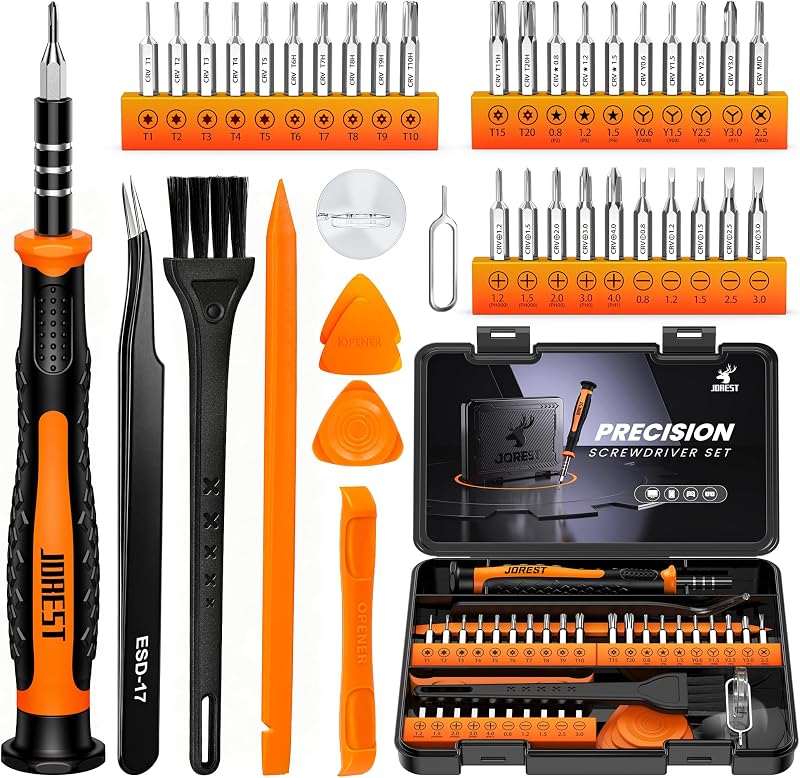
Design and build
The Jorest kit centers on a modular screwdriver handle engineered from polypropylene and thermoplastic rubber (TPR), weighing 0.2 kilograms across the entire 40-piece assembly. The handle incorporates a free-spinning end cap designed for palm indexing and magnetic retention for its 4 mm hex bits. Included in the yellow casing are 30 chrome vanadium (CR-V) bits, ranging from 0.8 mm to 3.0 mm flatheads, Phillips sizes from PH000 to PH1, alongside Torx, Torx Security, triwing, and pentalobe formats. Auxiliary tools include plastic pry tools, tweezers, and a brush. For horological tasks, the inclusion of -0.8 mm and -1.2 mm flatheads is notable for sizing screw-link bracelets or lug-bar hardware. However, unlike dedicated watchmaker screwdrivers machined from hardened tool steel with parallel hollow-ground profiles, these bits use conventional wedge geometry. While sufficient for casual maintenance, wedge-profile bits transfer force to the upper edges of screw slots rather than the root, introducing potential marring risks to polished decorative watch screws or high-grade case components.
Real-world performance
In bench operations, the magnetic bit collar facilitates fast exchanges and captures loose hardware reliably. On quartz casebacks, bezel screws, and external bracelet links, the flathead bits (-1.2 and -1.5) engage well enough for routine maintenance, provided the user exercises discipline regarding downward axial pressure. The rotating palm cap operates smoothly, enabling continuous rotation without disengaging the tip. Problems arise when approaching fine mechanical watch components. Routine movement servicing is the primary long-term expenditure of mechanical ownership, and attempting internal regulation or bridge removal with mass-market CR-V bits is ill-advised. The wedge-shaped flat blades cam out easily under the resistance of stubborn threadlock, which risks scratching bridges or damaging balance assemblies. The included stamped tweezers lack the fine alignment and non-magnetic properties required for balance springs or micro-screws, though they function adequately for handling replacement batteries. For external hardware, lug screw pins, and electronics, performance remains consistent and reliable for non-critical repairs.
Value for money
At an acquisition price of $9.99 backed by a 4.7 out of 5 rating across 26,933 customer reviews, the kit represents an economical entry point for general desktop utility. It bundles 30 drive profiles with essential auxiliary items, such as pry bars and tweezers, that would cost considerably more if purchased individually from specialized toolmakers. When evaluated as a multi-device repair set for consumer electronics, smartwatches, and eyeglass frames, the value proposition is solid. However, collectors looking after mechanical timepieces must weigh this initial economy against the cost of refinishing marred screws or scratched cases. While lug width rather than brand dictates strap compatibility, many strap systems rely on slotted threaded bars that this set can service cheaply. If your intended use is adjusting removable links, swapping quartz cells, or addressing consumer tech around the home, the set comfortably repays its low cost. It is an inexpensive, versatile secondary kit for non-delicate bench duties.
Who should skip it
Serious horologists, watchmakers, and collectors managing high-value mechanical movements should look past this set in favor of dedicated Swiss or German bench screwdrivers. Enthusiasts working inside mechanical calibers need hollow-ground, parallel blades made from tempered carbon steel that properly match slot dimensions to preserve screw heads during overhaul intervals. Buyers should verify their specific bracelet slot widths; those working with narrow or proprietary luxury screws will find these CR-V bits too thick at the tip, leading to cosmetic damage. Additionally, users who need insulated or strictly non-magnetic tools for handling hairsprings should avoid the included magnetic handle and steel tweezers, as residual magnetism can alter the rate of a mechanical escapement. Finally, anyone who regularly requires high-torque fastener removal on rusted or thread-locked hardware should seek out heavier-gauge, single-piece drivers, as thin chrome vanadium insert bits can twist or deform under sustained manual force.