Design and build
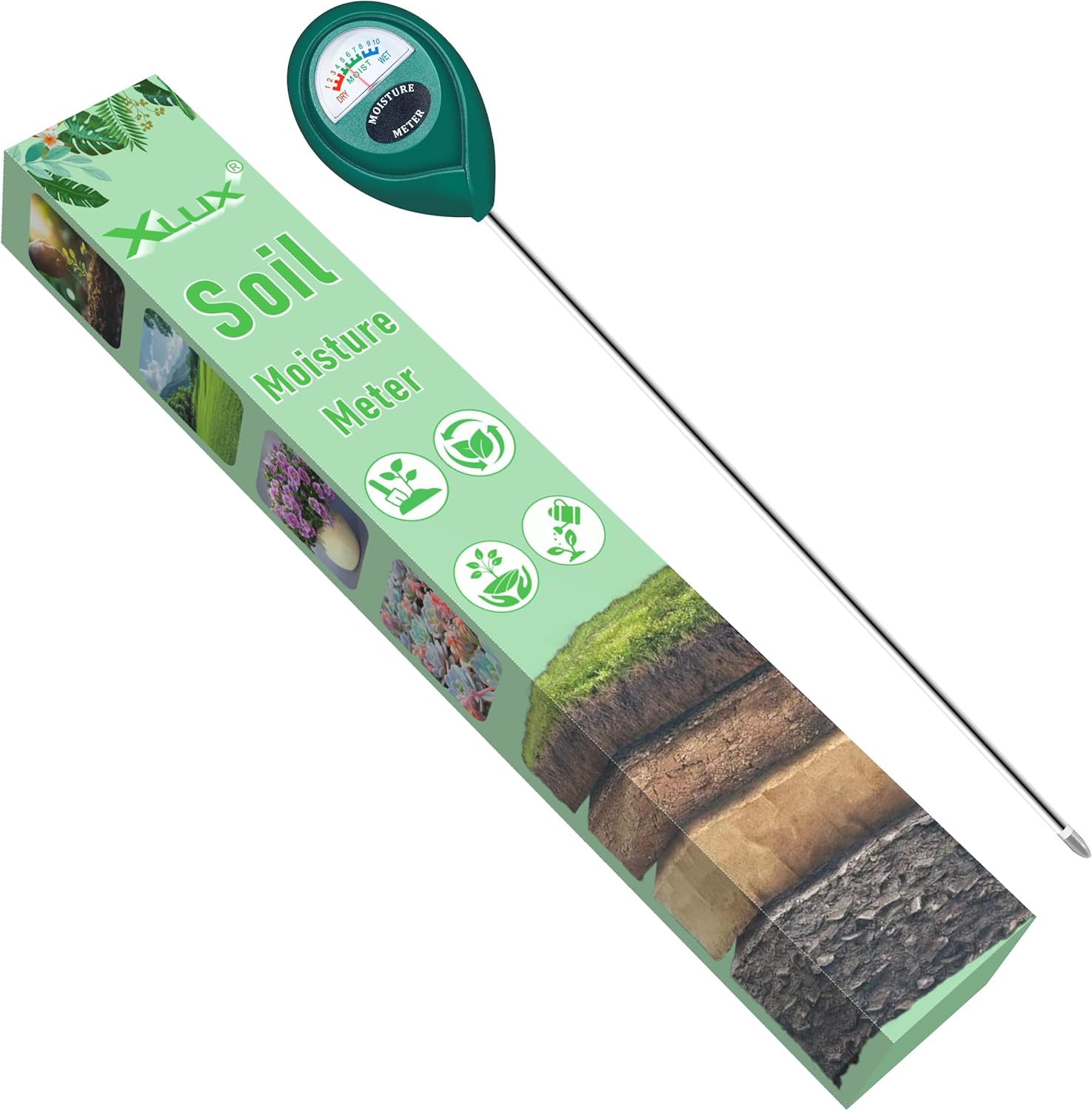
The XLUX T9178 is built around a single-probe analog architecture weighing 0.13 kilograms. Its primary physical asset is a 304 stainless steel stem extended by 5.5 inches compared to standard garden meters, granting deeper penetration into planting beds and hop mounds. The probe terminates at an analog display head finished in green, featuring an index partitioned into three colored zones and ten numeric divisions. Because it operates passively without batteries or external electronics, the housing remains simple and sealed against general outdoor dust, though the manufacturer provides no formal IP moisture ingress rating for the dial assembly. Structural integrity relies primarily on the probe shaft; users must avoid forcing the tip into hard or compacted rocky soil to prevent bending. The unit specifies an upper operating temperature limit of 50 degrees Celsius, which confirms its purpose is strictly ambient soil monitoring rather than heated process tracking.
Real-world performance
Operation is straightforward: inserting the probe into moist substrate produces an immediate galvanic deflection on the gauge without calibration cycles. However, several operational constraints govern performance. The sensor relies on direct physical contact with soil particles to measure conductivity. When inserted into airy or loose media such as bark or uncompacted perlite, the needle frequently sits at zero regardless of ambient dampness, requiring manual compression around the probe. More critically, the meter must never remain submerged in media for longer than five minutes. Leaving the device installed leads to gradual galvanic corrosion of the metal tip, permanently degrading sensor accuracy. After each deployment, the probe requires an immediate wipe-down to clear residual grit and moisture. In hop-growing scenarios, it accurately distinguishes dry root zones from saturated subsoil, provided the soil contains sufficient mineral density to bridge the electrical circuit at the tip.
Value for money
At an entry price of $12.74, the XLUX T9178 represents a modest financial outlay. Backed by more than 11,400 user reviews averaging 4.4 out of 5 stars, alongside recent monthly shipment volumes exceeding 5,000 units, the product demonstrates broad commercial consistency within the gardening sector. Its passive design eliminates ongoing costs related to button cells or alkaline battery replacement, reducing the total cost of ownership to zero beyond routine cleaning. If acquired solely to maintain outdoor hop bines or estate brewing ingredients, the cost-to-utility ratio is reasonable. However, buyers should recognize that the meter addresses zero core brewing processes. Because the probe cannot be applied to wort, mash tun operations, or cellar sanitation, its economic return depends entirely on agricultural utility rather than brewhouse efficiency.
Who should skip it
Homebrewers looking for tools to enhance fermentation control, liquid monitoring, or brewhouse automation should entirely skip the XLUX T9178. Standard brewing best practices prioritize tight fermentation temperature tracking, stainless conical vessels, and rigorous sanitation routines. This tool contributes to none of those steps. It cannot be submerged in liquids, cannot read wort gravity, and cannot track mash temperatures, operating only up to an upper limit of 50 degrees Celsius. In fact, dipping the tip into brewing liquor or cleaning solutions risks rapid chemical corrosion and permanent failure. Furthermore, growers utilizing coarse, soilless mediums like loose pine bark or hydroton for botanical setups will find the galvanic needle unresponsive without packing down the substrate. Only homebrewers who actively manage in-ground hop yards or container-grown bines in dense soil will derive any functional utility from this purchase.