Design and Build
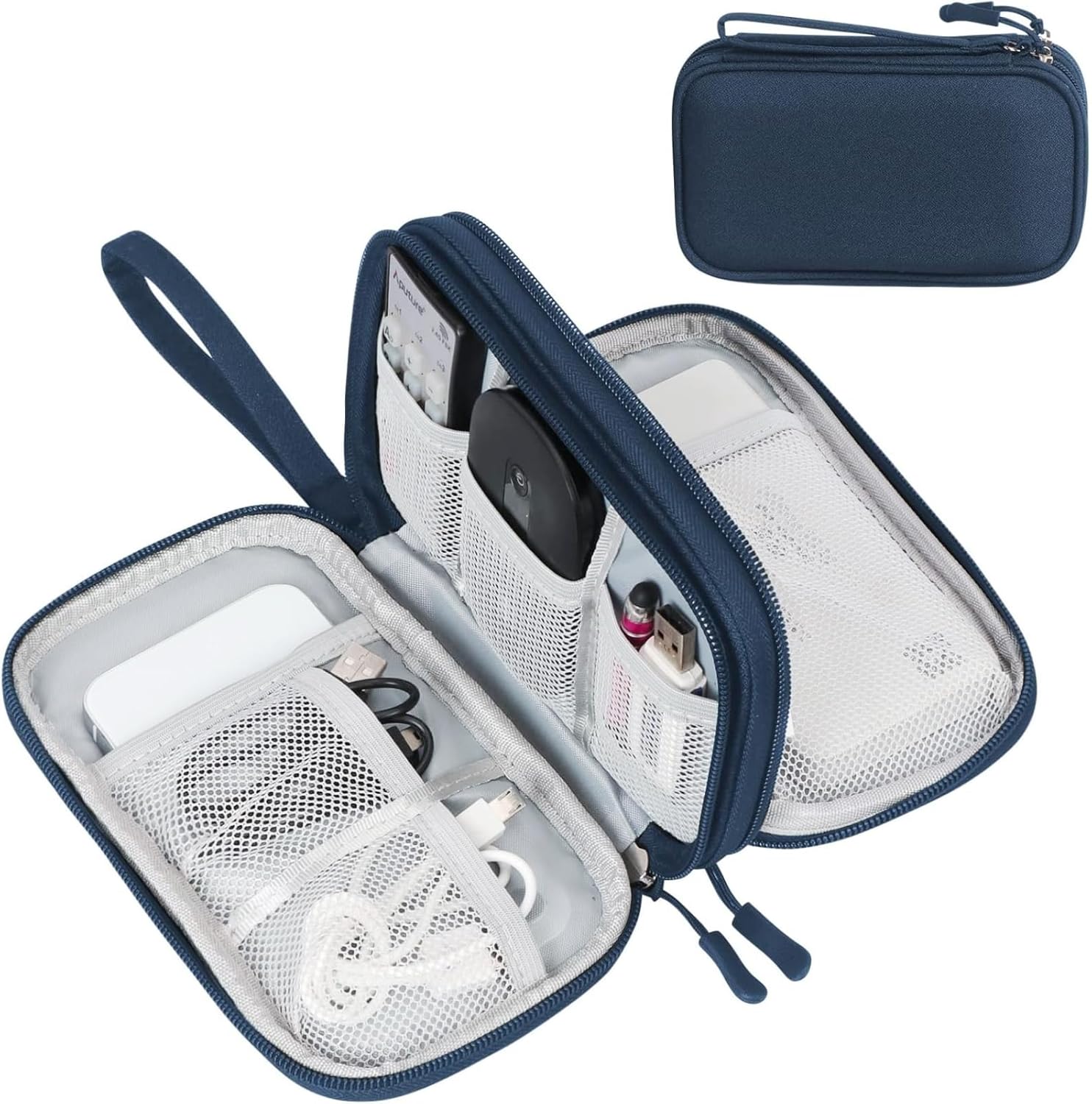
The FYY tech pouch measures 7.5 by 4.3 by 2.2 inches and weighs 4.1 ounces, yielding a total internal volume of 70.95 cubic inches. Construction relies on an exterior Oxford textile described as waterproof, backed by internal sponge padding designed to buffer modest impacts. While our luggage standards prioritize resilient polycarbonate hard-shells over brittle ABS in cargo holds, internal organizers like this operate under different mechanical demands, functioning entirely inside carry-on luggage or personal bags. The case utilizes a dual-layer zippered format equipped with an integrated wrist strap. The manufacturer notes both waterproof and water-resistant specifications, meaning buyers should expect surface splash resistance rather than complete submersion protection, particularly along the standard zipper track. The interior contains eight distinct divisions, featuring open and elasticized mesh pockets alongside open spaces for bulkier adapters. The overall build quality reflects its low production cost, focusing on functional containment rather than heavy-duty reinforcement or premium tactile finishes.
Real-World Performance
In field use, the FYY organizer succeeds when restricted to standard commuter and travel cords. The interior mesh sleeves are intentionally calibrated for charging cables measuring three feet or less; attempting to insert heavier six-foot braided laptop cords into these upper pockets causes bulging and prevents smooth closure. Longer cables and bulky power bricks must reside in the deeper open compartments of the secondary layer. The 2.2-inch depth accommodates low-profile accessories like wireless mice, thumb drives, and standard phone chargers, but high-wattage charging bricks will distort the exterior profile. The standard coil zippers run smoothly when not overfilled, though buyers should verify stitching along high-tension seams before departure. Because airline carry-on allowances demand strict adherence to dimensional constraints including handles, the compact form factor fits neatly into standard backpack side pockets or briefcase interiors without claiming valuable main-compartment volume. The wrist strap allows for quick retrieval from under-seat luggage during boarding.
Value for Money
Priced at $9.99, the FYY organizer represents an exceptionally low barrier to entry for travel organization. Backed by over 40,000 recorded consumer ratings averaging 4.5 out of 5 stars, its market presence is broad and established. When evaluated against dedicated technical pouches from established luggage manufacturers—which often command thirty to sixty dollars—the FYY offers comparable layout utility at a fraction of the investment. The trade-offs reside in hardware longevity and material density: the zippers lack brand-name credentials such as YKK, and the structural foam offers limited protection against heavy crush forces. Nevertheless, for travelers seeking to prevent cable tangles inside personal bags, the cost-to-benefit ratio remains favorable. As with secondary travel accessories, spending less on internal organization preserves budget for critical exterior luggage elements, such as polycarbonate shells and serviceable wheels that endure genuine transit abuse.
Who Should Skip It
Travelers managing substantial gear kits should bypass this pouch. If your travel workflow demands transport for multiple high-wattage power bricks, bulky camera batteries, full-size over-ear headphones, or long heavy-gauge extension cords, the 70.95-cubic-inch capacity will prove inadequate. The designated pockets are explicitly limited to short three-foot cords, making the organizer poorly suited for digital nomads carrying specialized audio-video equipment or multi-port workstation chargers. Furthermore, professionals who operate in harsh outdoor environments or wet industrial conditions should avoid relying on the stated waterproof claim; the standard zipper teeth and textile seams will admit water during sustained rain exposure. Those who require certified crush resistance or heavy-duty shock absorption for delicate solid-state drives should instead invest in rigid injection-molded or hard-shell EVA cases. Finally, individuals who prefer minimalist packing configurations using single-pocket drop pouches may find the internal eight-compartment partition layout overly restrictive.