Design and build
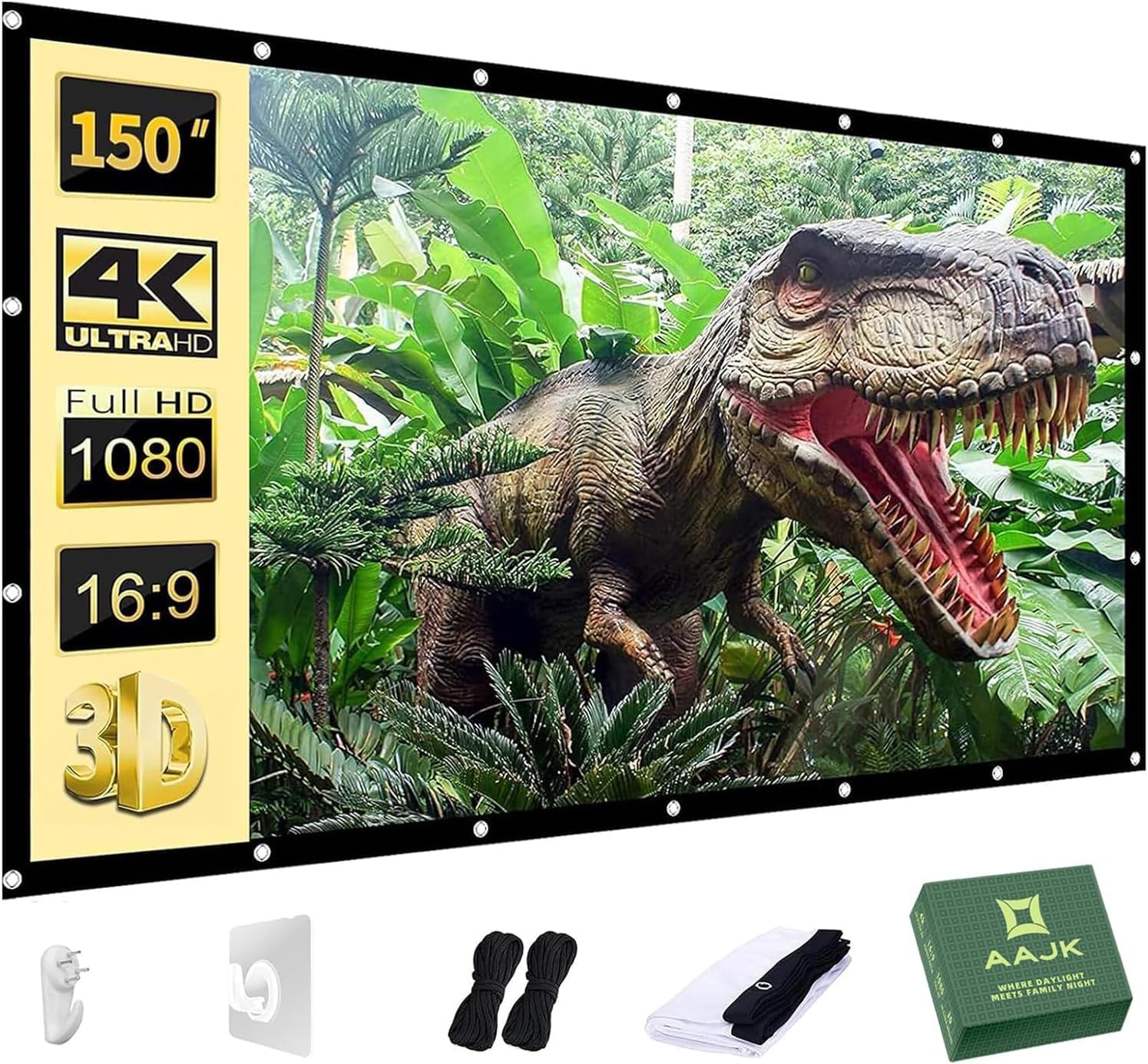
The AAJK 150-inch projector screen consists of a soft-touch, foldable white fabric weighing 2.8 pounds, with an active viewing area measuring 132 inches wide by 72 inches high. Built for temporary mounting rather than permanent installation, the sheet is secured using hooks, brackets, nails, double-sided tape, or ties along its perimeter. Without a rigid mechanical frame or tensioning rods, achieving a completely uniform, flat plane depends entirely on the tension applied to individual anchor points. The manufacturer specifies that the textile is washable both by hand and in a washing machine, which addresses the inevitable accumulation of dust during outdoor use. The material is designed to fold down into a compact profile capable of fitting inside standard travel luggage or backpacks. While the synthetic weave resists hard creasing, users should note that the absence of reinforced edge borders or a rigid border frame limits long-term structural durability against continuous pulling.
Real-world performance
Optical performance is heavily constrained by the basic white textile, which does not feature ambient light rejection layers or a certified gain rating. The manufacturer claims a 160-degree viewing angle, but contrast and black level fidelity will degrade rapidly if ambient light is present. Home theater principles dictate that screen material properties can double perceived image contrast, yet the specifications list support for double-sided projection. This capability directly indicates that light permeates the fabric rather than reflecting fully toward the viewer, inherently softening black levels and wasting projector output. In pitch-black environments, paired with a projector outputting sufficient ANSI lumens to illuminate a 150-inch surface, the screen provides an acceptable canvas for casual viewing. However, buyers should not expect the high-contrast performance, uniform gain, or color saturation delivered by tensioned vinyl surfaces or specialized grey-tinted projection materials.
Value for money
Retailing at $27.42, this screen provides an exceptionally low entry barrier for displaying a 150-inch 16:9 image. Dedicated pull-down or fixed-frame options of comparable dimensions routinely cost ten times this price, positioning this product firmly within the utilitarian budget category. A 4.5 out of 5 rating across 3,331 consumer reviews suggests consistent reliability for general backyard entertainment, casual gaming, and informal presentations. The primary economic trade-off lies in long-term longevity and optical refinement; the 30-day warranty provides minimal post-purchase protection should seams or grommets fail under repeated tensioning cycles. For consumers who require an expendable, transportable screen for occasional outdoor events, the cost-per-square-inch ratio remains mathematically favorable. It delivers utility precisely proportional to its modest price point, provided that the buyer does not anticipate the technical performance of calibrated theater surfaces.
Who should skip it
Buyers assembling a dedicated indoor home cinema should bypass this product in favor of a fixed-frame or tab-tensioned screen. Without mechanical tensioning, fabric screens exhibit minor waves along the surface that distort panning shots and straight lines during critical viewing. Similarly, users operating projectors in living spaces with uncontrolled ambient illumination will find standard white fabric inadequate, as it lacks ambient light rejecting properties required to preserve black floor integrity. Furthermore, prospective buyers utilizing low-output projectors must verify their hardware's ANSI lumen rating; dispersing modest lumen counts across a 132-by-72-inch area will yield a dim, desaturated image, particularly on fabric that transmits light through the rear. Finally, commercial environments demanding permanent, professional presentation infrastructure will find the hook-and-tape mounting mechanisms insufficient for ongoing institutional use.