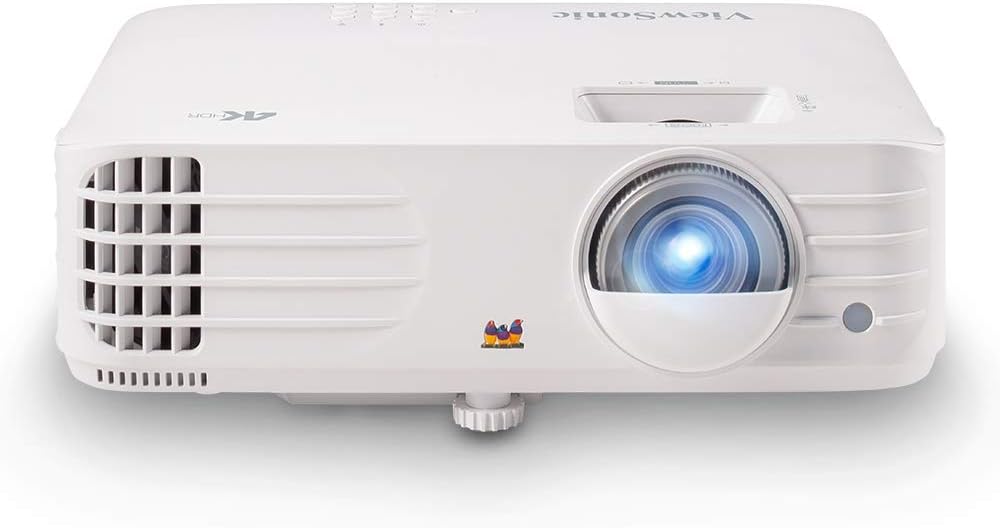
Design and physical hardware
The ViewSonic PX701-4K employs a functional, stationary chassis in matte black, engineered primarily for fixed tabletop or ceiling configurations using standard mounts like the PJ-WMK-007. Connectivity is straightforward, offering dual HDMI inputs alongside a powered USB-A port capable of driving basic streaming media dongles. Thermal dissipation is governed by internal fans venting a 265-watt power supply, supporting a conventional lamp source rated for a 6,000-hour operational lifespan. The optical assembly includes a minimal 1.1x manual zoom ring, requiring buyers to verify exact throw distances prior to mounting; for instance, achieving a standard 100-inch diagonal projection requires approximately 10.9 feet of clearance. While horizontal, vertical, and four-corner geometric keystone adjustments are integrated, they function in the digital domain. Physical lens shift is absent, meaning physical alignment is critical to avoid the resolution compromises and digital artifacts introduced by geometric correction algorithms.
Real-world visual and gaming performance
Visual performance is defined by two contrasting attributes: exceptional pixel sharpness and compromised black levels. The single-chip DLP system delivers 3840x2160 resolution with clean edge clarity across screen sizes up to 150 inches. Lumens are specified at 3,200 ANSI lumens, a standardized measurement confirming substantial light output that easily maintains image integrity through ambient room glow. However, as home theater dynamics dictate, contrast matters far more than native resolution for visual depth. The 12,000:1 dynamic contrast ratio produces noticeably elevated gray levels in light-deprived spaces, which HDR and HLG tone mapping cannot fully mask. To overcome these dynamic range limitations, pairing the unit with an ambient light rejecting (ALR) or negative-gain gray screen is essential, effectively doubling perceived black depth. For gaming, the projector excels, achieving an ultra-responsive 4.2ms latency at a 240Hz refresh rate, provided the input resolution matches ViewSonic's high-speed gaming profile constraints.
Value equation and market context
Retailing at $979.99 with an aggregate consumer score of 4.2 out of 5 stars from 767 ratings, the PX701-4K occupies an aggressively competitive space among entry-level Ultra HD DLP projectors. Buyers acquire bona fide 4K detail and responsive gaming hardware rarely found below four figures. However, total cost of ownership extends beyond the base price. The traditional 265-watt bulb architecture requires eventual replacement after its 6,000-hour duty cycle, unlike solid-state LED or laser engines. Furthermore, extracting acceptable contrast performance necessitates an appropriate projection surface. Projecting this unit onto a standard white wall or unity-gain matte white screen will wash out shadows in illuminated rooms. Buyers should budget accordingly for an ambient light rejecting screen to maximize the 3,200 ANSI lumens while mitigating the DLP chip's baseline black level floor.
Who should skip this model
Dedicated home cinema enthusiasts building a dedicated, fully light-controlled viewing room should bypass this projector. In light-sealed environments, deep black levels and wide native dynamic range are paramount, and the PX701-4K's 12,000:1 contrast ratio cannot replicate the deep contrast floors produced by dedicated home theater projectors or step-up optical engines. Additionally, consumers seeking a flexible, portable, or off-axis living room solution will struggle with the limited 1.1x optical zoom and total lack of physical optical lens shift. Relying on digital keystone correction to overcome awkward placement discards native pixels, compromising the very 4K resolution buyers are paying to achieve. Finally, those desiring solid-state illumination with instant on/off cycles and zero lamp maintenance over a ten-year operational horizon will find the 6,000-hour conventional discharge lamp outdated.