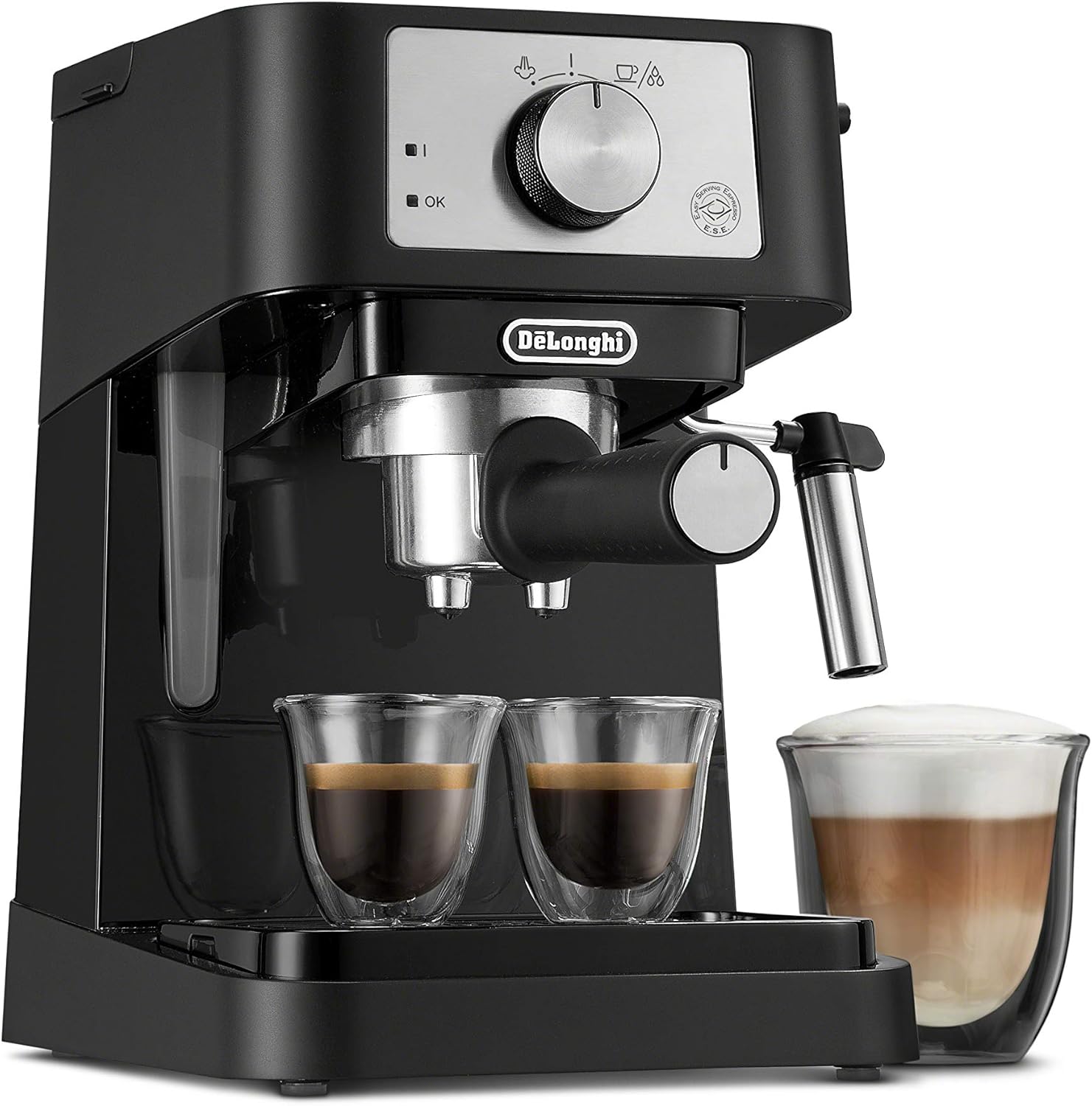
Design and build architecture
Weighing 8.6 pounds and measuring 12.13 inches deep by 9.45 inches wide, the Stilosa occupies a modest countertop footprint. Its exterior construction relies primarily on molded plastic, accented with basic metal trim. This low mass requires the operator to stabilize the machine with one hand while locking in the portafilter to prevent twisting. Internally, De'Longhi implements an 1100-watt stainless steel boiler, which offers greater resistance to corrosion and scale build-up than the aluminum blocks historically found in entry-level hardware. The water supply is managed through a removable 1000-milliliter tank positioned at the rear, facilitating direct cleaning and refilling. The control interface is strictly mechanical, utilizing a single rotary dial to toggle between standby, extraction, and steam functions. While the machine includes a combination plastic measuring scoop and tamper, this tool lacks the rigidity required for even bed consolidation, making an aftermarket 51mm metal tamper an immediate operational necessity.
Real-world extraction and thermal performance
In espresso equipment, thermal stability consistently outweighs high pump pressure ratings. While the Stilosa's manufacturer highlights a 15-bar pump, standard espresso extraction favors roughly 9 bars to avoid channeling fine grinds; uncalibrated high pressure often forces reliance on pressurized filter baskets. Because the internal boiler volume is relatively small, water temperature decays across longer extractions. Achieving consistent results requires running a blank heating flush through the portafilter prior to dosing. For milk texturing, the manual steam wand relies on the same single boiler. Switching from brewing to steaming necessitates a brief heating transition, during which pressure must build. The wand delivers adequate volume for basic lattes and cappuccinos, but it produces a wetter foam profile than commercial setups and struggles with back-to-back milk drinks due to recovery time. Operators seeking standard microfoam must practice precise tip positioning to aerate properly.
System valuation and grinder budgeting
Priced at $99.95, the Stilosa achieves a 4.2 out of 5 across more than 13,800 ratings by removing non-essential electronics. However, an espresso machine cannot function in isolation. Coffee gear guidelines dictate budgeting roughly as much for the grinder as for the machine itself. Pairing the Stilosa with pre-ground grocery coffee or an inexpensive blade grinder negates the mechanical advantages of its boiler, resulting in uneven, under-extracted shots. Buyers should allocate approximately $100 toward a dedicated manual hand grinder featuring stepless or micro-step adjustment and well-machined steel burrs. This pairing keeps the total hardware expenditure near $200 while unlocking the ability to dial in unpressurized baskets. Within this combined budget framework, the Stilosa provides a cost-effective platform for learning foundational espresso mechanics without paying a premium for automated conveniences or marketing-driven digital displays.
Who should look elsewhere
This machine is ill-suited for households serving multiple espresso drinks consecutively. The small single-boiler design requires deliberate cooling flushes between steaming milk and pulling a second shot, making consecutive preparations slow and prone to temperature variance. Enthusiasts seeking precise temperature adjustments, built-in PID control, or native commercial 58mm portafilter geometry should explore higher market tiers. Buyers who prefer hands-off, automated morning routines will find the manual workflow, manual milk frothing, and obligatory machine stabilization inconvenient compared to capsule systems or super-automatic units. Additionally, anyone unwilling to invest in a dedicated burr grinder should skip the Stilosa; the machine's unpressurized performance hinges entirely on uniform particle distribution that generic pre-ground coffee simply cannot supply. Those prioritizing solid metal chassis construction and commercial-grade steam velocity will need to increase their machine budget substantially beyond the entry-level bracket.