Design, Components, and Table Footprint
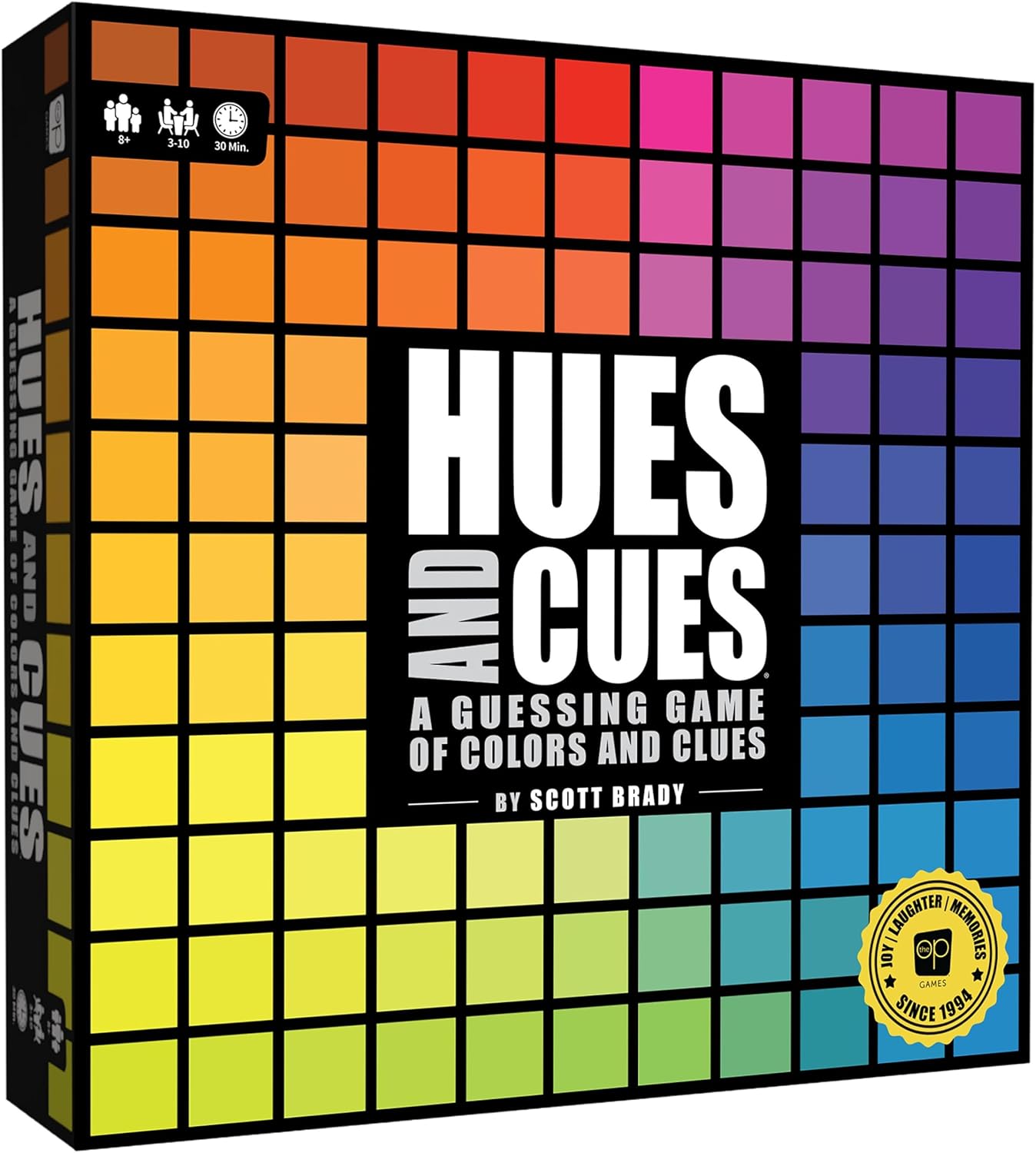
Hues and Cues relies on a centralized game board printed with a continuous 480-hue gradient grid. The physical package includes 100 color cards, 30 plastic scoring markers, a custom scoring frame, and a concise rulebook. The visual presentation is strictly utilitarian, prioritizing color distinction across the coordinate grid over ornate graphic design. The plastic scoring frame is a practical addition, neatly delineating exact points around target squares without physical ambiguity. Regarding storage, the box uses standard packaging that adequately holds the cards, tokens, and scoring frame, though it lacks specialized compartmentalization for sleeved cards or rigid component sorting. Table footprint is modest, requiring only enough space for the unfolded board and perimeter elbow room for players to place their tokens. However, the game requires consistent, neutral lighting; uneven room lighting or warm incandescent bulbs can alter color perceptions and skew coordinate identification across different sides of the table.
Real-World Performance and Player Dynamics
Gameplay operates on one- and two-word association, where clue givers guide opponents toward specific coordinates on the color grid. While the packaging claims support for 3 to 10 players, the functional sweet spot sits firmly between 5 and 7 participants. At three players, the deduction lacks competitive tension, as missing markers fail to generate meaningful board coverage. Conversely, at 8 to 10 players, physical access to the board becomes problematic, causing reaching, accidental token shifts, and visual obstruction around target hues. Turn pacing is brisk, with individual rounds completing in 10 to 15 minutes, amounting to roughly 30 minutes for a standard game session. Note that official documentation presents conflicting baseline ages, citing both 8+ and 12+. The lower threshold is mechanically accurate due to straightforward rules, though younger players may struggle with vocabulary precision under strict one- or two-word clue constraints.
Value Assessment and Expansion Independence
Priced at $24.97, Hues and Cues is positioned competitively within the casual tabletop tier. Backed by an aggregate rating of 4.7 out of 5 across more than 10,000 recorded customer reviews, it delivers dependable mechanical consistency without hidden costs. The game is entirely self-contained; no expansions are currently marketed, and none are needed to maintain replayability. With 100 cards featuring multiple targets per card and 480 discrete squares on the board, repetition fatigue is low. Subjective human interpretation ensures identical clues rarely produce identical marker placements across different player combinations. At roughly twenty-five dollars, the cost per hour of entertainment is low for casual gatherings. Prospective buyers should confirm whether their copy arrives in standard retail packaging or Frustration-Free Packaging, though the internal component manifest remains identical in either distribution format.
Who Should Skip It
Despite its broad appeal as an approachable icebreaker, Hues and Cues is unsuitable for specific groups. Most critically, individuals with color vision deficiency will experience substantial mechanical barriers, as the game contains no secondary iconographic or numerical indicators on the board to identify hues independently of color perception. Strategic tabletop hobbyists seeking complex resource management, deep planning, or engine-building will find the core loop too light and socially driven. Furthermore, pairs or dedicated three-player groups should avoid this title entirely, as the scoring dynamics and deductive satisfaction collapse without adequate marker density on the grid. Finally, groups playing in dimly lit rooms or environments with strong yellow-cast light sources should pass, as ambient lighting discrepancies alter the board's appearance sufficiently to undermine the fairness of clue delivery and token placement.