Design and build
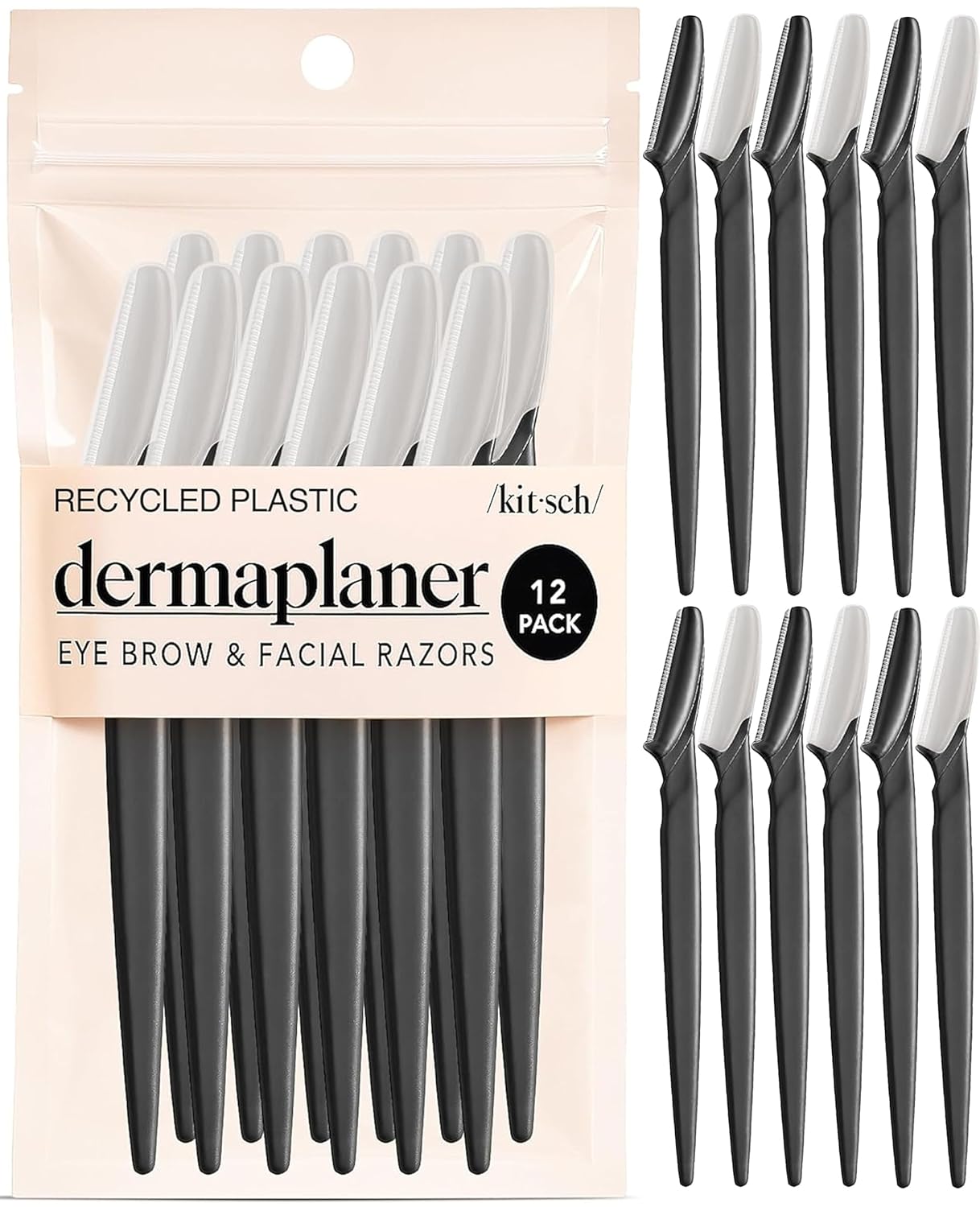
The Kitsch Dermaplane Razor is built around a slender handle fabricated from recycled polystyrene, balancing basic structural rigidity with an eco-conscious material choice. In hand, the tool is remarkably featherweight. In standard razor mechanics, handle weight and blade exposure dictate cutting aggression; with almost no mass behind this head, all downward and lateral forces must be regulated entirely by the operator's fingertips. The cutting edge is a fixed, straight micro-fluted blade integrated directly into the plastic head, protected by a simple friction-fit slip guard for storage. The manufacturer specifies total package dimensions of 3.75 by 0.5 by 7.75 inches, reflecting a compact footprint suitable for travel kits. While the use of recycled plastic is commendable, the structural flex under higher torque means users cannot rely on the chassis to maintain uniform blade contact across irregular facial planes.
Real-world performance
On clean, dry, or lightly oiled skin, the tool performs as intended for micro-exfoliation and removing soft vellus hair. It planes away epidermal debris smoothly when held at the recommended shallow angle between twenty and thirty degrees. Precision around the temples and brow arches is solid, owing to the narrow blade assembly and unobstructed sightlines. However, when tested against coarser terminal facial hair, the blade rapidly catches and skips. Because there is no mechanical heft to carry the edge through stubborn stubble, forced strokes lead directly to skin scraping and irritation rather than a clean cut. Edge retention is limited; users will find the blade loses optimal sharpness after two to three thorough sessions, confirming its disposable utility despite the marketing note regarding reusability. For minor edge cleanup and dermaplaning, it remains effective if manipulated with a very light hand.
Value for money
Priced at $9.99 for a twelve-pack, the Kitsch razor yields a unit price of roughly eighty-three cents per piece. This places it among the most accessible dermaplaning options on the consumer market. With over 38,000 recorded customer reviews averaging 4.3 out of 5 stars, the market acceptance reflects dependable consistency for low-intensity grooming tasks. The cost-to-benefit ratio is exceptionally high for users who merely need disposable eyebrow shapers or sporadic epidermal exfoliation without investing in a surgical-grade, metal dermaplaning handle with replaceable carbon steel scalpel blades. The packaging contains no superfluous accessories, maintaining focus on bare-bones utility. It does not replace a dedicated double-edge or multi-blade cartridge razor, but as an adjunct tool in an existing grooming kit, its financial barrier to entry is virtually non-existent.
Who should skip it
Buyers seeking to manage coarse facial hair, daily beard stubble, or dense neck lines should strictly avoid this tool. The blade geometry and featherweight recycled handle are entirely unsuited for terminal hair, where aggressive cutting gaps and mass are prerequisite for tug-free shaving. Similarly, wet-shaving traditionalists accustomed to substantial brass or stainless-steel instruments will find the hollow feel and flex of polystyrene frustrating to control. Those adhering to a strictly zero-waste lifestyle should also consider metal handles that accept standard double-edge or dedicated half-blades, as Kitsch’s integrated plastic-and-steel construction must ultimately be discarded in standard waste streams once dull. If you require aggressive cutting action or seek long-term tool longevity, bypass this disposable pack in favor of dedicated safety razors or professional-grade metal dermaplaning handles.