Design and Build Quality
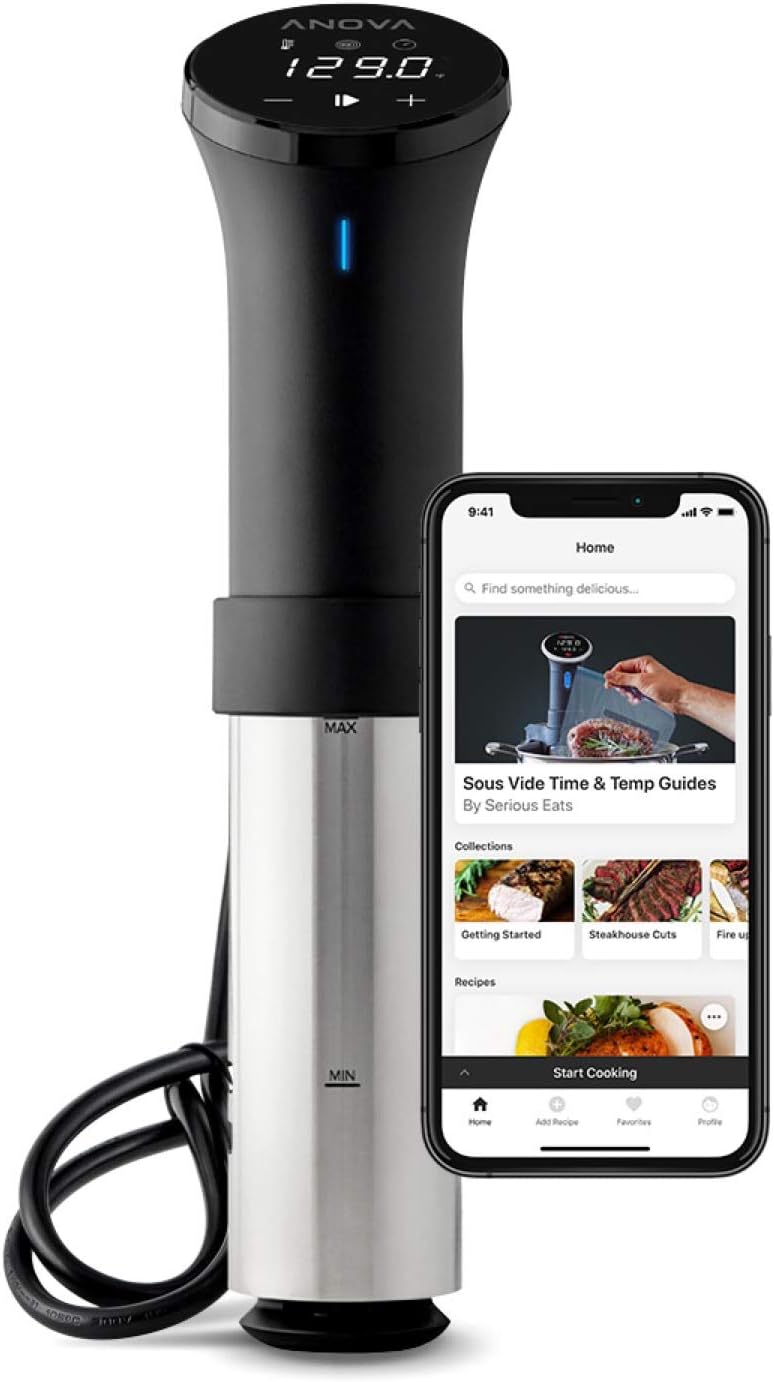
At 12.2 inches in height, the Anova Precision Cooker 2.0 is built with a more compact footprint than first-generation immersion circulators. The unit incorporates water resistance to protect the internal components against steam intrusion and accidental splashes during regular kitchen operation. Mounting hardware details present some ambiguity: the product narrative describes an adjustable clamp for securing the circulator to stockpots or dedicated vessels, while the technical specification sheet lists the clamp as fixed. Prospective buyers should inspect the clamp mechanism on delivery to confirm vessel wall clearance. The circulator is designed for standard 110-120 volt domestic electrical outlets and carries a continuous run rating of up to 3,000 hours. Anova backs the hardware with a two-year manufacturer warranty, which offers reasonable protection against early component failure in routine residential service.
Real-World Performance Considerations
In sous vide cooking, heating power determines how rapidly a water bath reaches target temperature, rather than its ability to hold that temperature over time. The Precision Cooker 2.0 presents contradictory manufacturer data, citing 1000W in the title, 1100W in descriptive bullet points, and 850W in the formal specifications table. Operating at 850 watts will require longer initial heat-up intervals, particularly when warming larger vessels from tap temperatures. Flow rate figures also diverge, listed alternatively as 5 liters per minute and 8 liters per minute. Even at the lower 5-liter metric, circulation remains adequate for uniform heat distribution across typical home pots. For multi-hour or overnight cooking, thermal retention depends on vessel management. Utilizing a fitted lid cuts evaporation on long cooks, preventing water levels from dropping below the intake threshold and triggering an automatic shutdown.
Value for Money
Priced at $114.99 with an aggregate rating of 4.5 out of 5 stars across 12,138 owner assessments, this circulator occupies an accessible middle ground in the immersion cooking market. It integrates dual Bluetooth and Wi-Fi wireless connectivity, allowing remote bath monitoring from a smartphone. The core control application is free, handling direct temperature adjustments and basic timer settings. However, Anova has placed certain educational guides, chef-curated recipes, and cook history tracking behind an optional subscription costing $1.99 monthly or $9.99 annually. This paywall does not inhibit fundamental manual operation or standard app functionality, but buyers should factor ongoing costs into their purchasing calculus if guided digital recipes are essential. Taken purely as heating and circulation hardware, the $114.99 retail price remains competitive against equivalent wireless devices.
Who Should Skip It
Cooks working with large-volume liquid preparations or heavy batch quantities may find this unit limiting. Because chamber sealers handle liquids while edge sealers do not, cooks relying on basic edge vacuum machines will struggle with marinades or liquid-heavy pouches regardless of the immersion circulator used. Furthermore, if you routinely prepare large catering volumes that demand rapid initial preheating, the potential 850-watt baseline will prove slow to reach high temperatures without supplemental hot tap water. Those seeking completely standalone manual hardware without app integration prompts, or users unwilling to navigate tiered subscription models within a companion application, should consider fully manual immersion sticks. Finally, cooks using non-standard coolers or thick-walled vessels should verify clamp clearance beforehand given the conflicting documentation regarding whether the mount is adjustable or fixed.