Design and build
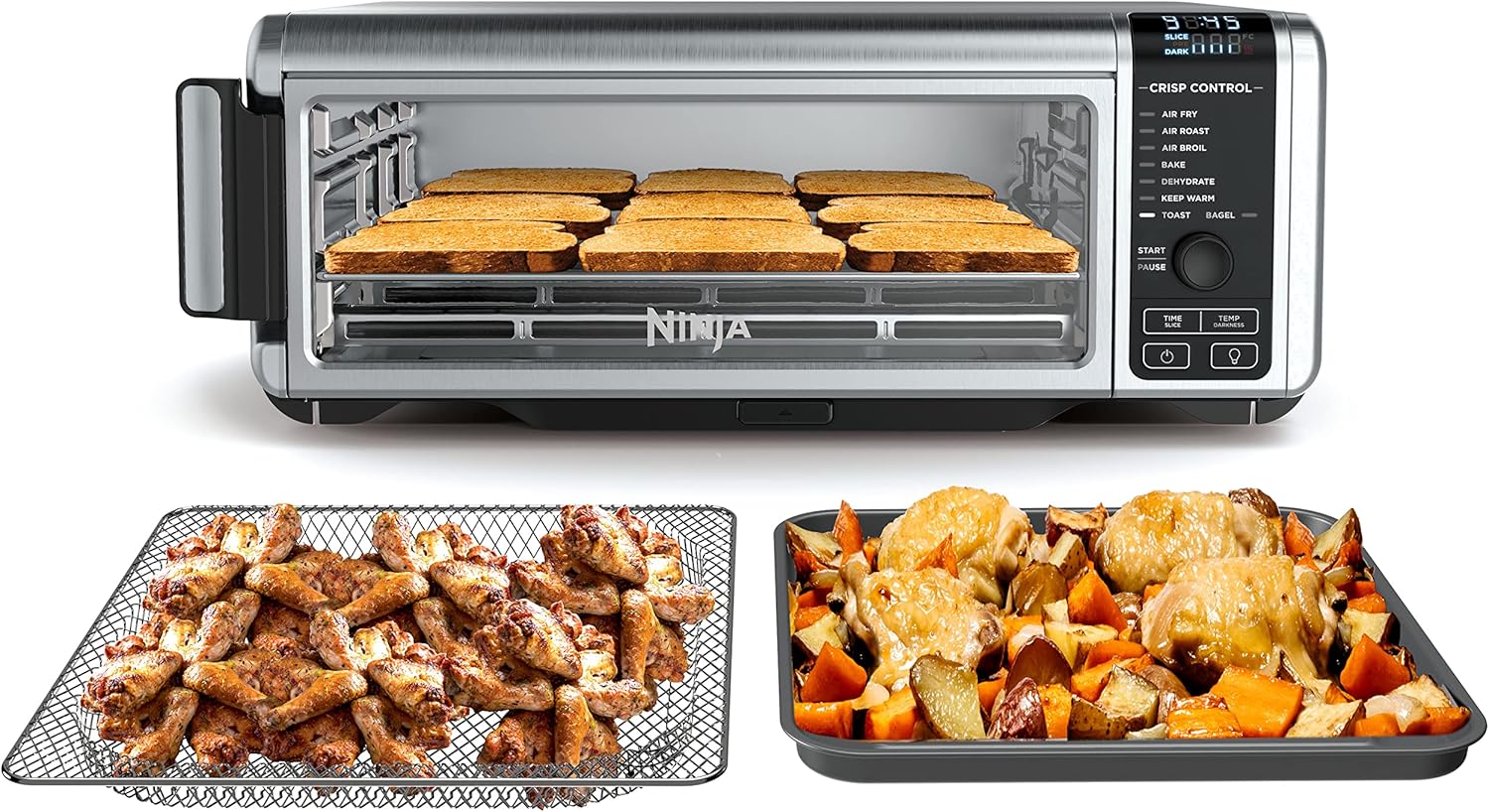
The Ninja SP101 differentiates itself through a low-profile, wide-chassis design anchored by a pivoting hinge mechanism that rotates the unit upward against a wall or backsplash when idle. This engineering choice reduces its active countertop footprint by approximately half, addressing a standard pain point in domestic kitchens. The exterior is finished in brushed sheet metal, operated via a digital display paired with a rotary dial selector. At roughly 1750 to 1800 watts, the appliance houses an integrated wire rack, sheet pan, air fry basket, and a pull-out crumb tray. The rear panel opens downward, granting direct interior access for periodic interior cleaning. However, the horizontal design compromise is interior height. Because the cavity favors wide surface spread over vertical volume, clearance between the upper heating arrays and the tray is narrow. Owners must take care when placing taller foods or standard bakeware inside, as the vertical clearance remains strictly limited.
Real-world performance
Thermal management in the SP101 leverages forced-convection airflow and rapid cycling elements, achieving an operational preheat in approximately 60 seconds. Its broad floor allows effective air roasting and baking across an expansive single plane, comfortably holding a 13-inch pizza or nine slices of sandwich bread without crowding. Our buying rules dictate that usable capacity is defined by layout rather than raw quoted volume, and the SP101 excels at single-layer distribution, yielding consistent browning on dehydrate and air roast presets. However, the manufacturer does not explicitly confirm quartz heating elements in the base specifications, an omission buyers seeking ultra-fast radiant responsiveness should verify against standard metal calrod configurations. Furthermore, because fats render very close to the overhead heating elements, proteins with higher lipid content require close observation to avoid smoke generation during high-heat broiling.
Value for money
At an MSRP of $249.99, the SP101 sits in the mid-tier segment of the multi-cooker market, supported by a 4.6-star aggregate across more than 26,000 recorded consumer reviews. The value calculation hinges primarily on the viability of its vertical stowage system. If you run a compact kitchen where standard toaster ovens permanently consume valuable prep space, the mechanical hinge provides tangible functional return on investment. The inclusion of an air fry basket, chrome-plated rack, and specialized sheet pan saves secondary accessory purchases out of the box, though long-term durability is tied to strict hand-cleaning protocols for the non-stick and wire surfaces. SharkNinja provides a standard one-year limited warranty, which is average for this category, but the mechanical durability of the flip mechanism appears sound when operated within normal clearance boundaries.
Who should skip it
Buyers seeking to roast whole chickens, bake high-domed artisanal bread, or utilize high-sided Dutch ovens should pass on the Ninja SP101. The interior chamber's vertical clearance is severely compressed to facilitate the flip-up storage footprint, making it incapable of handling vertically oriented cookware or thick cuts of meat exceeding roughly three to four inches. Similarly, households with deep upper cabinetry installed unusually low to the countertop will find the upright storage mechanism restricted or obstructed entirely, negating its primary design advantage. Those who demand deep multi-tier basket frying for high-volume batches should also look toward dedicated cylindrical basket air fryers, which handle agitated, stacked ingredients far better than the single-layer wire tray provided here.