Design and build
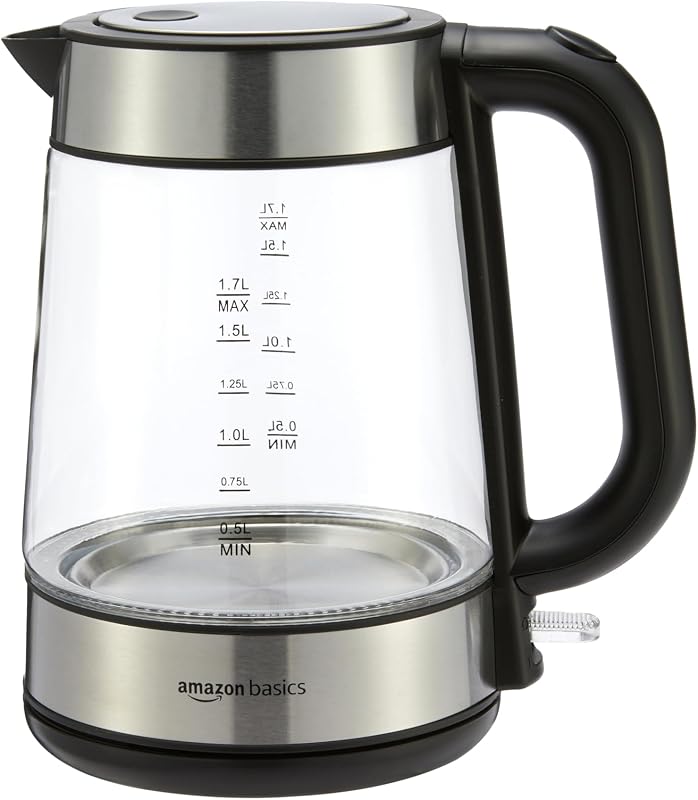
The kettle centers on a 1.7-liter borosilicate glass vessel mated to a composite plastic and metallic base. Amazon Basics incorporates a Strix mechanical thermostat, a welcome inclusion at this price tier that provides standard automatic shut-off and boil-dry protection. Water-contact points are designated as BPA-free, though buyers must accept standard plastic framing around the lid and handle assembly. The wide-aperture opening facilitates internal cleaning and descaling, while graduated water level indicators on the glass permit volumetric tracking. Blue internal LEDs illuminate during heating cycles, offering visual status verification without digital instrumentation. At this price point, fit and finish reflect utility manufacturing: seams are visible across the polymer shell, and the lid release operates via a basic mechanical hinge rather than a dampened mechanism. The 120-volt corded base permits full rotation, seating cleanly without excessive friction or lateral play.
Real-world performance
Operating at 1500 watts, the heating element brings a full 1.7-liter volume to an active boil in line with standard consumer kettles. Because our core evaluation priority is thermal stability and precision, this unit reveals functional boundaries immediately. It operates on an all-or-nothing basis: water heats until steam triggers the mechanical switch at the boiling threshold. There is no integrated temperature regulation, PID algorithm, or keep-warm cycle. For dark roasts or immersion methods like French press and cupping, reaching a rolling boil and resting for three minutes yields adequate strike water. However, the wide spout produces an agitated, turbulent flow that cannot sustain the slow, laminar stream essential for pour-over extraction. Attempting a steady drip into a V60 or Kalita Wave causes channeling and uneven bed saturation. Thermal management is strictly manual, necessitating an external thermometer for targeted recipes.
Value for money
At $23.52, the kettle offers exceptionally low capital commitment. Backed by a 4.6-star cumulative score across more than 28,000 recorded consumer ratings, its durability-to-cost ratio is established. Under our gear philosophy, an entry-level kettle that does not inflate its cost with superficial aesthetics frees critical funds for components where mechanical precision dictates cup quality. Allocating budget parity between the machine and grinder is fundamental; saving money on simple boiling hardware allows an aspiring brewer to invest in conical or flat steel burrs with stepless micro-adjustments. The inclusion of a Strix controller provides standard electrical safety, mitigating the fire and overheating risks common among off-brand heating elements. For users who rely on full immersion brewing or bulk batch preparation, this kettle fulfills basic thermal duties at a minimal financial footprint.
Who should skip it
Dedicated manual pour-over brewers should look elsewhere. Achieving balanced extraction with modern, lightly roasted specialty coffees demands predictable water temperatures between 90 and 96 degrees Celsius, combined with precise agitation control. Because this unit lacks variable setpoint adjustments and a restricted gooseneck spout, controlling flow velocity and bed turbulence is unfeasible. Commercial operations and busy domestic coffee bars requiring constant standby temperatures should also bypass this model, as the absence of a thermal hold function requires constant re-boiling. Anyone brewing high-clarity single origins via flat-bottom or conical filter drippers will find the pour dynamics frustrating. Such users should divert their budget toward a dedicated gooseneck kettle featuring an internal digital PID controller, even if that requires saving up to purchase the proper hardware alongside an appropriate stepless burr grinder.