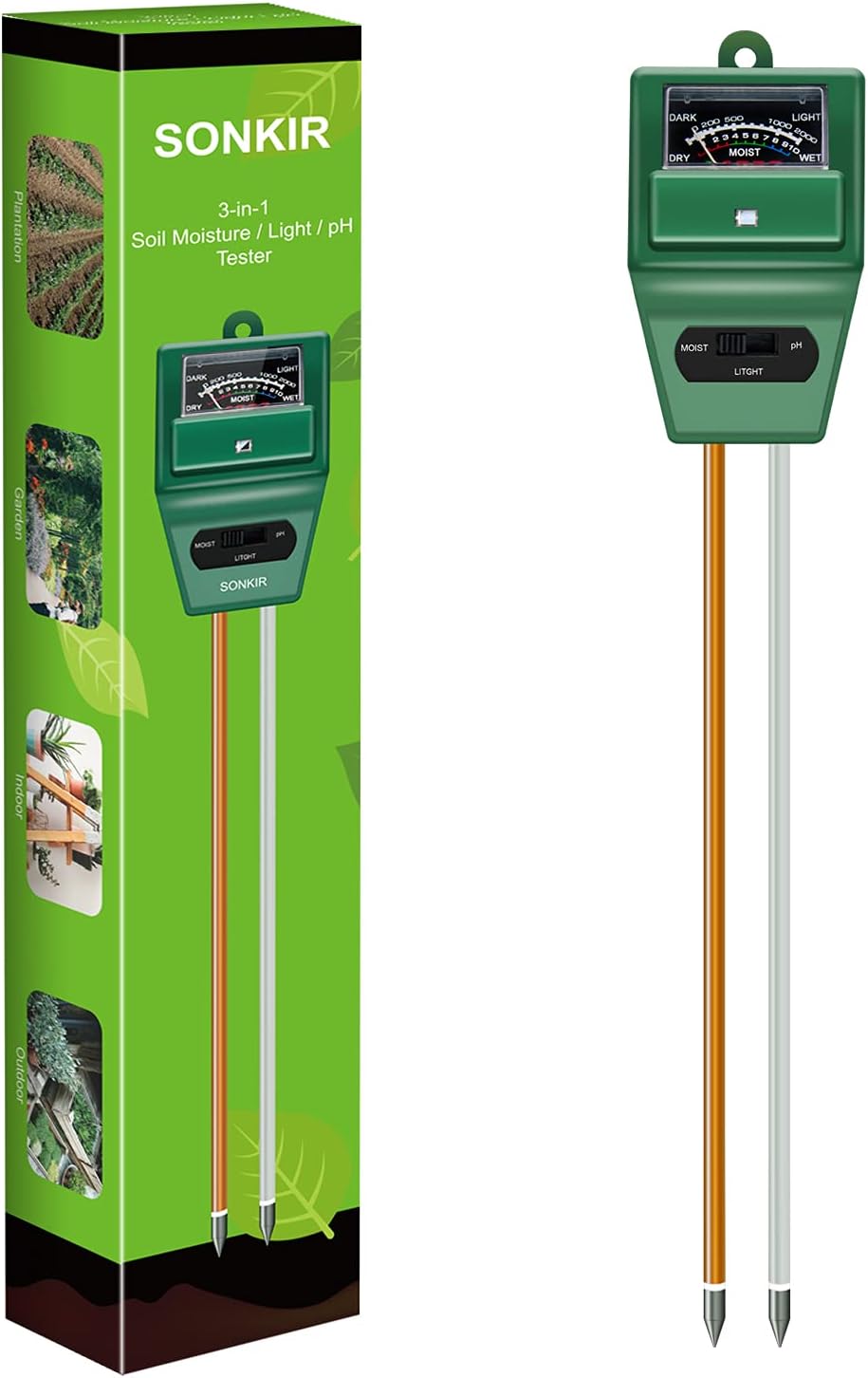
Design and build
The Sonkir MS02 weighs 2.89 ounces and measures 11.5 inches in total length, dominated by twin metal probe shafts extending from a teardrop-shaped plastic readout head. The mechanical selector switch toggles between moisture, light, and pH modes, driving a single needle across three color-coded analog scales. Because the instrument relies entirely on galvanic reaction between dissimilar metals and soil electrolytes, it requires no external batteries or charging cables. This passive design keeps the housing simple, but the overall construction is decidedly lightweight. The narrow probes flex easily when encountering compacted outdoor clay or dry, dense media, requiring careful vertical insertion to avoid snapping the connection at the base of the plastic housing. The integrated light sensor sits directly on the faceplate between the mechanical switch and the display lens, which restricts sunlight readings to whatever orientation the dial happens to face during probe placement.
Real-world performance
For indoor gardening, the MS02 functions primarily as an approximate moisture indicator. The dual probes generate a micro-current in damp soil, moving the needle reliably between dry, moist, and wet gradations. However, its pH function is far less capable. The manufacturer explicitly notes that the soil must be watered prior to testing, as completely dry soil fails to register continuity. Even in damp conditions, the pH scale lacks fine resolution, typically registering within a narrow band around neutral unless soil acidity is extreme. The ambient light sensor is similarly compromised for serious horticultural assessment. Modern indoor horticulture relies on photosynthetic photon flux density (PPFD) measured at canopy distance to evaluate light energy. The MS02 uses a generic ambient photodiode with an arbitrary 0 to 2000 scale, offering no actionable insight into photosynthetically active radiation or usable spectrum for indoor crops under artificial lighting.
Value for money
Retailing at $9.99, the Sonkir MS02 carries a pricing structure that accounts for its massive market penetration of over 46,000 recorded consumer ratings. At this price tier, the tool should be judged against the modest expectations of basic houseplant maintenance rather than analytical precision. It costs significantly less than dedicated digital glass-electrode pH pens or handheld quantum PAR meters, which easily command tenfold to fiftyfold its price. For general container gardening, preventing overwatering is the primary operational hurdle, and the analog moisture scale delivers sufficient utility to justify the ten-dollar outlay. However, buyers should recognize that the added light and pH features provide minimal diagnostic value. As long as users treat the device strictly as a mechanical moisture dipstick that saves roots from chronic saturation, the economic proposition remains reasonable, even if its secondary capabilities are largely superficial.
Who should skip it
Hydroponic growers, high-density indoor cultivators, and serious soil managers should pass on the Sonkir MS02 entirely. The manufacturer clearly states that the device cannot test liquids, rendering it useless for measuring hydroponic reservoirs, nutrient runoff, or foliar sprays where precise liquid pH monitoring is essential. Furthermore, growers attempting to map indoor lighting environments cannot substitute the meter's rudimentary photodiode for a calibrated PPFD sensor, which is the only measurement standard that accurately determines usable photons at the plant canopy. Cultivators managing sensitive species that demand narrow soil pH windows between 5.8 and 6.5 will also find the analog needle movement too coarse to prevent nutrient lockout. Those working with dense outdoor garden beds risk bending the probes. Serious hobbyists should instead invest in calibrated digital glass-bulb pH meters and dedicated moisture tension instruments.