Design and Build
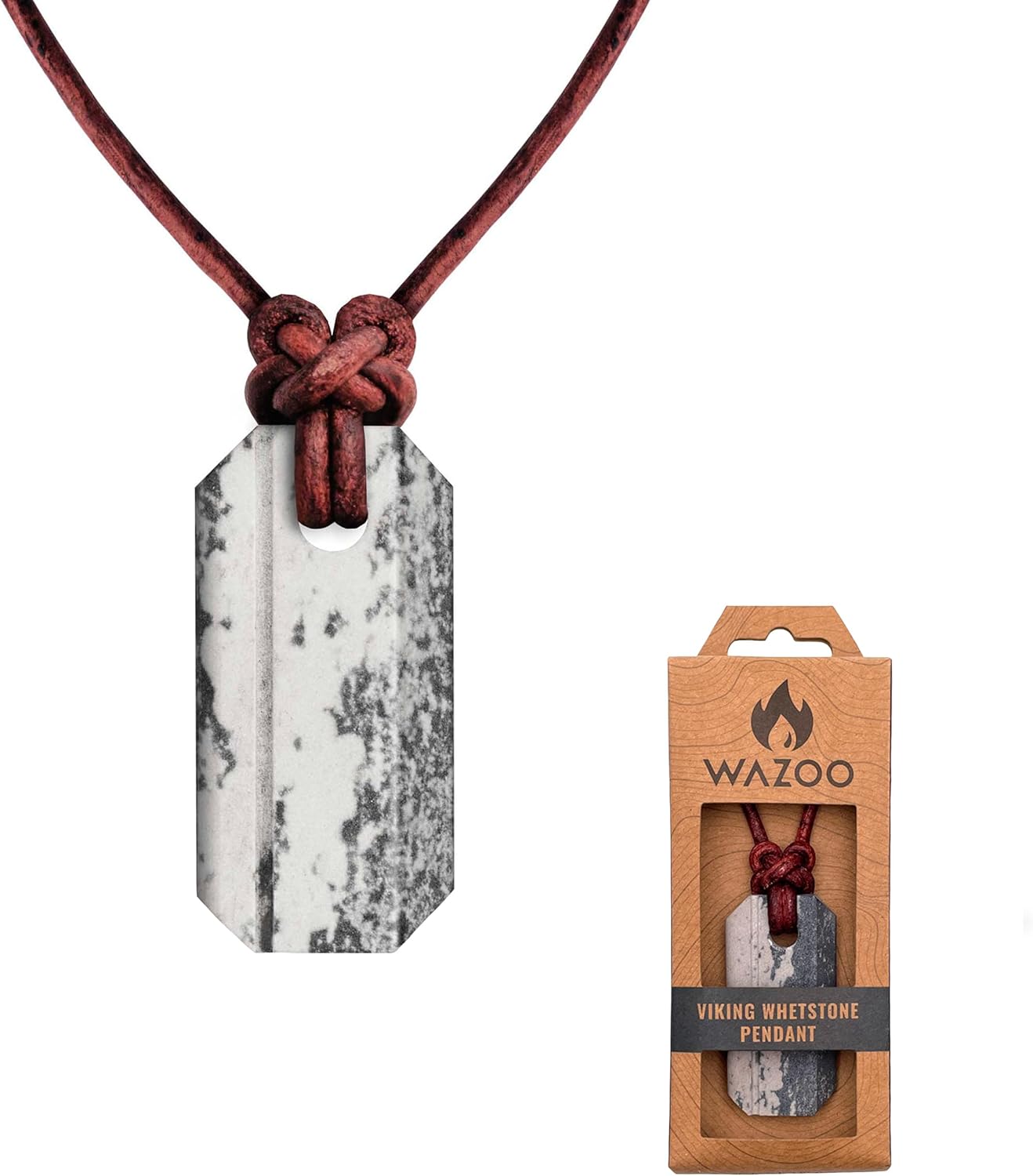
The Wazoo Viking Whetstone is built around a single piece of natural Arkansas Novaculite measuring 2 inches long, 1 inch wide, and 0.25 inches thick. At an overall weight of 18.14 grams, the stone is mounted on a natural leather cord secured with a custom adjustable screw-in clasp. Rather than presenting a flat bench format, the stone is ground into four distinct facets designed to dress plain knife edges, fish hooks, awls, and small saw teeth. Because Novaculite is a naturally quarried material, individual units arrive with natural variations in tint, ranging from off-white and pink to charcoal grey. Hand-assembled in Colorado, the knotwork and leather harness are cleanly executed, producing a piece of jewelry that maintains structural integrity when handled as a tool. However, the physical dimensions impose hard limits: the small contact patch leaves no margin for sloppy positioning, requiring a firm grip directly on the stone body during abrasion passes.
Real-World Performance
The pendant's Novaculite abrasive corresponds roughly to a medium 600 to 800 grit benchmark. Natural novaculite relies on microcrystalline quartz, which yields a slower material removal rate than modern synthetic waterstones or monocrystalline diamonds. In field conditions, this medium density is adequate for edge maintenance and micro-bevel realignment, but it lacks the coarse aggression required to repair chips or set initial bevels. Furthermore, users must control the sharpening angle completely freehand across a very narrow two-inch stroke path. For users accustomed to guided systems that lock in repeatable edge profiles, maintaining consistent angles on a piece this compact demands practice. The accompanying leather lace can serve as a makeshift strop to de-burr the apex after stone work, reinforcing the fundamental rule that honing and abrasive sharpening perform distinct tasks. Nevertheless, the miniature footprint limits its effectiveness primarily to pocket cutlery, outdoor utility blades, and camp tackle rather than wide bevels.
Value for Money
Retailing at $52.90, this whetstone pendant commands a significant premium when judged strictly on abrasive surface area. Standard 1000/6000 dual-grit synthetic bench stones often retail within the same price territory while providing full-sized work surfaces capable of handling an entire culinary block. With an aggregate rating of 4.7 out of 5 stars from over 2,200 buyers, user sentiment indicates satisfaction with its execution as an outdoor novelty and backup sharpening device. The valuation here rests heavily on domestic assembly in Colorado, domestic sourcing of Arkansas novaculite, and the wearable jewelry form factor. If assessed strictly by abrasive capability per dollar, the unit presents poor economy. However, for buyers seeking a functional emergency edge-dressing tool that eliminates pack weight and remains continuously accessible around the neck, the craftsmanship and natural stone longevity justify the outlay. The cost represents an investment in dedicated EDC utility rather than primary workshop knife care.
Who Should Skip It
Culinary enthusiasts and home cooks should bypass this sharpener entirely. Kitchen cutlery demands flat, continuous passes over broad surfaces, and our primary buying rule notes that a dual 1000/6000 combination stone handles virtually all domestic food preparation edges. Attempting to balance an eight-inch chef knife across a two-inch suspended pendant will inevitably round the apex and produce inconsistent results. Novices seeking their first knife sharpener should also look elsewhere; without the mechanical angle guidance provided by modern jig setups, unassisted sharpening on a miniature stone quickly introduces user error. Anyone needing rapid stock removal to repair damaged tools will find the dense 600-800 medium novaculite too slow. Finally, buyers looking purely for utilitarian field stones can acquire larger pocket stones for less money, provided they do not require wearable aesthetics. This pendant is designed strictly for backcountry enthusiasts who understand freehand field touch-ups and appreciate wearable, historical kit.