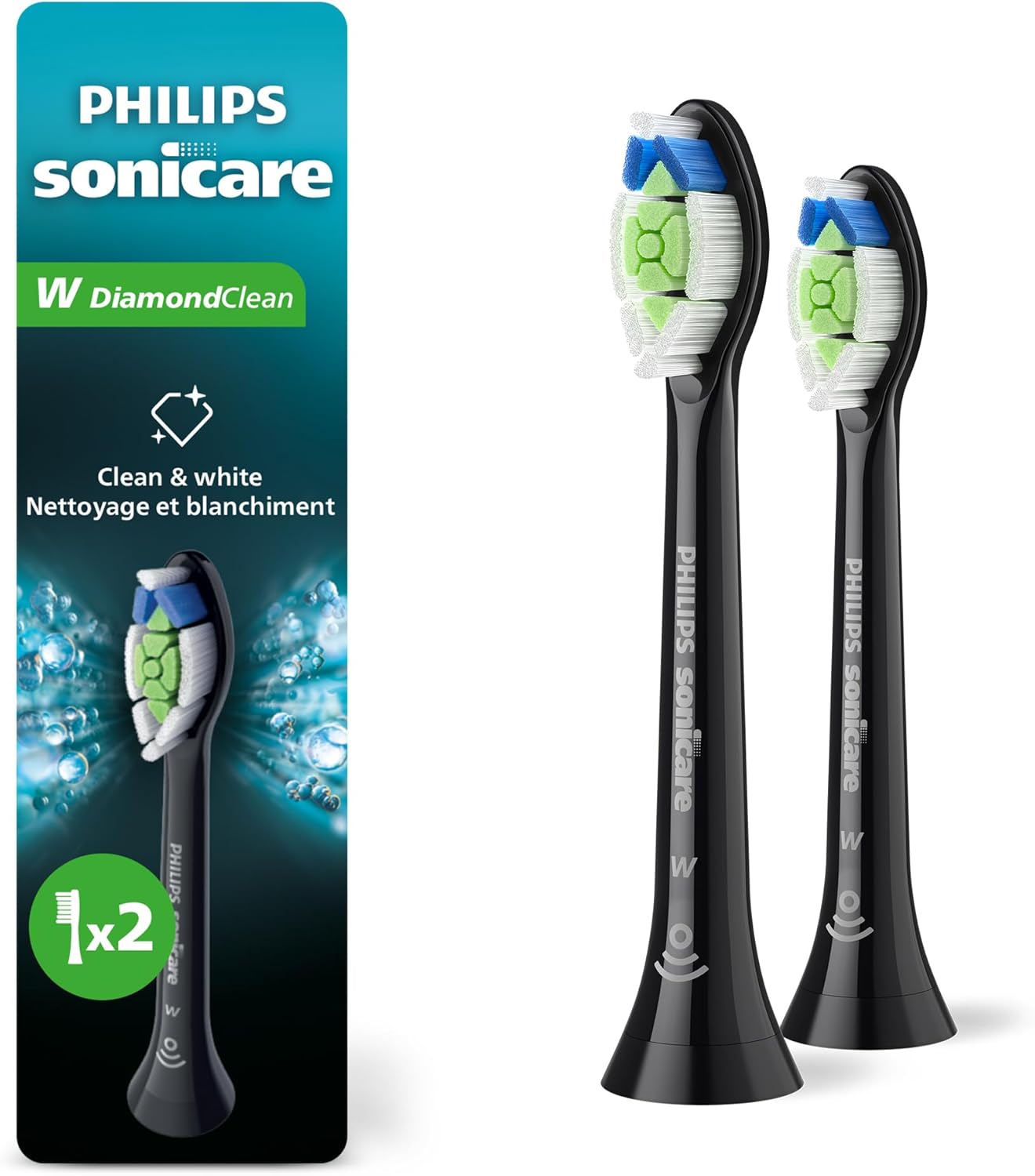
Design and Build Quality
The W DiamondClean replacement head pairs an understated black aesthetic with a functional, densely packed nylon bristle configuration. The central zone features tightly clustered diamond-shaped bristles engineered to polish enamel surfaces, while outer soft bristles target margins along the gumline. Construction incorporates 70 percent bio-based plastics, packaged in recyclable paper materials rather than blister packs. The internal shaft houses an integrated BrushSync microchip that communicates brush head telemetry directly to compatible Sonicare bodies. Physically, the standard click-on interface provides secure friction retention without excess lateral wobble during high-frequency oscillation. At 1.12 ounces for the two-pack packaging weight, the components are lightweight yet rigid. Wear tracking is twofold: blue indicator bristles lose their pigmentation over roughly three months of twice-daily use, complementing the digital alert cycle triggered by handles equipped with BrushSync sensors.
Cleaning Dynamics and Performance
Engineered to leverage Philips Sonicare motors delivering up to 62,000 bristle movements per minute, the DiamondClean head relies on fluid dynamics to clear interdental spaces. The central stain-removal pad increases contact area against enamel to lift extrinsic discoloration, which Philips notes can improve stain clearance compared to standard manual brushing. Because the bristles carry an official soft firmness rating, the array minimizes the risk of mechanical abrasion on delicate gingival tissue while operating at high sonic frequencies. For users with pressure-sensing handles, the head transfers tactile load effectively to the handle shaft, allowing the internal sensor to register excessive force before bristles flare. Plaque disruption across broad dental surfaces is thorough, although tight contacts still necessitate dedicated flossing. The head profile remains compact enough to navigate posterior molars without forcing the jaw into uncomfortable positions.
Three-Year Cost Analysis and Value
Priced at $24.96 for a pair, each head costs approximately $12.48. Following standard dental hygiene practices of swapping brush heads every ninety days, an individual consumer will consume four heads per year, amounting to roughly $50 annually. Over a typical three-year ownership horizon, replacement heads will demand roughly $150 in ongoing maintenance outlays. As an oral care buying principle, continuous consumable costs frequently surpass the purchase price of the underlying power handle itself. While third-party generic alternatives trade at a fraction of this cost, genuine Sonicare heads preserve full BrushSync radio-frequency tracking and maintain predictable bristle anchor retention. Nevertheless, the high per-unit cost makes this two-pack an expensive long-term proposition, particularly for multi-user households where recurring consumable expenses compound rapidly.
Who Should Skip This Model
Consumers using basic Sonicare models lacking BrushSync technology pay a pricing premium for embedded RFID chips that offer zero functional utility on entry-level hardware. Users prioritizing budget management above proprietary brand fidelity should bypass this two-pack, as multi-packs of standard Sonicare ProResults or third-party compatible heads yield substantially lower per-unit running costs. Individuals coping with acute gingival recession, severe cervical dentin hypersensitivity, or active periodontal pocketing may find the dense, stain-oriented bristle layout somewhat aggressive; such users should consider specialized ultra-soft sensitive heads instead. Finally, owners of older screw-on Sonicare handles must avoid this package completely, as the click-on base mechanism will not mount to threaded shafts.