Design and build
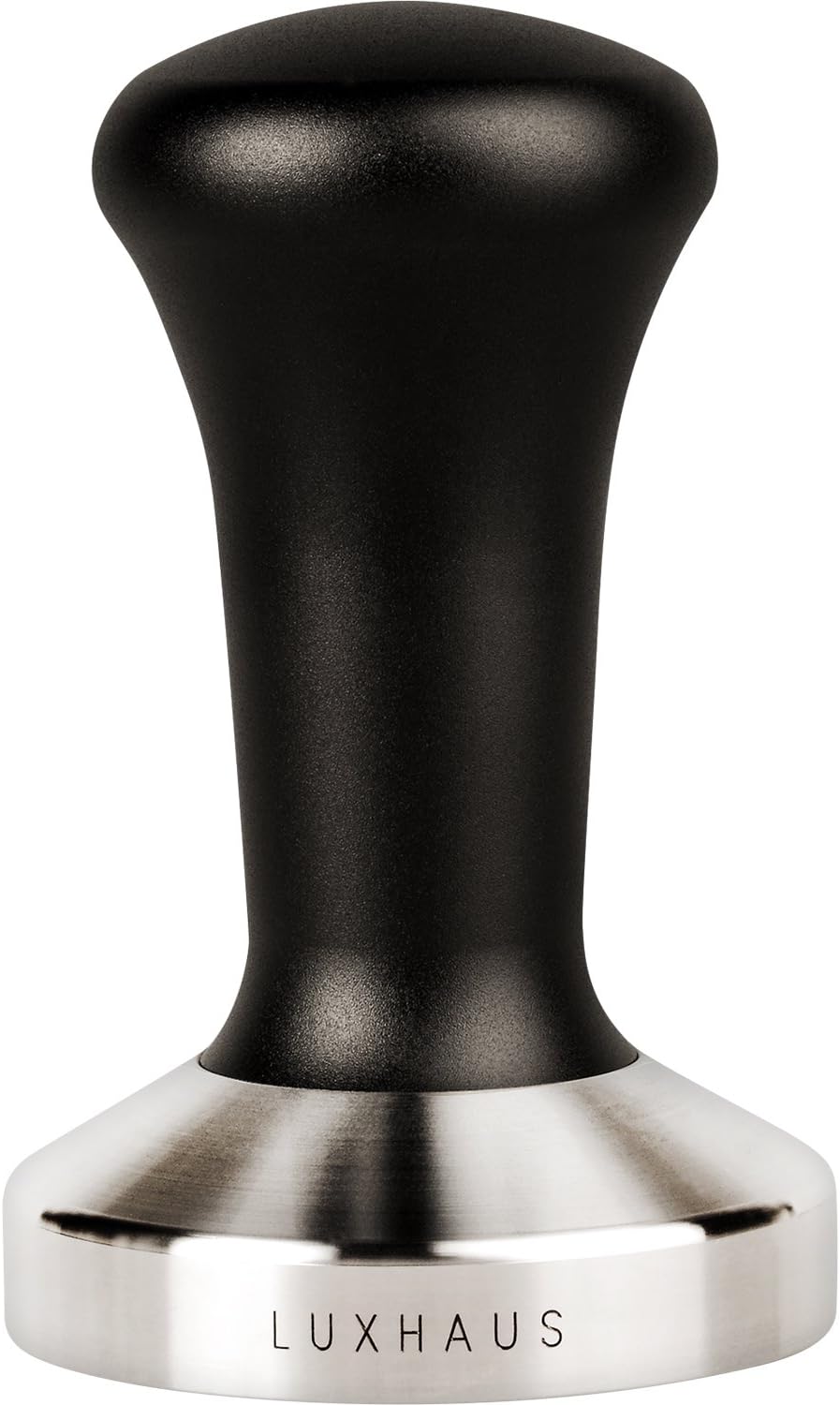
The LuxHaus tamper uses a flat base manufactured from food-grade stainless steel, paired with a classic contoured handle. The complete unit weighs 13.4 ounces, registering roughly 380 grams on the bench. This mass provides a center of gravity biased toward the base plate, which aids in applying downward force perpendicular to the coffee bed. Measuring 4.1 inches in total height and 2.5 inches across the widest handle section, the proportions accommodate standard palm and finger grip techniques. The base machining presents a uniform, flat surface devoid of ridges or concentric steps. Thread engagement between handle and base is straightforward, allowing disassembly if thorough cleaning or drying is required. The package also includes a red velvet drawstring storage pouch and a magnetic closure box. While functional, the exterior finish relies on standard lathe work rather than mirror hand-polishing. Overall, the physical construction prioritizes straightforward utility, dense metallic materials, and basic mechanical simplicity over intricate mechanical tolerances.
Real-world performance
In workflow, the 13.4-ounce mass allows the user to achieve a stable puck surface without excessive arm exertion. However, execution depends heavily on diameter pairing. The espresso accessory principle dictates matching tamper diameter to the basket within 0.2 mm. This LuxHaus tool is nominal 58 mm. When seated inside standard commercial 58 mm baskets, it clears the walls with acceptable tolerance. Conversely, when paired with modern precision baskets that typically measure 58.4 mm to 58.5 mm, an untamped outer ring remains. Under high-pressure water flow, uncompacted coffee along the perimeter provides a path of low hydraulic resistance. When evaluated under a bottomless portafilter, this gap manifests as edge channeling, donut extractions, and localized over-extraction. The flat face produces an even bed profile across the compacted zone, but maintaining level compression requires manual discipline because the tool lacks a self-leveling collar or edge-guided ridge. The user must actively verify horizontal alignment before applying downward pressure.
Value for money
Retailing at $24.99, the LuxHaus 58mm tamper occupies the space between negligible bundled accessories and premium calibrated workshop tools. Many domestic espresso machines ship with lightweight plastic tampers that flex under pressure and prevent consistent puck consolidation. Upgrading to a solid steel tamper resolves flex entirely. Given that precision baskets represent the cheapest real upgrade one can purchase to improve shot mechanics, investing hundreds of dollars in high-end tampers offers diminishing returns for standard domestic setups. This unit delivers the necessary structural rigidity, food-grade contact surfaces, and corrosion resistance for a modest initial outlay. The aggregated rating of 4.8 across more than 1,700 reviews indicates reliable manufacturing consistency without recurring structural failures. For owners of standard factory portafilters seeking a durable tool that avoids moving parts, the LuxHaus tamper represents a balanced economic decision that delivers basic tactile feedback without an inflated hardware surcharge.
Who should skip it
Home baristas utilizing high-flow precision baskets from manufacturers such as VST or IMS should skip this tool. Because precision baskets are manufactured to precise inner diameters of 58.4 mm or larger, this nominal 58 mm tamper leaves too much clearance around the sidewalls. The resulting ring of uncompacted grounds will induce peripheral channeling, visible immediately when diagnosing extractions with a bottomless portafilter. Furthermore, baristas struggling with puck levelness or inconsistent tamping angles will not find mechanical assistance here. The tool does not feature a self-leveling flange, internal spring calibration, or depth adjustment stops. Those seeking repeatable mechanical leveling across multiple users in a household should consider stepped or auto-leveling alternatives instead. Finally, owners of domestic machines with smaller proprietary portafilter groups, such as 51 mm or 54 mm systems, must pass on this model entirely, as the 58 mm diameter will not enter smaller filter baskets.