Design and build
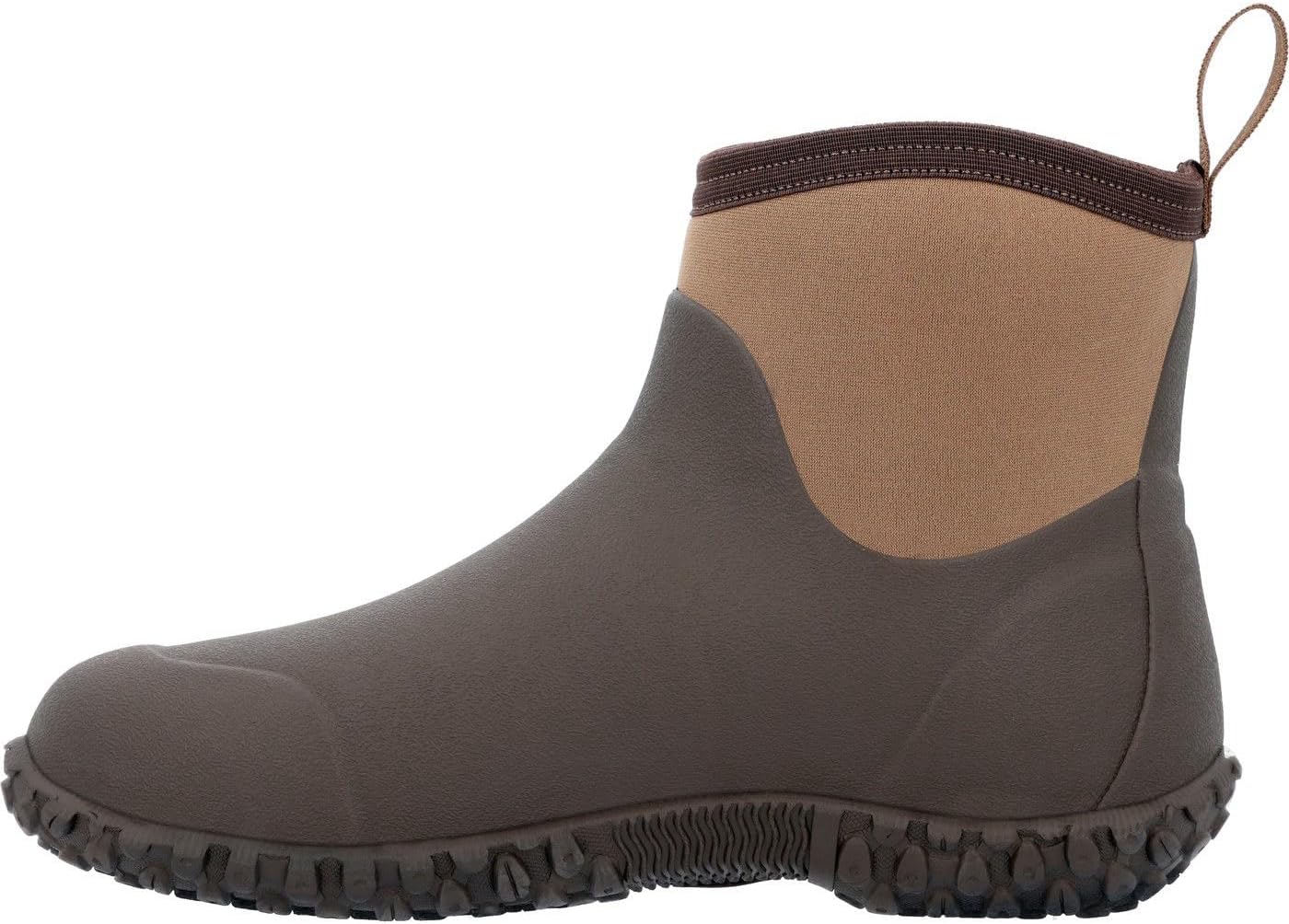
The Muckster II Ankle Boot utilizes a vulcanized rubber lower bonded to an elasticated collar, prioritizing rapid entry over anatomical trail security. Manufacturer specifications omit exact compound formulations and stack heights, requiring buyers to verify insole thickness and arch contours prior to rigorous use. The provided sizing documentation details conversions from EU size 33 through 42.5, matching a broad spectrum of foot lengths despite the absence of half-size options in the upper range. Without a standard lacing system, the boot relies entirely on the tension of the ankle opening to retain the heel. Materials are assembled to seal out exterior wetness, creating an unbroken barrier between the foot and muddy ground. The low-cut silhouette minimizes mass compared to knee-high rubber models, but the basic internal footbed provides limited structural chassis support or torsional resistance across uneven surfaces.
Real-world performance
Under field conditions, the boot functions reliably within flat, wet environments such as muddy campsites, boat launches, and garden plots. The waterproof boundary behaves strictly according to physical principles: moisture from puddles and wet grass remains entirely outside, yet internal moisture generated by the foot cannot escape. On warmer days or during continuous walking, perspiration accumulates against the interior lining, leading to damp socks and potential hot spots. Traction across wet grass and shallow mud is acceptable due to widely spaced lugs that shed debris, but the outsole compound hardens on cold, slick rock. Without mechanical laces to lock the instep, the foot slides forward on descents, causing toe collision against the front bumper. It excels primarily when stationary or walking short distances across waterlogged surfaces where quick removal at the tent door is advantageous.
Value for money
At an accessible price point of $61.88, the Muckster II presents a practical proposition for utilitarian outdoor duties. A collective user rating of 4.5 out of 5 across 5,180 submissions demonstrates high consumer satisfaction for its intended domestic and wet-weather roles. It does not replace a technical approach shoe or a dedicated trail hiker, nor is it priced like one. Instead, the boot competes against low-cost slip-on footwear and utilitarian farm galoshes. At this price level, the primary advantage is dependable perimeter sealing and a resilient exterior that rinses clean with a garden hose. Given the simple construction, there are few seams to fail or hardware pieces to break under normal wear. For purchasers needing a secondary foul-weather camp shoe or utility slip-on, the financial outlay is balanced by its durability in wet conditions.
Who should skip it
Dedicated hikers, long-distance backpackers, and anyone operating in warm, arid environments should look elsewhere. In dry climates, waterproof barriers needlessly trap sweat against the skin, accelerating blister formation and thermal discomfort. A breathable, non-waterproof trail runner provides superior moisture evaporation and biomechanical efficiency for trail use. Furthermore, hikers negotiating loose talus, steep gradients, or heavy pack loads will find the slip-on architecture entirely inadequate. Torso length determines proper pack loading, and that distributed weight demands footwear with torsional rigidity, structured midsoles, and dependable heel lock down, none of which this boot provides. If your route involves miles of uneven terrain or arid desert heat, skip this model in favor of ventilated, supportive trail shoes, reserving the Muckster II exclusively for flat, wet utility and static camp tasks.