Design and build
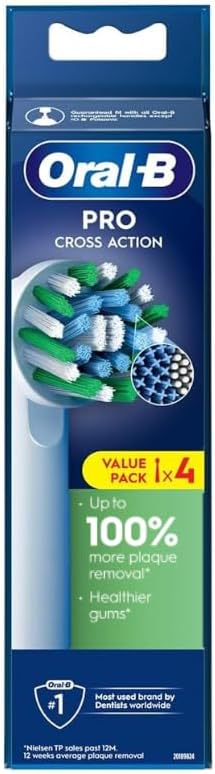
The Oral-B CrossAction refill package contains four individually wrapped round brush heads, totaling approximately 40 grams in packaging weight. The core design employs nylon bristles arrayed in opposing angles to clean along tooth contours and interdental spaces. Classified under a soft firmness profile, the tufts are arranged on a compact circular head that executes mechanical rotation and oscillation. Integrated blue indicator bristles fade gradually across routine usage cycles to provide a visual timeline for replacement. The plastic shafts snap onto the motor spindle with standard tolerances, eliminating rotational play during operation. Furthermore, the material composition incorporates an additive aimed at suppressing bacterial growth on the bristle filaments between brushing intervals. Aside from Oral-B Pulsonic sonic handles, the mechanical interface remains compatible across the manufacturer's conventional power brush range, presenting a standardized physical build.
Real-world performance
In operation, the circular geometry of the CrossAction head isolates individual teeth, relying on angled nylon filaments to reach proximal surfaces. The soft bristle rating reduces mechanical abrasion against enamel and soft tissue, an essential attribute given that aggressive pressure causes gum recession. While these heads facilitate thorough surface coverage, they do not substitute for handle-based pressure sensors, which serve as the definitive safeguard against over-brushing. The fading blue indicator bristles eliminate subjective estimations of bristle wear, signaling replacement as mechanical fatigue diminishes cleaning efficacy. Bacterial protection properties remain confined to bristle hygiene, preventing microbial accumulation on the brush head itself during damp bathroom storage. The mechanical coupling retains stability under standard rotational loads, delivering consistent vibration transfer without erratic motor rattling or unintended detachment during routine oral care sessions.
Value for money
Priced at $18.40 for a pack of four, each CrossAction head costs approximately $4.60. Standard dental guidelines advise swapping brush heads quarterly, meaning a single user consumes all four units within one calendar year. Over a three-year timeline, this cadence requires twelve heads totaling $55.20, an expenditure that frequently matches or eclipses the initial purchase cost of an entry-level or mid-tier electric handle. While third-party generic clones are available at lower price points, they often vary in bristle softness consistency and plastic molding tolerances. For consumers committed to manufacturer-certified specifications and predictable snap-fit tolerances, this four-pack represents a standard baseline cost, though buying larger multi-packs often yields a lower per-unit expense over identical operating windows.
Who should skip it
Owners of Oral-B Pulsonic models must avoid this package, as the slender sonic interface is mechanically incompatible with these round oscillating heads. Additionally, individuals with specific clinical requirements, such as severe gingival inflammation, exposed roots, or active orthodontic hardware, should verify whether dedicated ultra-soft or interdental heads are clinically preferable over the standard CrossAction bristle configuration. Budget-conscious households maintaining multiple electric toothbrushes may also wish to pass on this four-count format; the $4.60 unit price remains relatively high compared to bulk bundles containing eight or ten heads. Finally, those utilizing electric handles lacking an integrated visual pressure sensor should exercise caution, as the angled bristles require careful handling to avoid compounding heavy manual force against delicate gum tissues.