Knife sharpening

Sided, Gray Knife Stone-Dual 400/1000 Grit Wet Block-Sharpens and Polishes Sharp Tools and Kitchen, Hunting, and Pocket Knives by Whetstone, 1-Pack, Limestone

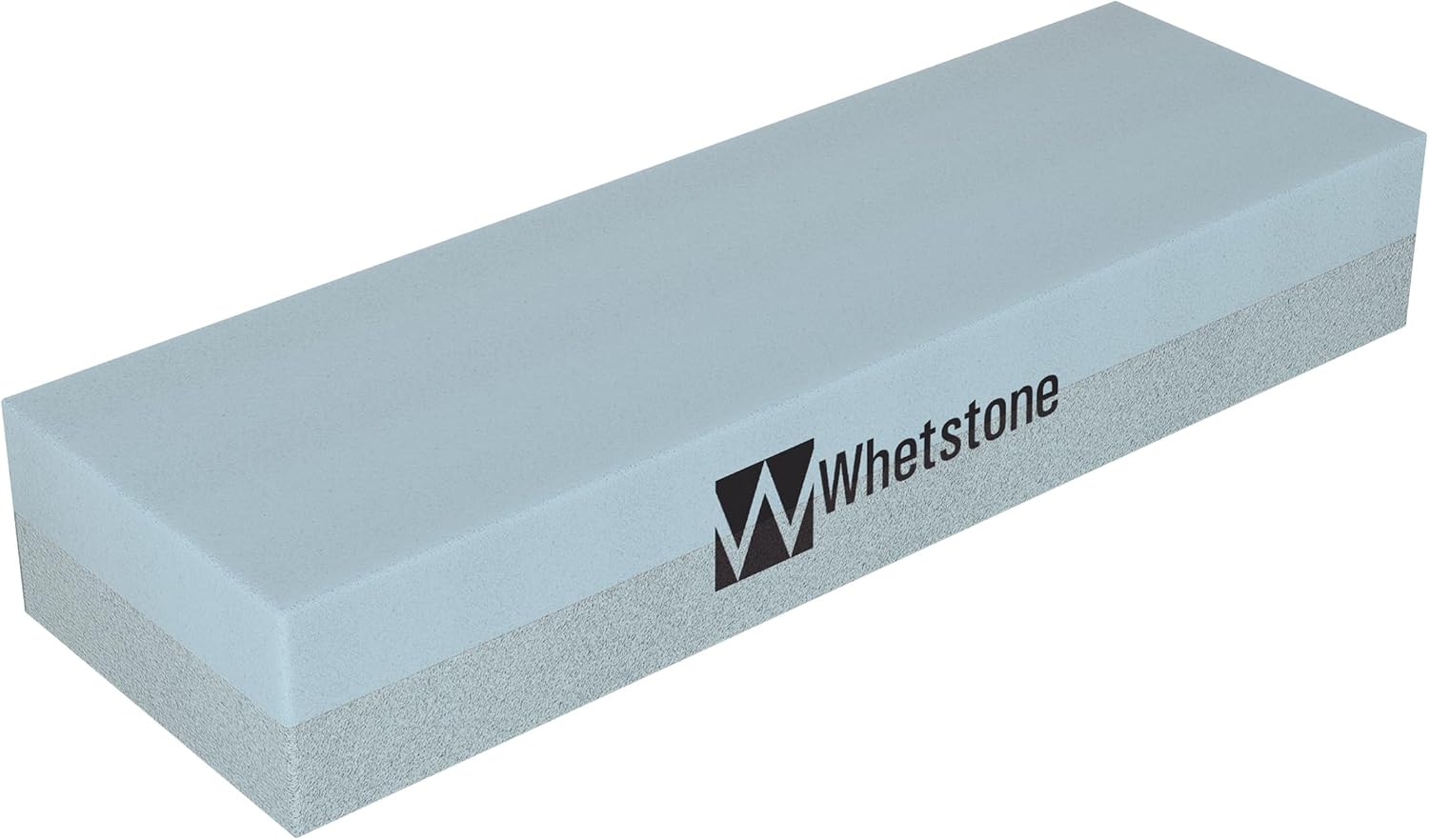
The Whetstone Cutlery 400/1000 Dual-Grit Water Stone provides an entry-level silicon carbide block designed for repairing chipped profiles and establishing working edges on severely dulled tools. Priced at $24.97, it offers functional coarse-to-medium shaping capability, though it lacks the higher grit stages necessary for refined culinary edges as well as an included non-slip base.

Sided, Gray Knife Stone-Dual 400/1000 Grit Wet Block-Sharpens and Polishes Sharp Tools and Kitchen, Hunting, and Pocket Knives by Whetstone, 1-Pack, Limestone
Price

$24.97

Amazon rating

4.5

4.5
Ratings

6,172

Best for Rough sharpening of utility and pocket knives

A utilitarian 400/1000 combination block geared toward pocket, outdoor, and heavy kitchen blades. It removes material quickly on dull steel but stops well short of the fine polish preferred for Japanese cutlery. The surface requires thorough soaking and maintenance to avoid uneven dishing.

What we like

  • Suitable for heavily worn working knives
  • Aggressive stock removal on the 400 side
  • Straightforward single-block layout

What to weigh up

  • Leaves a toothy edge lacking fine polish
  • Requires periodic flattening to remain true
Check today's price on Amazon

Price and rating were captured on 28/09/2026 and change often. We earn a commission on qualifying purchases.

Our scorecard

Weighted against our category rules
6.7out of 10
Overall
  • Abrasive Quality7.0

    Silicon carbide cuts quickly but dishing requires periodic flattening monitoring.

  • Grit Versatility6.2

    Coarse 400 and medium 1000 omit essential fine finishing stages.

  • Stability & Fixtures5.0

    Lacks an included non-slip rubber base, stand, or angle jig.

  • Form Factor7.4

    Seven-inch working surface adequately clears standard utility and pocket knives.

  • Value Proposition7.9

    Low cost of entry for heavy tool reprofiling and repair.

The full review

Design and Build Quality

The Whetstone Cutlery 20-10960 is a straightforward two-sided bench block measuring 7.01 inches long, 2.24 inches wide, and 1.14 inches thick. It uses a bonded silicon carbide composite, engineered as a dual-layer water stone combining a coarse 400-grit face with a medium 1000-grit reverse. The physical footprint provides sufficient surface area to accommodate pocket knives, carving tools, and mid-sized kitchen blades, although longer chef knives will require careful section-by-section sweeping strokes across its 2.24-inch width. Notably, the product ships strictly as an unmounted stone without an integrated base, rubber boot, or angle guides. Buyers should verify their work surface arrangement beforehand, as using an unsecured block on a slick countertop introduces unnecessary slippage. The manufacturer supplies a limited 30-day warranty, which is standard for entry-level porous abrasives. Structurally, the silicon carbide substrate maintains good flatness under moderate pressure, but like all water stones, it will gradually dished over time and eventually necessitate a dedicated diamond flattening plate.

Real-World Performance and Grit Profile

In practical sharpening workflows, grit selection defines functional utility. The manufacturer advertises the 400-grit side for stock removal and chip remediation, and the 1000-grit side for smoothing. At 400 grit, the silicon carbide abrasive cuts quickly, efficiently grinding away minor edge imperfections on battered garden tools, axes, or neglected pocket knives. Progressing to the 1000-grit side establishes a baseline apex suitable for general utility slicing. However, marketing claims that 1000 grit provides ultimate blade polishing conflict with standard sharpening benchmarks. A 1000/6000 combination stone represents the baseline standard for comprehensive kitchen knife care; stopping at 1000 grit leaves a toothy edge lacking refined push-cutting refinement. Users must also account for technique: this is a manual freehand block. Unlike guided sharpening setups that systematically lock in bevel angles, freehand stones demand manual consistency. Furthermore, users should remember that stone sharpening abrades steel, whereas regular honing straightens an existing edge; using this stone cannot replace daily honing maintenance.

Value for Money and Market Placement

Priced at $24.97 with an aggregate rating of 4.5 out of 5 stars across more than 6,100 consumer ratings, this stone targets the budget-conscious utility segment. Its silicon carbide formulation operates purely with water lubrication, eliminating the ongoing recurring cost and mess associated with mineral honing oils. For users who need to reprofile lawnmower blades, axes, or heavily chipped secondary beaters, the $25 entry point provides considerable cutting volume per dollar. Nevertheless, hidden costs exist if this is your sole sharpening tool. Because the manufacturer omits a stable non-slip holder, purchasers will likely need to source an aftermarket rubber base or sink bridge. Additionally, kitchen enthusiasts will still need to acquire a higher-grit water stone—such as a 3000 to 6000 grit finishing block—to achieve polished cutting edges. In context, it represents decent functional value for coarse remediation, provided buyers recognize it is a repair block rather than a complete kitchen edge system.

Who Should Skip It

Certain users should pass on this particular Whetstone model. First, cooks seeking hair-whittling precision on Japanese or high-end Western kitchen cutlery will find the 1000-grit ceiling inadequate; they should bypass this abrasive profile in favor of a 1000/6000 combination setup that delivers genuine polish. Second, novices who lack freehand sharpening experience should strongly consider skipping bench stones entirely in favor of a guided sharpening system. Guided platforms deliberately trade manual throughput for exact, repeatable edge angles, protecting expensive knives from uneven bevels and scuffed blade flats while motor skills develop. Third, individuals whose knives merely feel slightly sluggish do not need an abrasive stone. Edge degradation is frequently simple misalignment rather than severe dulling; such blades require a smooth honing steel or ceramic rod, not stock removal on coarse 400-grit silicon carbide. Finally, buyers unwilling to purchase separate non-slip base accessories should skip this unmounted block for a bundled package.
Specifications

As listed by the manufacturer
Brand NameWhetstone Cutlery
Number of Items1
ManufacturerTRAUV
Number of Packs1
Unit Count1 Count
Global Trade Identification Number00886511020160
UPC886511020160
Included ComponentsStone
Item Type NameKnife Sharpening Stone - Dual 400/1000 Grit Wet Block - Sharpens and Polishes Sharp Tools and Kitchen, Hunting, and Pocket Knives by Whetstone
Model Number20-10960
Manufacturer Part Number20-10960
Manufacturer Warranty Description30 day
Material TypeBlend
ColorLimestone
Grit TypeFine,Rough
Item Dimensions L x W x H7.01"L x 2.24"W x 1.14"H

What the maker claims

  • DUAL-SIDED KNIFE SHARPENER - Made from durable silicon carbide, this two-sided sharpening stone comes with both a 400-grit side used for sharpening and returning knives to their original shape and a 1000-grit side used for smoothing and polishing edges.
  • WET STONE - An economical accessory for maintaining your tools, this water stone for sharpening knives does not use expensive honing oil. Simply soak the sharpener stone in water for 5 to 10 minutes before use, and lubricate as needed when sharpening.
  • MULTI-USE STONE - This knife sharpening stone can be used to sharpen and polish any household item with a blade, including kitchen cutlery, scissors, pocket knives, and razors. It also works efficiently on hatchets, axes, carving, and gardening tools.
  • RESTORES SHARPNESS - With one use, this knife sharpener stone will hone edges, remove chips, and restore dull knives and battered blades to razor sharpness. Recondition all your knives and tools with this kitchen or workshop wet stone essential.
  • PRODUCT DETAILS - Materials: Silicon Carbide. Dimensions: (L) 7" x (W) 2.25" x (H) 1.13". Color: Blue Gray.

How it compares

Same category
ProductPriceRatingRatings countOur score
Sided, Gray Knife Stone-Dual 400/1000 Grit Wet Block-Sharpen (this one)$24.974.56,172 ratings6.7
Whetstone Knife Sharpener – 1000/6000 Grit Sharpening Stone$39.994.625,664 ratings8.1
Work Sharp Precision Adjust Knife Sharpener Kit - Fixed Angl$69.954.511,551 ratings8.1
Kota Japan 12 in. Diamond Carbon Steel Professional Knife ShGBP 14.094.47,826 ratings7.4
Complete Knife Sharpening Stone Set – Dual Grit Whetstone 40$29.994.57,223 ratings7.8

Common questions

Does this stone provide a finished, razor-sharp edge for fine kitchen slicing?
While the 1000-grit surface restores an effective working edge, it does not refine or polish a bevel for delicate kitchen tasks. Culinary standards typically require progressing from a 1000-grit apex to a 6000-grit finishing stone. For maximum sharpness, follow this block with higher grit abrasives and regular honing.
Does this sharpening stone include a non-slip base or angle guide?
No. The packaging includes only the bare 7.01 by 2.24-inch stone block. Operating it safely requires setting it on a damp towel, a dedicated silicone holder, or a sink bridge to prevent slipping. Beginners should verify whether they can maintain freehand angles reliably without a guided jig.
How long should this silicon carbide stone be soaked prior to use?
The manufacturer specifies soaking the block in clean water for 5 to 10 minutes before sharpening. Once bubbles stop rising from the porous silicon carbide blend, the stone is saturated. Do not use petroleum-based honing oils on this water block, and splash additional water onto the surface during sharpening.
Can this block replace daily blade maintenance tools like a honing steel?
No. Sharpening on a 400 or 1000-grit stone physically removes metal to reprofile or apex a dull blade. Honing realigns microscopic edge rollover without removing material. Both processes are essential; abrasive stone sharpening should be done periodically, while a honing rod should handle routine realignment between stone sessions.

How we judge knife sharpening

  1. Rule 01

    A 1000/6000 combination stone covers almost every kitchen need.

  2. Rule 02

    Guided systems trade speed for repeatable angles — worth it early on.

  3. Rule 03

    Honing is not sharpening; you need both.

Ready to buy?

Prices move daily. Check the current listing before you decide — the figures above were captured on 28/09/2026.

View on Amazon