 Viante Alba Electric Tea Kettle With Infuser, No Plastic, 1.5L
Recorded price: $99.99 · Editorial score: 7.9/10
- Included Components
- Removable food-grade stainless steel infuser
- Voltage
- 120 volts
We evaluated all-in-one electric kettles featuring built-in infusers and thermal settings to find models that brew loose leaf cleanly without plastic contact.
By the Niche Picks editorsUpdated October 14, 20269 min readDrawn from our 30 research-based tea accessories reviews
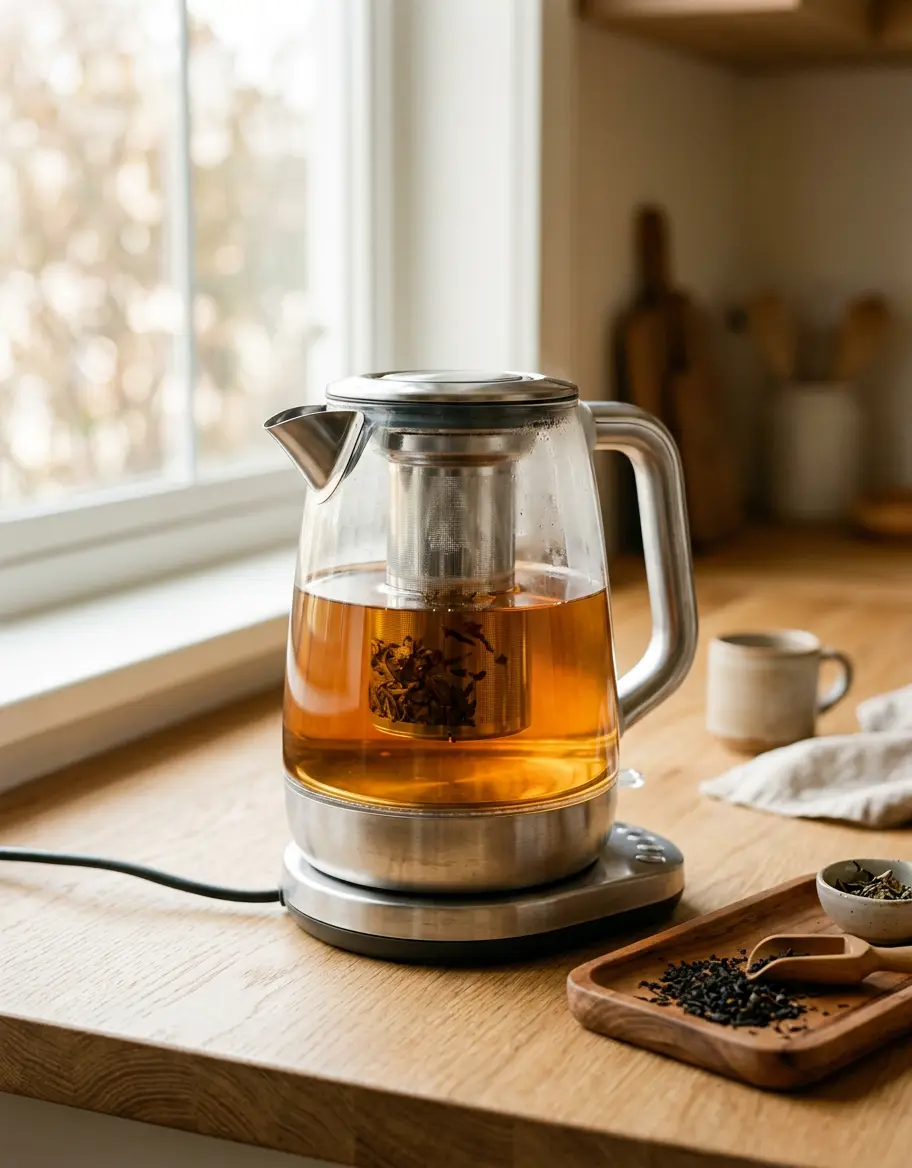
An electric kettle with a tea infuser and temperature control lets you heat water to tea-specific thresholds and steep loose leaves in a single borosilicate glass or stainless steel vessel. While dedicated models like the Chefman RJ11-17-CTI, Aigostar 300104IBS, and Viante Alba provide convenient stepped presets and removable baskets, serious drinkers should note that true single-degree precision remains rare in combination units.
Editorial scores and recorded prices are reference points, not measurements of suitability for every use. Read each review's specifications and limitations.
 Chefman Electric Kettle with Temperature Control, 5 Presets LED Indicator Lights, Removable Tea Infuser, Glass Tea Kettle & Hot Water Boiler, 360° Swivel Base, BPA Free, Stainless Steel, 1.8 Liters4.4$27.96Our score 7.5/10Best for Convenient preset brewing in one vessel
 Aigostar Electric Kettle with Temperature Control and Tea Infuser4.4$39.99Our score 7.7/10Best for Budget-conscious drinkers wanting an all-in-one setupViante Alba Electric Tea Kettle With Infuser, No Plastic, 1.5L4.3$99.99Our score 7.9/10Best for In-kettle loose leaf brewing without plastic contact
| Product | Price | Capacity | Power | Temperature Control | Primary Materials |
|---|---|---|---|---|---|
| Chefman RJ11-17-CTI | $27.96 | 1.8 Liters | 120V / Rapid Boil | 5 Presets (160°F - 212°F) | Borosilicate Glass & Stainless Steel |
| Aigostar 300104IBS | $39.99 | 1.7 Liters | 1500W (120V) | 5 Presets (60°C - 100°C) | Borosilicate Glass & 304 Stainless |
| Viante Alba | $99.99 | 1.5 Liters | 1500W (120V) | 4 Presets (175°F - 212°F) | Borosilicate Glass & 304 Stainless (No Plastic Path) |
Steeping specialty loose-leaf tea traditionally demands multiple pieces of hardware: a dedicated water boiler, a liquid thermometer, and a separate steeping pot or ceramic mug. An electric kettle with an integrated tea infuser and variable temperature control combines those steps into a single appliance. By placing the dry leaves directly into a suspended metal basket inside the heated carafe, you eliminate heat loss during pouring and can monitor the infusion color directly through transparent glass walls.
However, combining water heating and steeping introduces unique functional demands. When hot water reaches your leaves, extraction begins instantly. High-tannin leaves will turn astringent if subjected to uncontrolled boiling or left sitting in hot water past their optimal steep time. That is why thermal regulation and a fully removable infuser basket are essential rather than luxury upgrades. Exploring our broader tea accessories buyer's guide clarifies how these all-in-one designs fit into varied daily brewing routines.
In our reviews, we look closely at how the infuser seats within the kettle lid, whether steam can escape during steeping, and how easily you can lift the leaf chamber out once your timer ends. For everyday drinkers preparing morning batches of black, green, or herbal teas, a unified vessel minimizes morning dishwashing and simplifies counter space. Still, understanding the trade-offs between pre-programmed temperature modes and manual brewing gear remains vital before choosing an all-in-one model.
When brewing loose-leaf tea, water temperature dictates which aromatic compounds dissolve and which bitter tannins remain restrained. Delicate Japanese greens like gyokuro or sencha require gentle water between 140°F and 170°F, white teas steep best around 175°F to 185°F, oolongs prefer 185°F to 195°F, and full-bodied black teas or herbal blends demand a rolling 212°F boil.
Our foundational evaluation rule stresses that degree-level temperature control is ideal for premium tea preparation. However, current all-in-one kettles with built-in infusers universally rely on stepped presets rather than continuous single-degree digital thermostats. For example, the Chefman RJ11-17-CTI provides five distinct presets ranging from 160°F to 212°F, signaled by color-coded LED indicators. Similarly, the Aigostar 300104IBS uses five rigid metric thresholds at 60°C, 70°C, 80°C, 90°C, and 100°C. The premium Viante Alba configures four targeted stages at 175°F, 195°F, 200°F, and 212°F.
While these broad brackets successfully prevent the severe scalding caused by ordinary 212°F binary boilers, they compromise slightly on precision. A drinker seeking an exact 165°F extraction for a rare shaded green must either steep slightly hotter at a 170°F or 175°F preset, or let water rest manually. If your routine demands single-degree calibration, pairing one of the best electric kettles for tea with a standalone steeping basket remains the superior technical approach. For standard loose-leaf drinkers, however, four to five stepped presets offer more than enough thermal management to avoid ruining delicate leaves.
Referenced reviewChefman Electric Kettle with Temperature Control, 5 Presets LED Indicator LightsRecorded specifications and review trade-offsReferenced reviewAigostar Electric Kettle with Temperature Control and Tea InfuserRecorded specifications and review trade-offsReferenced reviewViante Alba Electric Tea Kettle With Infuser, No Plastic, 1.5LRecorded specifications and review trade-offsA critical criteria we enforce across our reviews is that wide infusers let leaves open, while narrow tea balls choke them. Whole-leaf teas—especially rolled oolongs, dragon pearls, and large-leaf orthodox blacks—absorb water rapidly and expand to several times their dry volume. If packed into a cramped space, the leaves press tightly against each other, preventing hot water from circulating freely through the core of the mass. The result is an uneven, hollow cup where external leaves are stripped while internal leaves remain dry.
Traditional novelty infusers and compact spherical strainers routinely fail this test, as detailed in our guide on common tea brewing mistakes. By contrast, integrated electric kettles utilize wide, tall cylindrical stainless steel baskets that drop through the lid into the center of the water chamber. The Viante Alba incorporates a full-height food-grade stainless steel basket that spans nearly the entire vertical water column, providing ample room for bulky botanicals or large whole leaves to unfurl naturally.
The Aigostar and Chefman models also utilize broad central baskets suspended directly beneath their lids. In addition to leaf expansion, basket mesh geometry dictates how cleanly your tea pours. Fine micro-perforations prevent powdery fannings and rooibos needles from escaping into the boiled water, while maintaining swift drainage when you lift the basket out to halt extraction. When shopping, check whether the basket extends deep enough to submerge leaves during half-capacity boils, or if it requires filling the kettle near maximum volume to cover the tea.
Nothing spoils a delicate first-flush Darjeeling or light green tea faster than hot water that tastes like synthetic plastic. When boiling water repeatedly contacts lower-grade polymer carafes, lid linings, or synthetic gauge windows, microscopic chemical off-gassing can leach into the liquor. Our testing criteria mandate stainless steel or borosilicate glass interiors to eliminate this issue entirely.
All three combination kettles reviewed here utilize thermal shock-resistant borosilicate glass carafes. Glass provides two distinct functional benefits for tea drinkers: it is chemically inert, meaning it absorbs zero odors or lingering stains, and it offers complete visual transparency so you can watch the steeping liquor deepen in color. Beneath the glass, the heating base is sealed with food-grade 304 stainless steel.
However, prospective buyers must scrutinize secondary contact points. While the Viante Alba advertises an entirely plastic-free water path—ensuring the inner lid and spout assembly are shielded in stainless steel—budget-tier alternatives like the Chefman and Aigostar require checking the inner lid underside and filter brackets for exposed synthetic trims. Even when materials are certified BPA-free, purists who want absolute material purity often prefer a completely unlined stainless steel electric kettle paired with a separate all-metal brewing vessel. Borosilicate glass remains the most forgiving countertop material for an all-in-one steeping kettle, provided it is handled with care during sink washing.
Referenced reviewViante Alba Electric Tea Kettle With Infuser, No Plastic, 1.5LRecorded specifications and review trade-offsReferenced reviewChefman Electric Kettle with Temperature Control, 5 Presets LED Indicator LightsRecorded specifications and review trade-offsReferenced reviewAigostar Electric Kettle with Temperature Control and Tea InfuserRecorded specifications and review trade-offsWhen evaluating the models reviewed in our lineup that meet every query condition, three distinct choices emerge based on budget and build priorities:
Referenced reviewChefman Electric Kettle with Temperature Control, 5 Presets LED Indicator LightsRecorded specifications and review trade-offsReferenced reviewAigostar Electric Kettle with Temperature Control and Tea InfuserRecorded specifications and review trade-offsReferenced reviewViante Alba Electric Tea Kettle With Infuser, No Plastic, 1.5LRecorded specifications and review trade-offsSteeping tea leaves directly inside an electric kettle creates maintenance challenges that pure water boilers never face. In a standard water kettle, mineral scale from hard tap water is the primary buildup concern. In an all-in-one infuser kettle, natural tea tannins, oils, and plant pigments coat the stainless steel floor, stick to the glass walls, and bake onto the concealed heating plate during subsequent heating cycles.
To prevent baked-on tea residue from imparting bitter, stale flavors to subsequent boils, you must empty spent leaves and rinse the basket immediately after brewing. Never leave steeped wet leaves inside the kettle during a keep-warm cycle; ongoing heat will scorch the trapped leaf matter and create stubborn deposits. The infuser basket should be rinsed under warm running water and cleaned using a soft nylon bottle brush to clear tea dust from the microscopic mesh perforations.
For routine carafe cleaning and descaling, follow standard procedures outlined in our guide on how to clean and descale an electric kettle. A simple solution of equal parts white vinegar and water—or dissolved citric acid powder—brought to a low simmer and left to soak for twenty minutes dissolves both white mineral scale and brown tea tannin stains without scouring pads. Avoid submerging the power base or electrical contacts on the bottom of the glass carafe, and always refer strictly to the manufacturer's user manual regarding dishwasher compatibility for removable infusers and lid components.
Before committing to an all-in-one electric kettle with an infuser, consider whether a two-piece setup better matches your brewing goals. An integrated kettle excels at simplicity. Preparing multiple cups of English breakfast, rooibos, or peppermint tea for breakfast requires filling one pot, choosing a preset, dropping the leaves, and pouring straight into mugs. There is only one glass pitcher to wash, and your counter remains free of clutter.
Conversely, serious tea enthusiasts often outgrow all-in-one kettles for two reasons: temperature precision and over-steeping risk. When you steep tea in a 1.7-liter kettle, you must remove the infuser basket the moment the brew timer rings. If you fail to remove it, the leaves continue steeping indefinitely, ruining the remaining liquid. Furthermore, if you only want to brew an 8-ounce single cup, an all-in-one basket may sit too high inside a large 1.8-liter carafe to reach the water line.
For single-cup drinkers or whole-leaf collectors brewing multiple brief infusions, buying a dedicated temperature-controlled kettle and pairing it with one of our top standalone options from the best tea infuser review offers greater versatility. That method keeps your electric kettle dedicated solely to clean water, completely eliminating tannin scrubbing. However, if your goal is convenient batch brewing with preset heat safeguards, models like the Chefman RJ11-17-CTI and Viante Alba deliver practical, space-saving service.
Amazon links are affiliate links; we may earn a commission at no cost to you.
This page summarizes our research reviews of Amazon listings, listed specifications and captured buyer ratings. It is not a hands-on test. Scores are editorial assessments, not measured performance; prices are recorded snapshots and may change. A category can include both main products and accessories, so its overall price range is not the cost of a complete setup.
Most recent product record update: October 3, 2026. Individual records may be older; this is not a verification date for every claim.
Amazon links are affiliate links. We may earn a commission on qualifying purchases, at no extra cost to you.
A more useful shortlist
Choose the product type first. These groups require a match in the listing title; an import search term alone is not enough. Scores rank our recorded research assessments within each group, not independently measured performance.
Viante Alba Electric Tea Kettle With Infuser, No Plastic, 1.5LRecorded price: $99.99 · Editorial score: 7.9/10
Aigostar Electric Kettle with Temperature Control and Tea InfuserRecorded price: $39.99 · Editorial score: 7.7/10
| Specification | Viante Alba Electric Tea Kettle With Infuser, No | Aigostar Electric Kettle with Temperature Control |
|---|---|---|
| Included Components | Removable food-grade stainless steel infuser | Kettle body, base, stainless steel filter |
| Voltage | 120 volts | 120 volts |
| Wattage | 1500 watts | 1500 watts |
| Capacity | 1.5 liters | 1.7 liters |
Values are shown as recorded, without unit conversions or inferred compatibility. Not recorded means unknown, not absent. Prices are snapshots, not current offers.
If a specification, certification or compatibility detail is absent, mark it as unknown and ask the seller or manufacturer. Do not substitute a star rating, an editorial score or a different model's specification.